Nicole Richardson
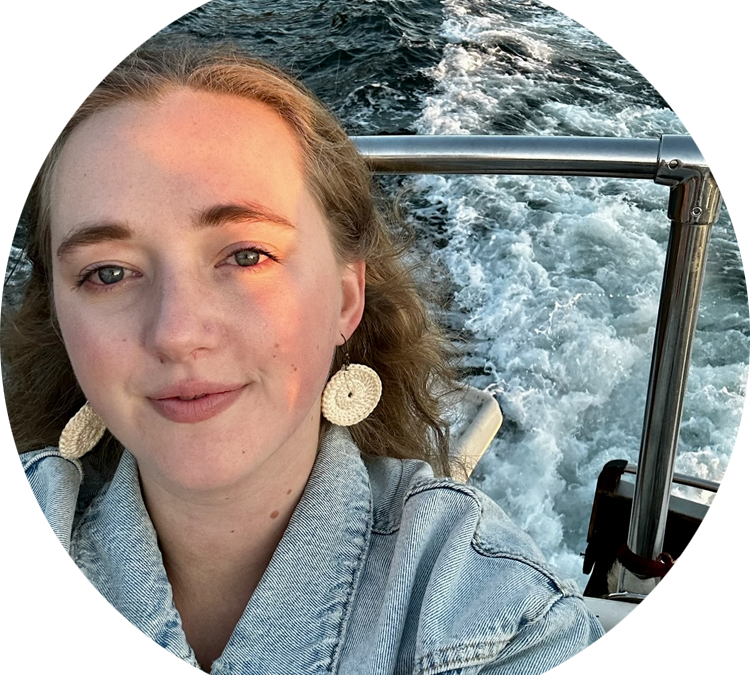
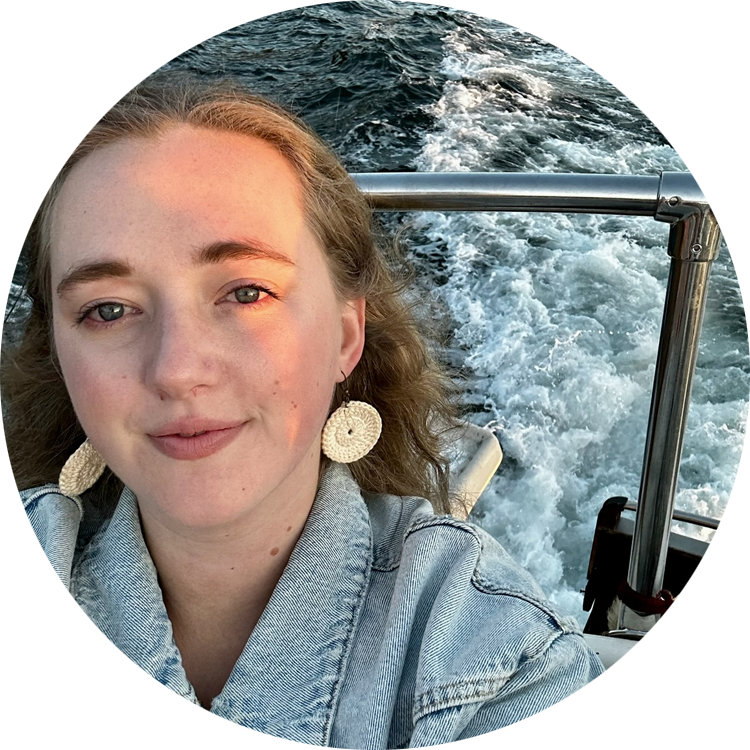
Nicole Richardson (she/her) is in the final year of her Interdisciplinary BA at Capilano University. Before beginning her degree, she studied in Capilano’s School of Tourism and Hospitality, where she developed a strong foundation in hospitality management. After several years of hands-on industry experience, she took a three-month reprieve from restaurant life and moved temporarily to San Pancho, Mexico with her partner and their dogs. Whether it was the magical sunset, the great book she had just finished, or the Pacifico she’d enjoyed that evening – something in San Pancho convinced her to change direction.
In the fall of 2023, Nicole returned to Capilano University with renewed purpose. Since then, she has fully immersed herself in her studies and consistently earned high grades throughout her degree. She will graduate this spring; Nicole’s goal is to become an elementary school teacher – one who will always, without hesitation, encourage her students to read.
Introduction
I have lived thousands of lives. I’ve been a mid-century teenager, full of angst and pain. I’ve been a child who watched my best friend die. I’ve been an Upper-East Side socialite, and I’ve been an orphan, whose world was forever changed when a giant man said, “you’re a wizard, Harry.” I’ve been a runaway slave. I’ve been a handmaid. I’ve lived in worlds both real and imagined, tragic and triumphant, because books have allowed me to step beyond the limits of my own life. I’ve been able to live these lives because I’ve been privileged enough to read freely.
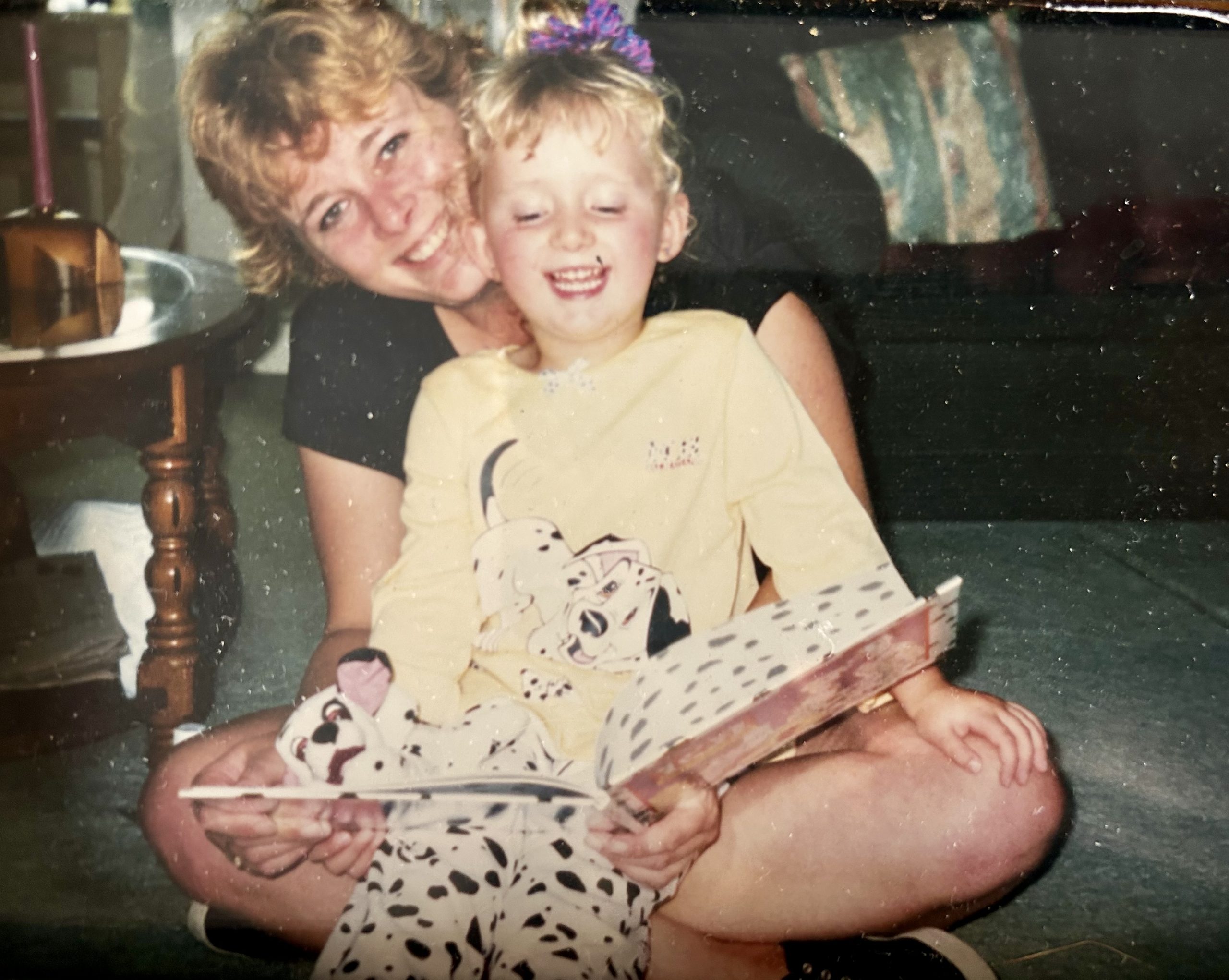
I feel so lucky to have grown up with a parent who shared my love of reading, and always encouraged my literary adventures.
This freedom has allowed me to encounter different ideas, to question, imagine, and empathize. I owe who I am to the stories I have read. Yet today, and not for the first time, this freedom is under threat. In classrooms and libraries across North America, books are being challenged by parents and policy-makers, and are subsequently removed. Often, these books are stories about race, gender, sexuality, or difference. This movement is not new. It echoes historical patterns of moral panic and cultural control that have been repeated since ancient times. Though the panic of the day may change, one truth remains constant: when we remove voices from the shelves, we lose the chance to learn from lives beyond our own.
Since 2021, the United States has seen an unprecedented amount of book bans – near 23,000 nationwide (Tolin). The 2024 – 2025 school year has seen 6,870 bans affecting nearly 4,000 unique titles (Tolin). A school or library book ban has been defined by PEN America as
“any action taken against a book based on its content and as a result of parent or community challenges, administrative decisions, or in response to direct or threatened action by governmental officials, that leads to a book being either completely removed from availability to students, or where access to a book is restricted or diminished” (Tsioulcas).
Often, the stories targeted are ones that discuss sexual violence or drug use, explore 2SLGBTQIA+ identities and experiences, or BIPOC characters and themes of racism. This surge of literary restriction is not limited to south of the border: this past summer it began to rear its head in Alberta, Canada.
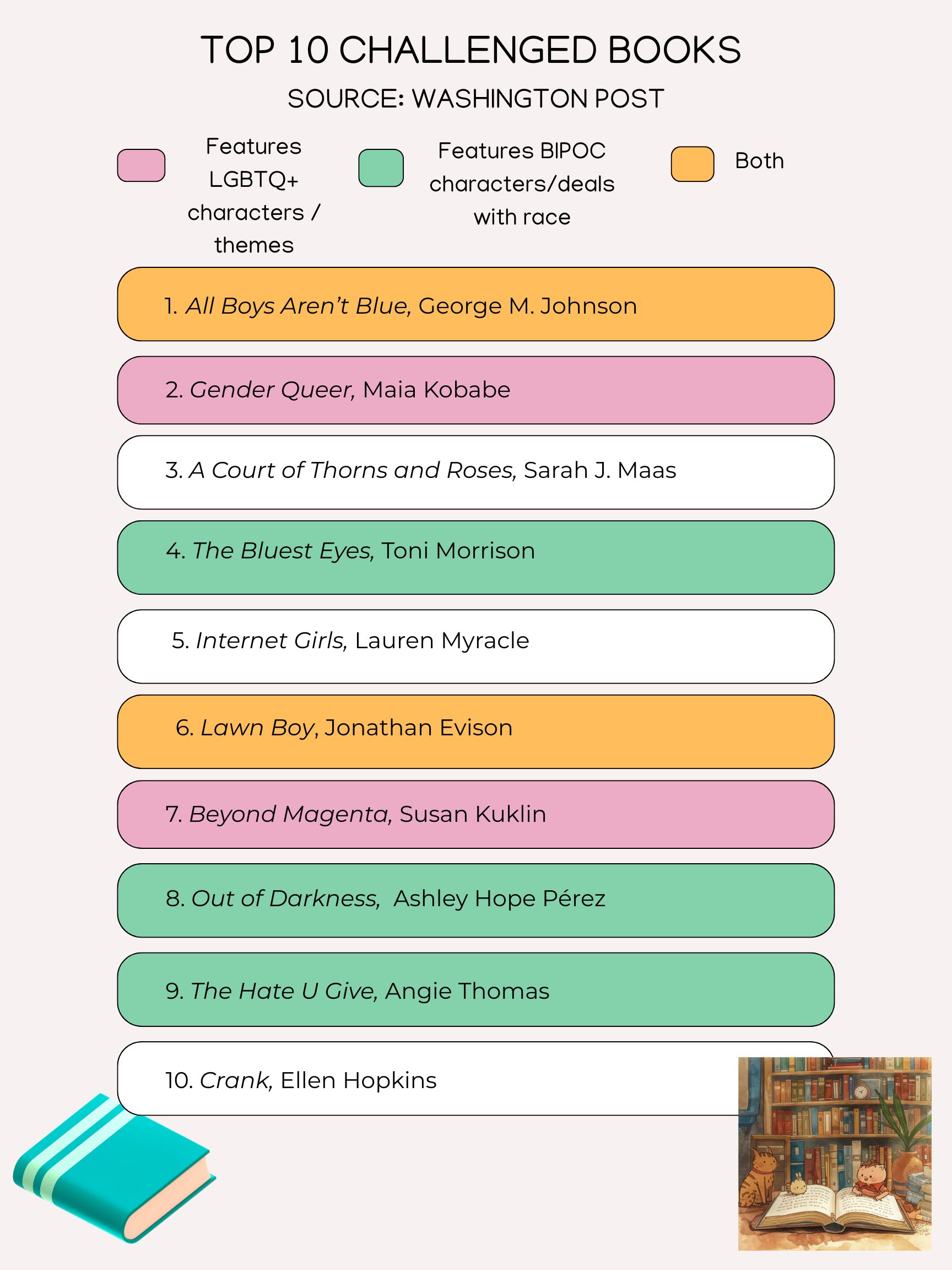
This graphic shows that the top 10 challenged books, according to the Washington Post, frequently feature either LGBTQIA+ or BIPOC characters and themes, or both.
In July of 2025, Alberta’s Minister of Education, Demitrius Nicolaides, under UCP Premier Danielle Smith, released Ministerial Order #030/2025 informing school authorities that they must “remove materials with explicit sexual content from school libraries no later than October 1, 2025” (Nicolaides, 3). Edmonton Public School Board was quick to obey – they promptly published a list of hundreds of titles slated for removal from their schools due to “sexually explicit” content. Among these titles were classics like Huxley’s Brave New World, Atwood’s The Handmaid’s Tale, and Angelou’s I Know Why the Caged Bird Sings (Williams). EPSB’s publishing of such an extensive list, including well-loved and respected texts, may have been a strategic move. In following the Ministry’s order to the letter, which Premier Smith later described as “vicious compliance” (Frew, par. 4), EPSB ensured that the public would see the full impact of the policy, generating the backlash that pressured the Ministry to reconsider. While Albertan book bans may be in a state of flux currently, advocacy groups like Parents for Choice in Education hope to see an updated, more specific order before the school year is through.
Conservative parental advocacy groups are often the driving force behind book restrictions (Natanson). They do so in the name of protecting their children, but this often masks a deeper political aim – book challenges frequently stem from fear of narratives that complicate dominant worldviews. Stories that acknowledge racism, that affirm queer and trans identities, or that portray the realities of sexual violence or substance abuse disrupt neat and tidy versions of childhood innocence (Natanson). By framing certain experiences as dangerous or inappropriate, these groups imply that only some youths’ realities are acceptable, and that the rest should be hidden from view. In doing so they transform libraries and classrooms, spaces meant for curiosity and exploration, into echo chambers defining whose lives are deemed worthy of being read, and whose are erased.
The efforts to restrict “controversial” books are not a series of isolated decisions, but part of a longstanding pattern of moral panic and cultural control (Brady). When we compare today’s North American legislation to historical instances of censorship, it becomes clear that these actions are not simply about protecting students from age-inappropriate content, but about determining which ideas and identities are allowed to shape young readers’ understanding of the world (Bailey, 6). What distinguishes today’s movement is the scale. According to the American Library Association, from 2001 to 2020 an average of 273 unique titles were challenged or banned each year; between 2021 and 2024, that average surged to 2,780 (American Library Association). This unprecedented surge raises urgent questions: whose concerns are being prioritized, whose fears are driving these decisions, and at what cost? Access to diverse literature has the power to expand understanding, provoke critical thought, and cultivate empathy – especially for young people whose identities and worldviews are still forming. They deserve the right to read freely.
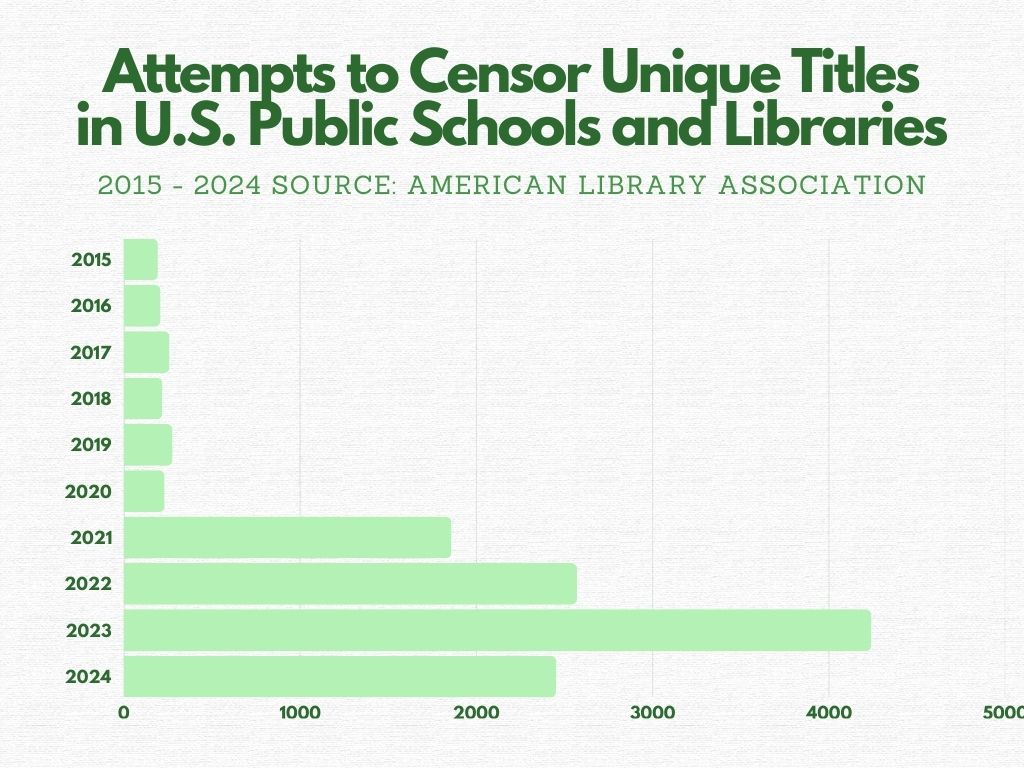
This graphic shows the unprecedented increase in titles challenged throughout the last decade.
History of Bans
Literary restriction dates back to ancient times. In 212 B.C., the Chinese Emperor burned all the books within his kingdom, in an attempt to control the writing of history (Freedom to Read). In 35 A.D., Homer’s The Odyssey was banned throughout the Roman Empire for expressing ideas of freedom (FTR). Across the 15th-17th centuries, European religious and political leaders outlawed certain Shakespearean works, like Richard II and King Lear, for their rebellious themes, alongside English translations of the New Testament (FTR). In the 19th century Darwin’s Origin of Species was banned from Trinity College, Cambridge, for promoting the idea of evolution (FTR). In 1930’s Nazi Germany, thousands of titles, many by Jewish or communist authors, were infamously burned to prevent the German public from reading dissenting ideas (FTR). In each of these examples, we can see the familiar pattern at play: in moments of rapid political, religious, cultural, or moral change, those in power often attempt to restrict the narrative to best serve their needs.
The 1960s, too, was a period of transformation in the United States, and it was during this decade that parental-led literary challenges began to take root. With the Civil Rights Movement challenging longstanding systems of segregation, Cold War anxieties fueling patriotism, and youth counterculture and the rise of second-wave feminism reshaping cultural expectations, many American parents grew increasingly uneasy about what their children were encountering in the classroom. In 1961, Norma Gabler was one such parent. Disturbed by what she believed to be a “factual and moral omission” (Gaddini) in her son’s textbook, she traveled from Longview, Texas to Austin to personally confront the State Board of Education after discovering that the words “one nation under God” were absent from the Gettysburg Address in said textbook. Throughout the next decade, through persistent activism involving hearings, protests, and regular appearances at textbook committee meetings, Gabler’s efforts culminated in the tangible changes she fought relentlessly for. In 1974, when Texas mandated that science textbooks include a warning that evolution was not a fact but a theory (Gaddini), a new era of parent-driven challenges to educational content began. Gabler’s emphasis on being an everyday concerned mother was a political strategy that was difficult to counter. By staking her politics on her identity as an American mom, she, and an increasing number of other right-wing parental activists, appealed to Christian parents nationwide (Gaddini), expanding the reach of the movement and laying the groundwork for the forms of parental activism we see today.
Present Day
The debate over what children are allowed to read in schools has never disappeared, and in recent years has intensified under the political and cultural pressures of the present. Throughout the Donald Trump era, nationalist and Christian-conservative rhetoric has surged throughout public discourse, and many parents and advocacy groups have been closely scrutinizing what ideas and identities their children may encounter within school settings. According to Dr. Zoe Teel, who holds a PhD in learning technologies, efforts to restrict or remove certain books are “increasing and [becoming] mainstream.” In recent years, Teel claims, “it has begun to significantly [and] specifically target children and young adult books that are written by authors who are part of minority groups and subject areas pertaining to sexuality and gender identity, the presence of violence, witchcraft or paganism, religious reasoning, and racial issues” (Teel, 5). These challenges are often framed by their proponents not as censorship, but as efforts to “protect” children or uphold community values, though critics like Teel warn that these challenges overwhelmingly reflect ideological anxieties, rather than valid pedagogical concerns.
Alberta’s commentary on book bans this year has reflected this pattern. Parents for Choice in Education (PCE), one of the most vocal provincial organizations in supporting literary restrictions, has been advocating for the removal of what they deem “sexually explicit and age inappropriate books” (Hilton-O’Brien, par. 1) from school libraries and classrooms. In their brief published this spring, ahead of Ministerial Order #030/2025, PCE claimed that certain titles such as Gender Queer by Maia Kobabe, Flamer by Mike Curato, and Fun Home by Alison Bechdel are “designed primarily to normalize and encourage sexualized behaviour in children” (Hilton-O’Brien, par. 3). This argument mirrors that of successful U.S. parental-rights groups, like Moms For Liberty, and reinforces the idea that restricting certain books is an act of protection, rather than censorship. The titles flagged by PCE were the same ones we’ve seen challenged throughout the States: those about queer youth, marginalized identities, or about understanding one’s body or identity. These narratives, the ones that help young readers to see themselves or to see others more clearly, are the ones singled out by these vocal groups as dangerous.
Former South Park writer and self-professed creator of anti-fascist websites Toby Morton claims on his satirical site momsforliberties.com, “… book banning is promoted under the guise of protecting innocent kids from mature content, [but] there’s nothing innocent or benevolent about restricting young people’s access to media representation and critical thinking about the systems of power that rule our world” (Morton). Morton exposes the contradiction at the root of this issue. Removing books doesn’t protect or shield children from the realities of the world, it just deprieves them of the tools they need to understand them. As Dalhousie University MI graduate Emma Hak-Kovacs quotes in her paper on the issue (Hak-Kovacs, 5), “[r]eality is not censored or sanitised; reality is full of experiences dealing with these subjects, and we owe it to the coming generations to make them ready to process those experiences” (TLN).
Today’s young people are already navigating these realities. They move through a constantly changing digital world, saturated with information, narratives, and images, many of which are far more graphic and far less thoughtful and intentional than anything found in a school library. Children and teenagers aren’t naive; from such a young age they are grappling with questions of identity, belonging, power, and injustice – whether the adults in their lives acknowledge and affirm this fact or not. Denying them access to nuanced, carefully crafted stories does not protect them. It pushes them towards unreliable, often unrealistic or even entirely fabricated content they will encounter online, leaving them less prepared to think critically and empathetically about the world they are inheriting.
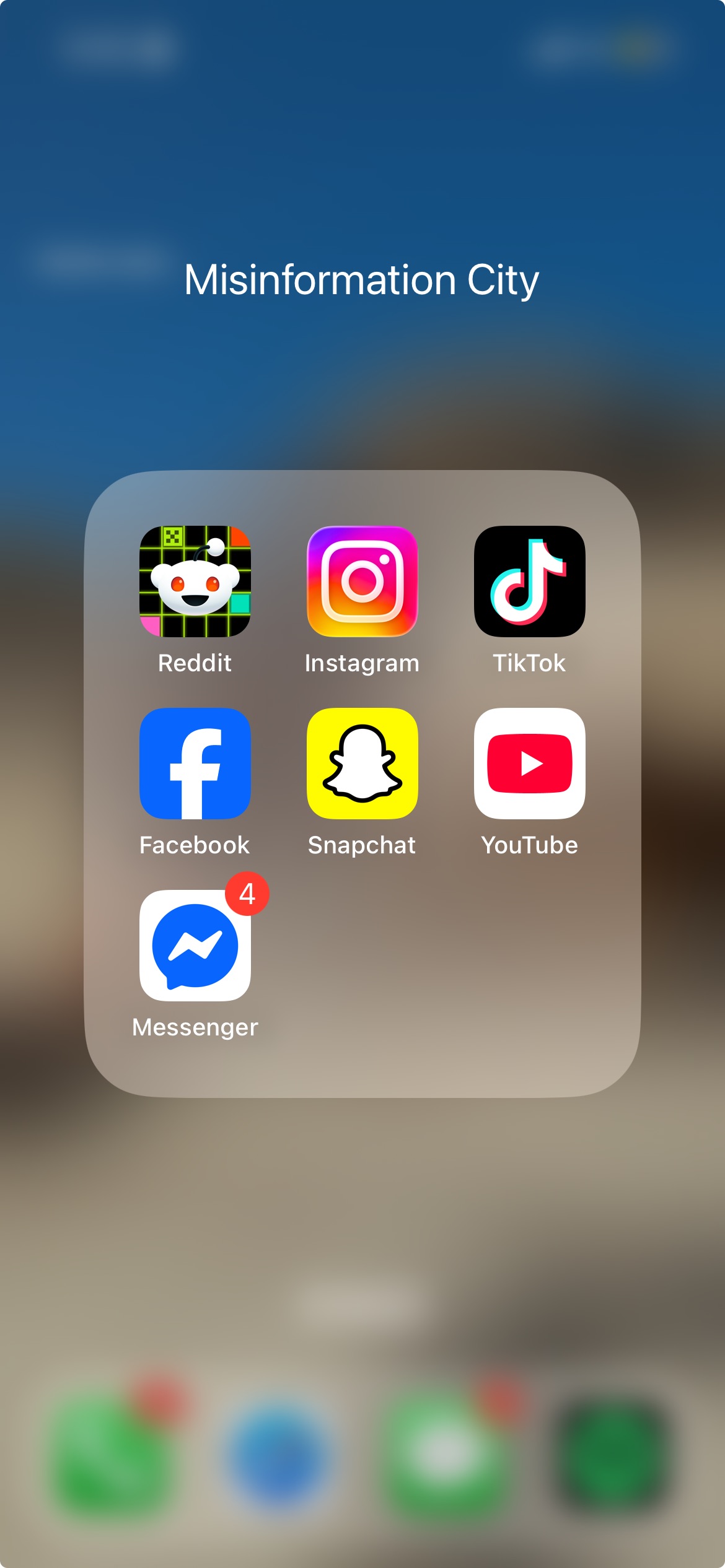
A few months ago, I opened Instagram, and without warning or option to consent, I witnessed a viral video of a well-known American political activist being murdered. The apps that are available to most of today’s youth can cause far more harm than books with explicit content can.
Discourse
I spoke with Edmonton-Highlands-Norwood NDP MLA, and former secondary educator, Janis Irwin about this issue. She framed Ministerial Order #030/2025 as a broader political strategy: “This was really an example of making an issue out of something that wasn’t an issue … suddenly nobody’s talking about teaching conditions. They’re talking about book bans” (Irwin). The debate on literary restrictions in Alberta unfolded alongside their recent teacher’s strike, which brought issues like class sizes, funding, and working conditions to the forefront. “Instead of doing anything [to address these issues] the UCP brought up this book ban. And that was part of their strategy. … It’s a conservative strategy, decades old strategy of, you know, divert, deflect, distract” (Irwin).
However, the issue runs deeper than political diversion. When real lives, experiences and identities are removed from the shelves, the impact is profound. Jennifer MacLeod, cofounder and director of the Vancouver Writer’s Exchange, a nonprofit organization promoting youth literacy in under-resourced communities, emphasized the impact these removals have on students: “it’s harmful in that kids don’t see themselves represented. They’re not introduced to, or they don’t see that it’s healthy [or] normal. They [won’t] see that everybody is a person and it doesn’t matter their sexuality, gender, beliefs… it really narrows the view for kids” (MacLeod). In contrast, she noted that when she’s seen youth encounter characters that they can connect with, through small but impactful details like meals they eat at home, or family traditions, they become visibly excited and feel a sense of belonging. These small moments matter. They affirm that every child’s life is valid and important.
I often find myself to feel grateful to live, work, and learn in British Columbia – a province often viewed as relatively progressive. Yet even here, challenges to literature are happening. In speaking with Metro Vancouver library assistant Cassandra, I learned that book challenges have been occurring in my own neighborhood. In the five years she’s been in her role, Cassandra described, “we have a lot more patron interaction where people are coming up to us and saying ‘I don’t know about this [book]’. They’re questioning titles more than I’ve ever seen” (Cassandra). She pointed me to The Canadian Library Challenges Database, where all public library challenges in the country are catalogued. In browsing the database, I was able to see that the most common reasons for library complaints in Canada are “age inappropriate material”, “explicit content”, and “pro-LGBTQIA2S+”, in that order (The Canadian Library Challenges Database). This tracks with my research. The database also details outcomes – whether the title was removed, relocated to a different area of the library, or retained. Overwhelmingly, Canadian public libraries retain challenged titles (TCLCD), which is a win for intellectual freedom.
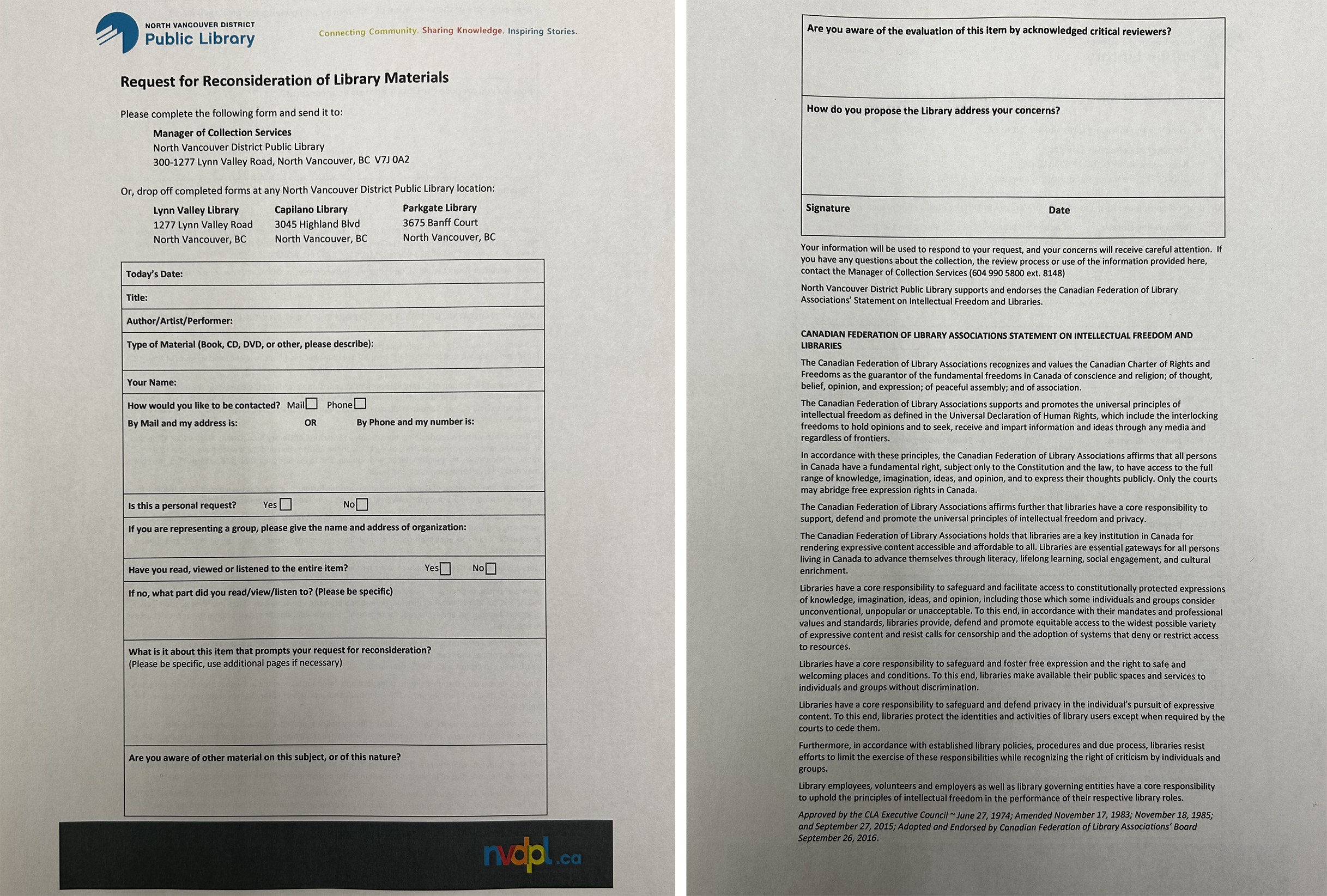
The above images are of the form one would fill out when challenging a title found within a North Vancouver District Public Library. Libraries play an important role in balancing Canada’s fundamental freedoms of thought, belief, opinion, and expression, and in safeguarding intellectual freedom.
Libraries play a huge role in protecting this freedom. Cassandra explained that once library card holders reach age thirteen, their accounts are confidential. This ensures that what they read is between the library and themselves. This policy allows youth to explore books they might not otherwise access due to parental pressures or household rules. I was touched by a story she shared about a homeschooled teenage girl who frequented Cassandra’s library. Restricted at home, this student could indulge in magical worlds and explore ideas she would otherwise never experience. Stories like these are vital. They give youth space to imagine, question, and learn about lives different from their own.
Consequences of Book Bans
Fear is a powerful force, and right now, many fear a rapidly changing world. Jennifer MacLeod urges all who care about literary freedom to “[get] ready to have that conversation, and possibly fight for what’s right. I know we say, it wouldn’t happen in B.C. or Vancouver, but we’ve said that about a lot of things. And the way things are sweeping across the states is pretty scary … we need to be prepared and face the facts that this could happen here” (MacLeod). The increasing presence of book challenges across North America begs an important question. What happens when young people lose access to diverse literature? What would happen here, in our classrooms and libraries, and in the lives of the students who rely on literature not only for information or entertainment, but for connection, affirmation, and imagination?
Should literary restrictions be imposed here, the consequences would be immense. As MacLeod emphasized in our conversation, many young readers feel a sense of belonging when they see even a small detail, like a familiar food or a similar family structure, that reflects their own lives (MacLeod). When these details disappear, so too does the message that their lives and experiences are normal. For youth who are queer, racialized, or navigating trauma, representation can be a lifeline. Seeing one’s identity reflected in media can lead to higher self-esteem, emotional intelligence, and academic engagement (Herb and Betts, 440). When youth can’t find themselves represented, they may internalize the harmful message that their lives are lesser.
Beyond this, banning books can severely limit our capacity for empathy and understanding. Literature allows us to experience lives far beyond our own, and to see the world through others’ eyes. In removing books that might broaden perspectives and provoke thought, censors restrict our ability to understand diverse experiences. Arguably, this is precisely their intent. As Janis Irwin noted, these bans have emerged alongside political efforts to redirect public attention, and enforce particular ideological agendas. Uncle Tom’s Cabin by abolitionist Harriet Beecher Stowe was banned in the Southern United States in 1852 (Mudium, par. 6), due to the fear plantation owners felt regarding the loss of control that slavery afforded them. In 1933, thousands of books deemed “un-German” were burned by the Nazi regime – they were afraid that narratives other than their own would promote dissent or revolt (Freedom to Read). Today, Gender Queer is the target. Alberta’s Parents for Choice in Education claims that the YA graphic novel “sexualizes children” (if we can call consuming a graphic novel that comments on things like menstruation, body hair, and other coming-of-age normalities “sexualizing”) by “encourag[ing] minors to explore sexual identities without parental involvement” (Hilton-O’Brien, par. 7). Whether or not parents should be involved in their children’s exploration of sexual identity is debatable in itself. The fear behind today’s obviously targeted bans is clear – proponents of bans fear that exposure to queer or otherwise different themes will “normalize” the identities and lifestyles that a largely white, heternormative, often conservative group considers to be unacceptable. This narrowing of worldview creates a polarized society, one in which young people learn that unfamiliar identities are dangerous, and that empathy for them is optional.
Conclusion
“Banning books gives us silence when we need speech. It closes our ears when we need to listen. It makes us blind when we need sight.” —Stephen Chbosky
As someone preparing to enter the classroom as an educator, I’m aware of the responsibility I will bear. In today’s online world where youth will experience misinformation, and sensationalized algorithmically targeted content, protecting access to intentional, well-crafted stories is more important than ever. When a library removes a book that carefully depicts queer adolescence, social media will quickly fill that void with stereotypes, harmful tropes, or dangerous misinformation.
Books are a form of art, and authors are artists. If we censored Michelangelo, Salvador Dali, and Georgia O’Keefe because of the explicit elements of their art, we would lose not only the beauty but the depth and meaning beyond the nudity. Likewise, if we censor Harry Potter because magic is “un-Christian,” we erase messages of friendship, loyalty, and courage. Censorship narrows the lens through which young people see the world.
I want for my future students to have access to the thousands of worlds that books offer. I want them to experience joy, sorrow, wonder, and curiosity. I want them to encounter ideas that comfort and ideas that challenge, to wrestle with ethics, ambiguity, and perspective. Schools and libraries should be spaces where such exploration is not feared but encouraged. They should be spaces where students can practice critical thinking, and meet perspectives beyond their own.
Whether under authoritarian regimes of the past or under contemporary conservative calls for censorship, the effect of book bans is the same: certain voices are deemed dangerous, certain identities are erased, and young readers are denied the chance to meet ideas and lives beyond what dominant powers find acceptable. By removing books, those in power don’t just hide content. They limit possibilities. Protecting access to diverse stories is a moral imperative. We all deserve the freedom to read, question, and imagine. We all deserve to live the thousands of lives that books make possible.
Works Cited
Bailey, Jordyn L. To Read or Not to Read: How Book Censorship Affects Students and Undermines Different Worldviews. 2 Dec. 2024, encompass.eku.edu/cgi/viewcontent.cgi?article=2101&context=honors_theses.
Brady, Amy. “The History (and Present) of Banning Books in America.” Literary Hub, 22 Sept. 2016, lithub.com/the-history-and-present-of-banning-books-in-america/.
C, Cassandra. Personal Interview. Interview by Nicole Richardson, 13 Nov. 2025.
Freedom To Read. “Bannings and Burnings in History.” Freedom to Read, 2025, www.freedomtoread.ca/resources/bannings-and-burnings-in-history/.
Frew, Nicholas. “‘Vicious Compliance’: Alberta Premier Decries Edmonton Public Schools’ Banned Book List.” CBC, 29 Aug. 2025, www.cbc.ca/news/canada/edmonton/alberta-premier-smith-edmonton-public-schools-banned-books-1.7621238.
Gaddini, Katie. The Woman Whose Crusade Gave Today’s Book-Banning Moms a Blueprint | Department of History. Stanford University, 13 Nov. 2024, history.stanford.edu/news/woman-whose-crusade-gave-todays-book-banning-moms-blueprint.
Hak-Kovacs, Emma. “The Right to Read in a Censored World: The Position of Young People, Educators, and Librarians in Protecting Intellectual Freedom.” Dalhousie Journal of Interdisciplinary Management, vol. 18, no. 1, Sept. 2024, https://doi.org/10.5931/djim.v18i1.12314.
Herb, Annika, and David Betts. “Queering the Book Club: Empathy Development through Young Adult Literature in Australian Discussion Groups.” Children’s Literature in Education, vol. 55, Nov. 2022, https://doi.org/10.1007/s10583-022-09512-w.
Hilton-O’Brien, John. “Now’s the Time, Speak up about Sexualized Books in Schools.” Western Standard, 27 May 2025, www.westernstandard.news/opinion/hilton-obrien-nows-the-time-speak-up-about-sexualized-books-in-schools/65008.
Irwin, Janis. Personal Interview. Interview by Nicole Richardson, 31 Oct. 2025.
MacLeod, Jennifer. Personal Interview. Interview by Nicole Richardson, 22 Oct. 2025.
Morton, Toby. “Banned | Moms for Liberty.” Moms for Liberty, 2023, www.momsforliberties.com/about-8.
Mudium, Nikhita. “Book Bans in the United States: History Says It All – UAB Institute for Human Rights Blog.” Sites.uab.edu, University of Alabama Birmingham, 12 Jan. 2023, sites.uab.edu/humanrights/2023/01/12/book-bans-in-the-united-states-history-says-it-all/.
Natanson, Hannah. “Objection to Sexual, LGBTQ Content Propels Spike in Book Challenges.” Washington Post, 9 June 2023, www.washingtonpost.com/education/2023/05/23/lgbtq-book-ban-challengers/.
“Nazi Book Burnings.” Holocaust Encyclopedia, United States Holocaust Memorial Museum, 28 July 2025, encyclopedia.ushmm.org/content/en/article/book-burning.
Nicolaides, Demitrius. Standards for the Selection, Availability, and Access of School Library Materials . 4 July 2025, smartcdn.gprod.postmedia.digital/calgaryherald/wp-content/uploads/2025/07/2025_030_Education_and_Childcare.pdf.
Teel, Zoë (Abbie). “Discouraging Freedom in the Library.” The Serials Librarian, vol. 84, no. 1-4, Feb. 2023, pp. 1–6, https://doi.org/10.1080/0361526x.2023.2173357.
“The Canadian Library Challenges Database.” Centre for Free Expression, cfe.torontomu.ca/databases/canadian-library-challenges-database.
Tolin, Lisa. “Banned Books List 2025.” PEN America, 1 Oct. 2025, pen.org/banned-books-list-2025/.
Tsiouclas, Anastasia. “PEN America Warns of Rise in Books ‘Systematically Removed from School Libraries.’” NPR, 1 Oct. 2025, www.npr.org/2025/10/01/nx-s1-5559158/book-bans-challenges-pen-america.
Williams, Emily. “The Handmaid’s Tale among More than 200 Books to Be Pulled at Edmonton Public Schools.” CBC, 29 Aug. 2025, www.cbc.ca/news/canada/edmonton/edmonton-school-books-removal-1.7620807.