
Kunal Jhanjee
2Lt. Kunal Jhanjee is a psychology major at Capilano University, currently serving in the Royal Canadian Airforce as an Air Operations Officer. He made it on the Dean’s list throughout his undergrad at Capilano and has had a positive experience during his journey of learning as a mature student. He is an avid mountain biker and thrill seeker who loves to travel whenever he has an opportunity to do so. He is looking forward to furthering his career in the military and also in applying his psychology background to make him an effective leader and a cognizant human being.
In the summer of 2023, I made my way to Saint Jean, Quebec, expecting to spend the next three months being indoctrinated. I was attending CFLRS (Canadian Forces Leadership & Recruit School) to start and hopefully finish my BMOQ (Basic Military Officer Qualification). This is mandatory training required in the CAF (Canadian Armed Forces) for all future officers. (The military loves to use acronyms.) At the end of the training, I realized that it wasn’t indoctrination, but rather enlightenment. Indoctrination refers to the process of teaching a person or group to accept a set of beliefs uncritically. Instead, I saw there was a method to the madness of basic training, and I was glad to have gone through it.
Canada’s military representation has fallen sharply, in 1962 one in 147 Canadians served, by 1986 it was one in 309 and today, with a population over 40 million and roughly 58,500 personnel in the regular force, it’s about one in 684. The CAF currently faces a shortfall of about 13,000 personnel (Taylor). To make things worse, these dwindling numbers are further stretched thin in the ever increasing and recurring national emergencies such as forest fires, floods, heatwaves and landslides. Given Canada’s size, climate, extensive forests, waterways and a warming climate, natural disasters will remain frequent. Since the 1950s, the CAF has supported communities with personnel, equipment and expertise for floods, storms and wildfires and requests for military assistance have risen sharply since 2013 (Lee). Although one of the CAF’s core missions is to aid civil authorities during domestic disasters, it must also balance other defense priorities. With climate change driving more emergencies, experts warn that Canada is becoming overly reliant on the military for disaster relief. From 2010 to 2023, Operation LENTUS was deployed on 51 occasions, with eight activations occurring in 2023 alone. This operation serves as the CAF’s standard domestic response to support civilian authorities during natural disasters (Forster). In tandem with the actual climate, the current geopolitical climate is also warming up, a polarized world with an ‘every country for itself’ approach seems to be becoming the norm. Overreliance in any sector, especially defense, can be worrying to say the least. Reliable partners from the past are not so reliable anymore.
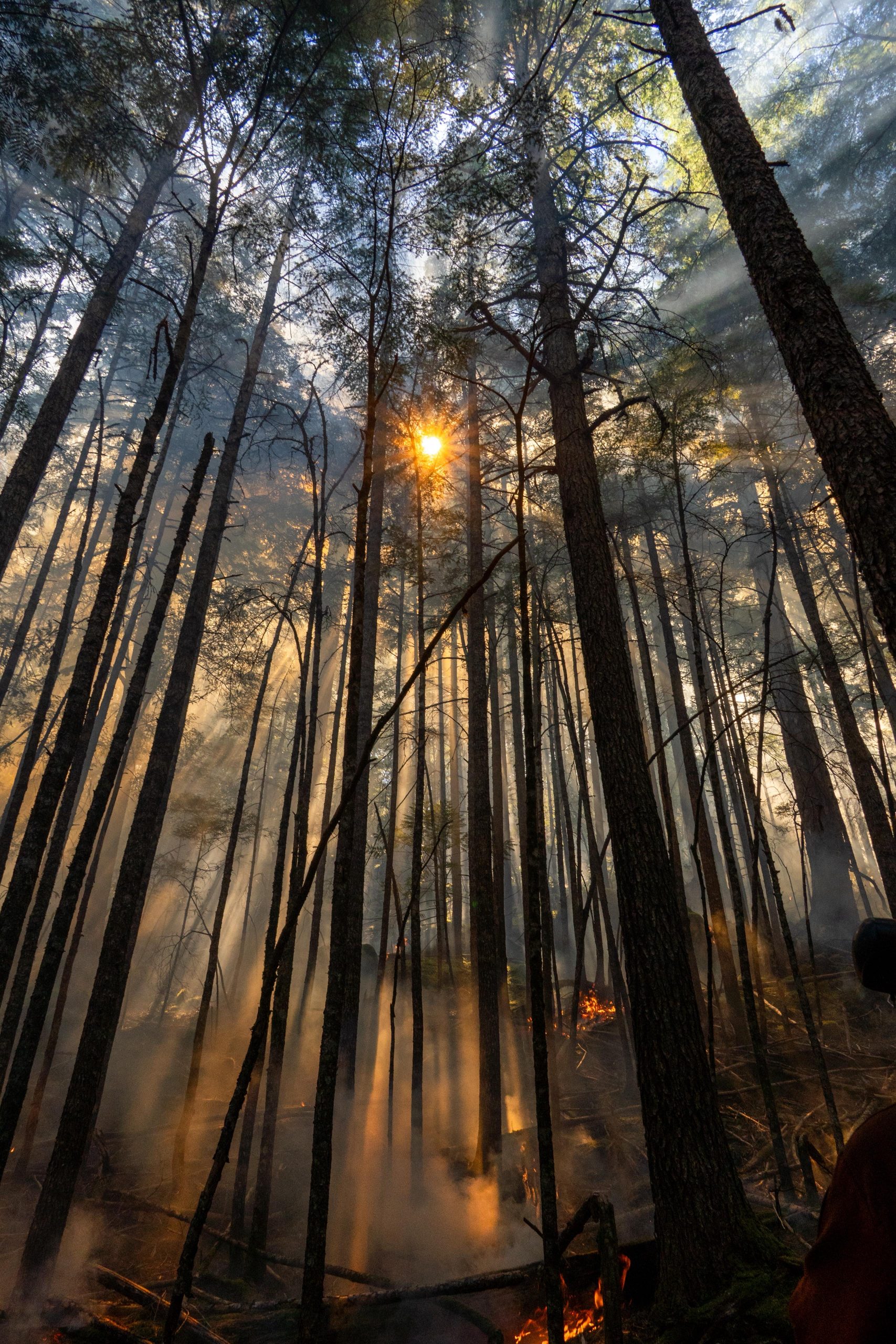
Scorched earth. A recent forest fire capture by Mika H.
“We need to be focused on war fighting and not focused on domestic operations, that should be really more of a civil organization responsibility, and we should be the last resort, but unfortunately, over the last ten years we’ve become not the last resort as we get called in to help out way more than we normally ever did twenty years ago.” Capt. Kaine, Public Affairs Officer at 39 CBG, Vancouver.
It seems that for the CAF to perform its primary role effectively, which is to protect Canada and to participate in global peacekeeping initiatives, it needs to rely in full on its already scantly numbered personnel. However, the CAF also ends up serving as a primary actor in Humanitarian Assistance and Disaster Relief (HADR) efforts. Diverting these personnel from vital training, or equally vital rest periods, once they are back from deployments etc. and placing them in disaster response roles is asking too much of them. It’s understandable why the CAF would be considered a primary actor, civil authorities consistently view the CAF as a well-trained, versatile, and well-equipped combat force, recognized for its mobility and ability to effectively transition into HADR operations (Lee). Surely, when it comes to the use of actual equipment and expertise, the CAF should be called on to provide support functions and rightfully so, but at the same time, their main purpose should be to provide back-up to the key emergency teams such as firefighters and first responders. Instead, what if there were a national service force that helps Canadians in need? Introducing a short, dual-approach, mandatory national service in Canada would strengthen surge capacity and help in assisting with climate related natural disasters. An interest in its alternative – basic military training, can improve Arctic readiness and will signal greater burden‑sharing to NATO partners, helping address recruitment shortfalls and diplomatic criticisms.
UNDERSTANDING DEMAND
In an article published by CBC News this year, a Quebec coroner highlighted the absence of first responders as a contributing factor in the death of a thirty-seven‑year‑old man who suffered hypovolemic shock and blood loss after cutting himself on a glass door in Rivière‑à‑Pierre, a rural community northwest of Quebec City. Coroner Audray Tondreau noted that the lack of a local first responder service prevented timely medical intervention (Plante). While for those of us who live in dense cities such as Vancouver and Toronto, we come across the sirens of first responders at least once a day, if not more, we shouldn’t forget that Canada as a whole is much more than its major cities. The demand for first responders is particularly acute in rural areas, where limited ambulance availability and expansive geographic coverage contribute to longer response times compared to urban centers. A recent report from Quebec’s auditor general shows that about one in two people in Quebec live in communities without first responders, despite ongoing appeals to make emergency first aid more available (Plante). What if someone in the above deceased young man’s community had advanced first aid training? It could have certainly changed the outcome or bought more precious time.
A recent report from Public Safety Canada stated that Canada’s climate is warming much faster than the global average, especially in the North, causing more dangerous heatwaves, floods, and wildfires that put communities at risk. Indigenous Peoples and other vulnerable groups are affected the most. In the last thirteen years, First Nations communities have gone through more than 1,300 emergencies, leading to over 580 evacuations and affecting about 130,000 people (Public Safety Canada). Some had to leave their homes more than once because of different disasters. CAF helps in emergencies, but the increasing number of disasters shows that civilian response systems need to be strengthened. The report in its conclusion states “The Government of Canada recognizes that a sustainable whole-of-society, pan-Canadian approach for civilian response capacity is needed to keep pace with the evolving threat to environment and help strengthen Canada’s preparedness for future all-hazard emergency events.”
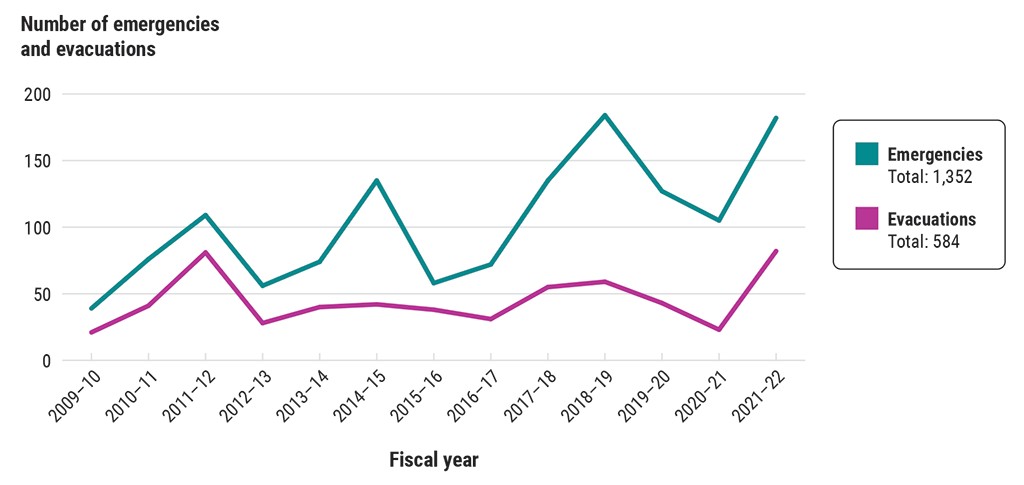
Graph from Public Safety Canada showcases the rise in emergencies since 2009.
A proactive rather than a reactive measure is required. Employing a national service model in which youth can either choose to go through emergency response training for two months or enroll as a reservist in the CAF and go through one month of basic military training, as part of their high school curriculum can be the answer. Individuals enrolled in either model could expect monetary compensation along with educational credits which can be used towards their higher education. Looking at the current youth unemployment rate, which is hovering around 15% according to StasCan, is worrying. A paid service model can help absorb this to a large extent and make the youth more employable in certain fields. Being an OCdt (Officer cadet) in the Royal Canadian Airforce myself, the benefits and subsidies provided by the military are nothing short of a golden ticket. Time wise, a one-to-two-month commitment is not a whole lot of an ask, especially when it offers such valuable training which can assist with developing youth and help fellow Canadians in times of need. Imagine if every teenager in a given household had disaster/emergency response preparedness.
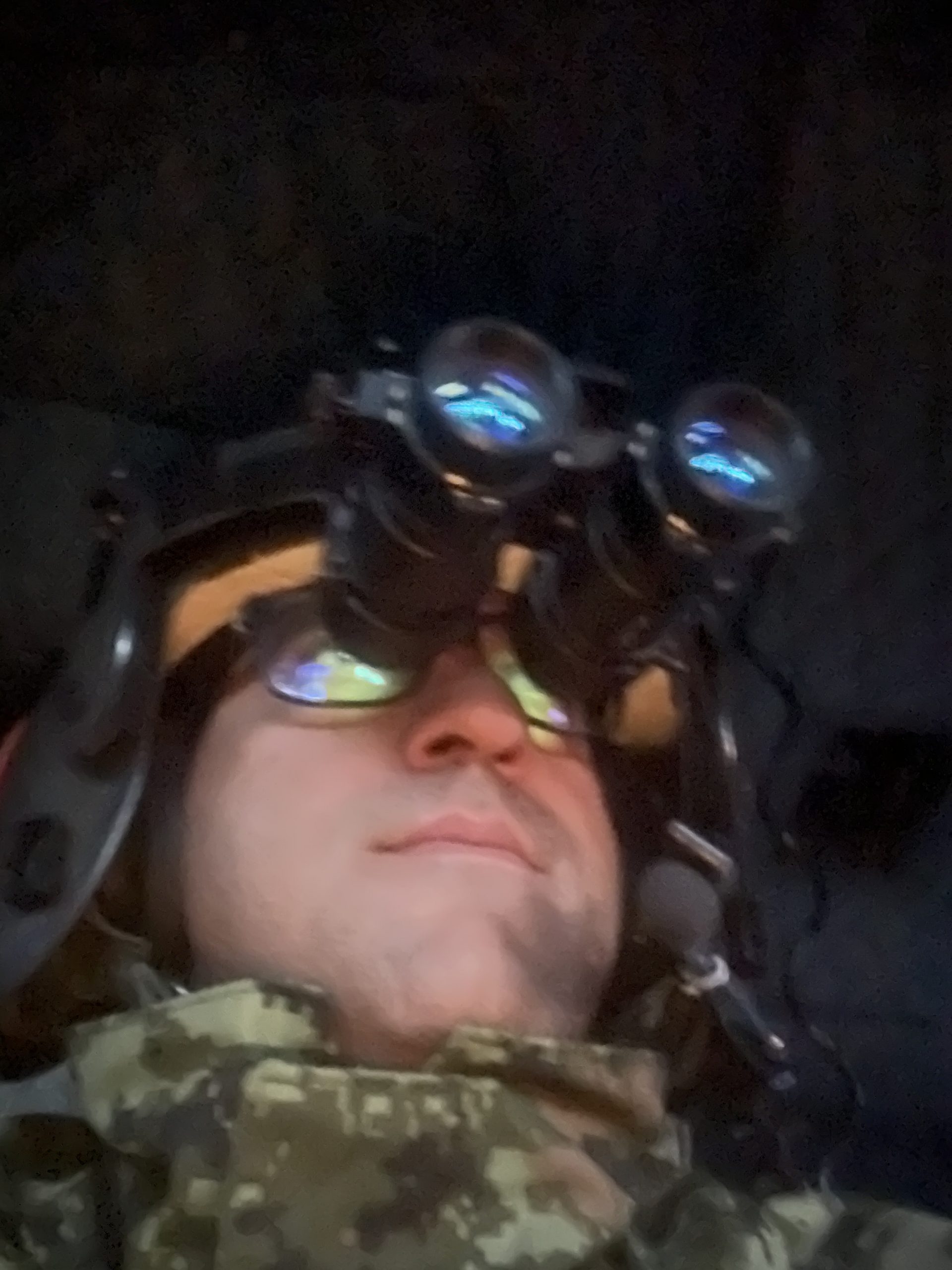
Night Ops during my OJE (On the job experience) at 408 tactical helicopter squadron, Edmonton, taken by author.
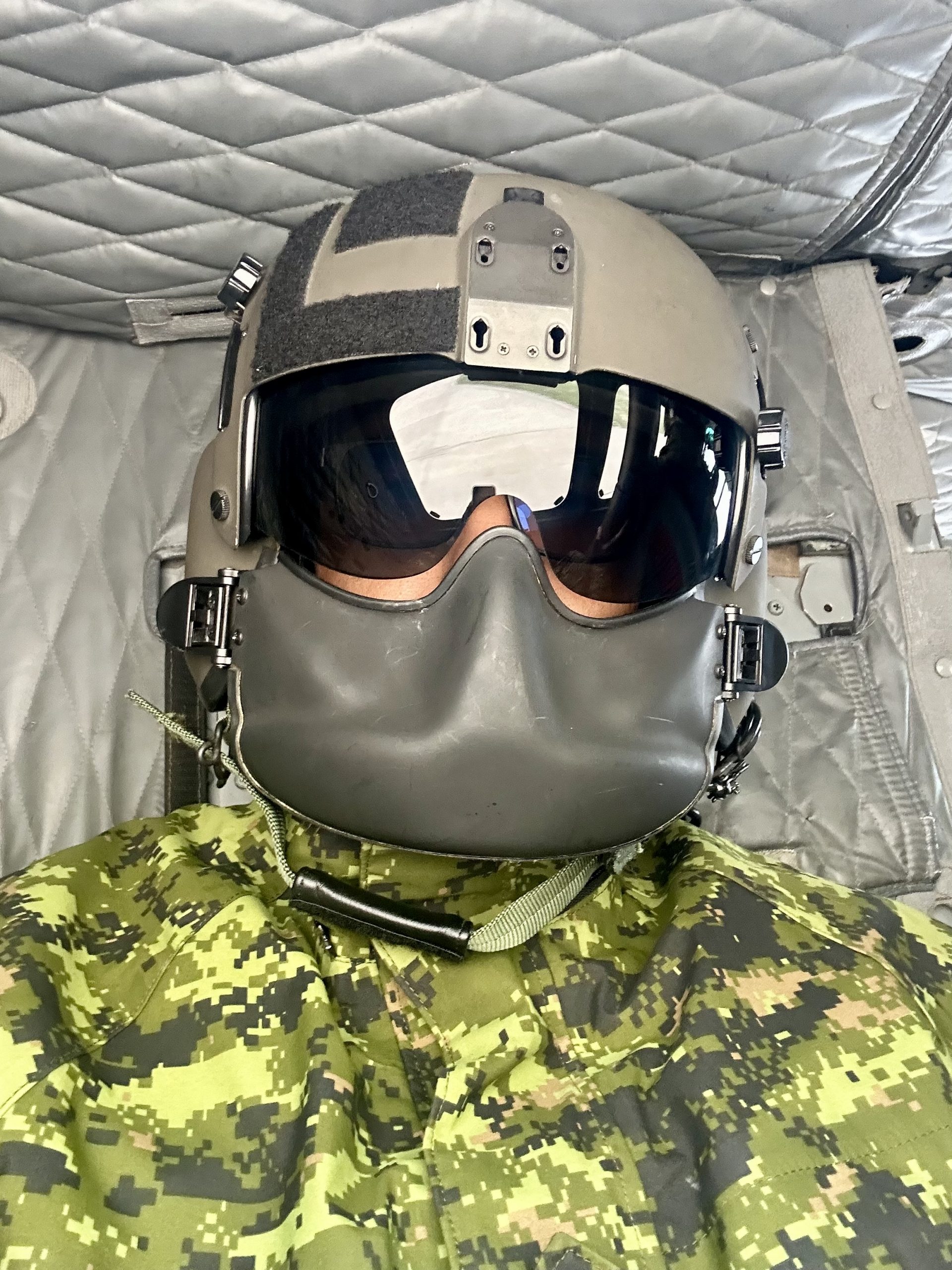
Aboard a tactical helicopter, taken by author.
While designing a model like this, especially it being mandatory, considering the autonomy of the individual is important, particularly Section 7 of the Charter of Rights and Freedoms, which protects “the right to life, liberty and security of the person.” Considering the perspectives of conscientious objectors to violence (they can choose national service instead of military training) and also, individuals with medical constraints who can be employed accordingly to better suit their needs.
“I think autonomy is probably the main thing here. Autonomy is not absolute. If you get them to choose between military and some kind of civil defense sort of thing, or civil work, that’s at least bringing back some autonomy.”
—Dr. Fleming, Chair of School of Humanities, Philosophy Instructor at Capilano University.
One could argue that citizens aren’t obligated to perform these roles and the government should be responsible for it. Afterall, what do we pay our taxes for? “A lot of people don’t see paying their taxes as an obligation,” says Dr. Fleming, who teaches courses on bioethics and ethics of war and peace. “They see it as something that they’re just legally required to do. And if you ask them if you could get away with not paying tax, many of them would probably just be fine with that. But that’s not upholding your obligation.” As citizens, we do have a social contract to uphold, essentially giving up some freedom for the sake of freedom itself.
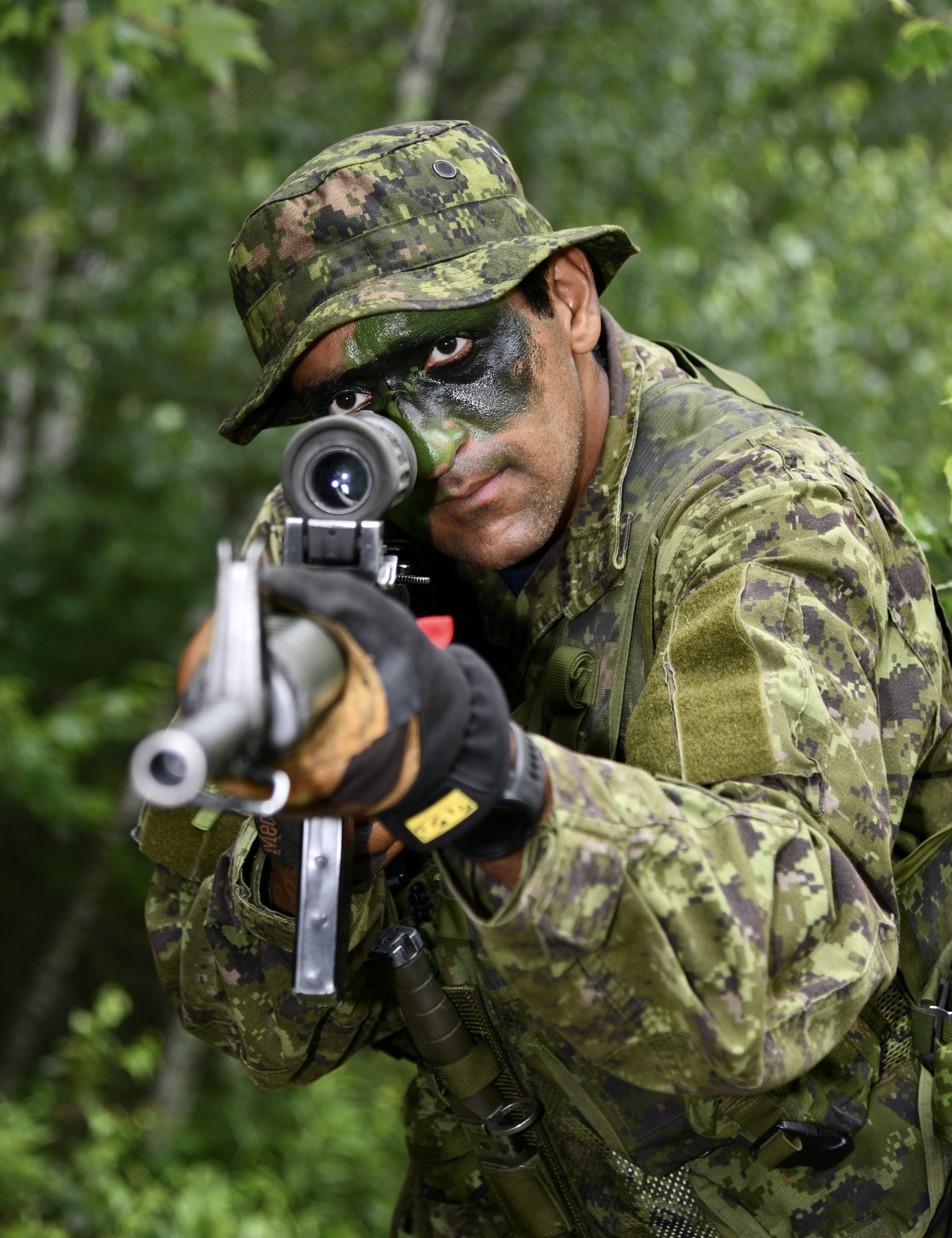
Blending in the surroundings, taken by author.
As I mentioned at the beginning of this article, all future officers have to go through BMOQ in order to further their careers in the military. It is usually a month long for NCM’s (noncommissioned members), and that’s the other option being proposed here, instead of the two months of disaster response management training. I had a challenging, yet amazing experience during BMOQ. I performed daily activities in close proximity to others, with uniform treatment and shared tasks for all individuals. These activities followed a strict schedule dictated by institutional authorities. The training process involved rigorous instruction combined with frequent use of rewards and punishments (mostly punishments), to shape our behaviour and ensure conformity to the system’s framework. This conditioning is crucial for military operations in combat, as it prepares individuals to perform tasks under extreme stress that are not typically required in civilian life.
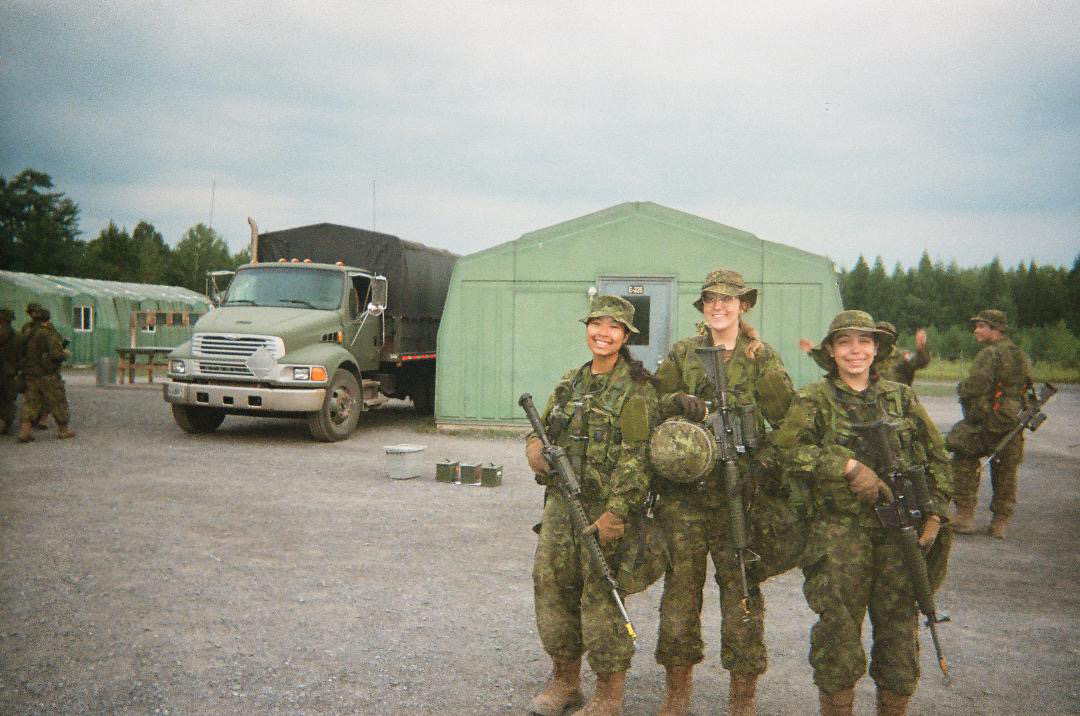
Staying at a FOB (forward operating base) during basic training, credit – OCdt Gabby P.
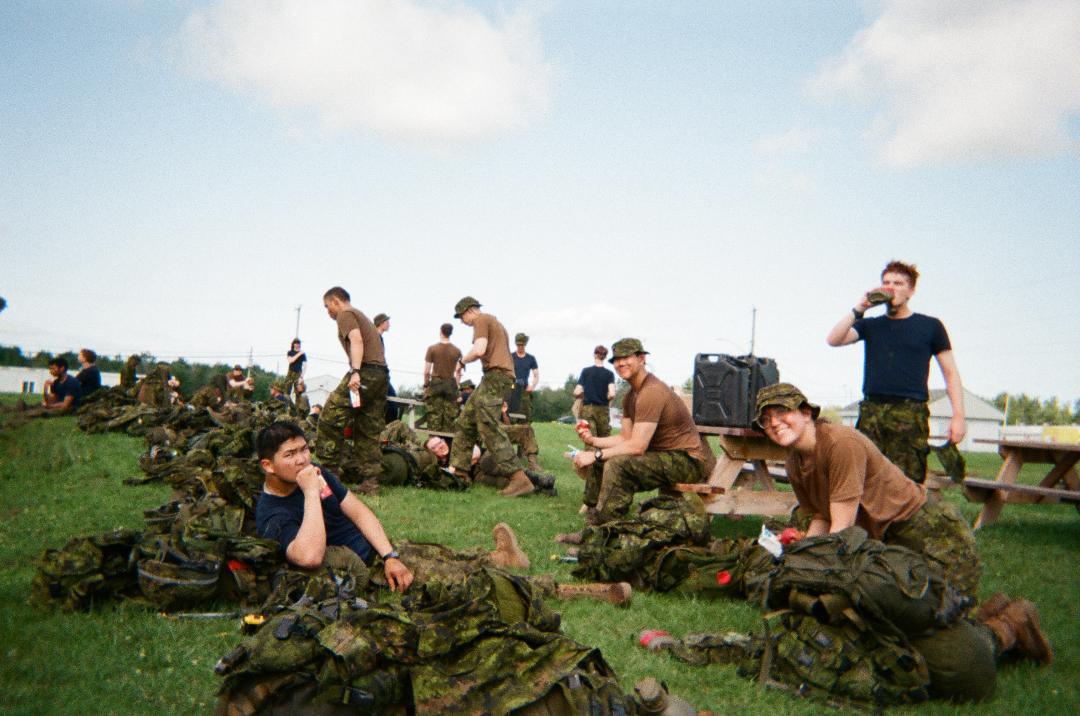
Enjoying some downtime after a 13k rucksack march, credit – OCdt Gabby P.
The training process also acts as a primer. Social priming in military training refers to subtle cues, rituals, and environmental structures that unconsciously shape soldier’s attitudes and behaviour. The aim of this training is to dismantle the civilian mindset and replace it with a military-oriented way of thinking (Jhanjee). I see myself applying the skills I learnt during basic in my current civilian life as a student. Valuing time, staying focused, keeping physically fit and being professional are a few things that stuck with me. Giving one’s best usually tends to create just the right amount of stress to make progress and persevere. While the word stress might sound like cause for concern, short-term stress in moderation is actually essential and useful, from a psychological perspective, and it will most definitely be a part of either of the chosen models.
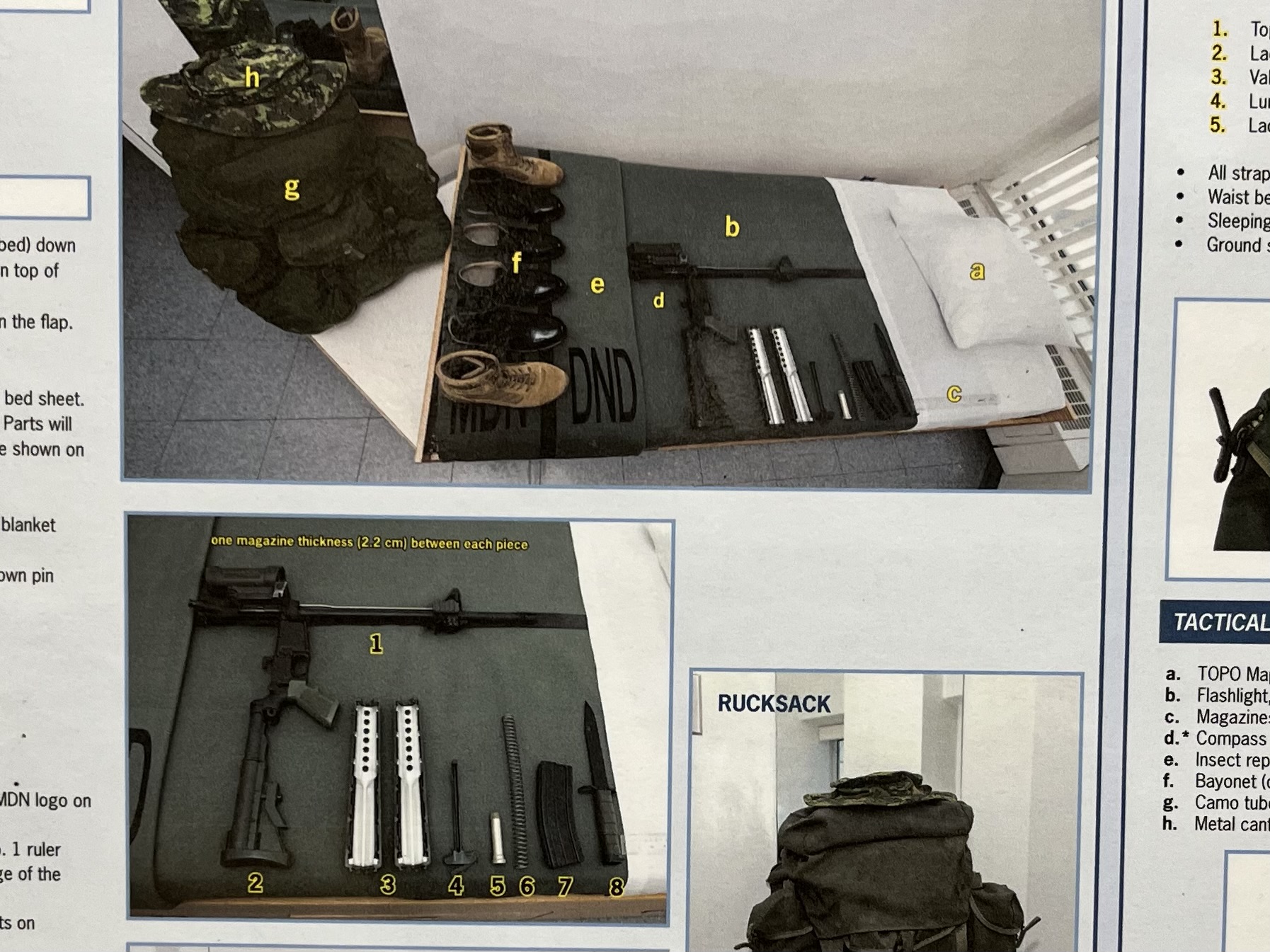
Layout of rifle and rucksack during inspection, credit – CFLRS.
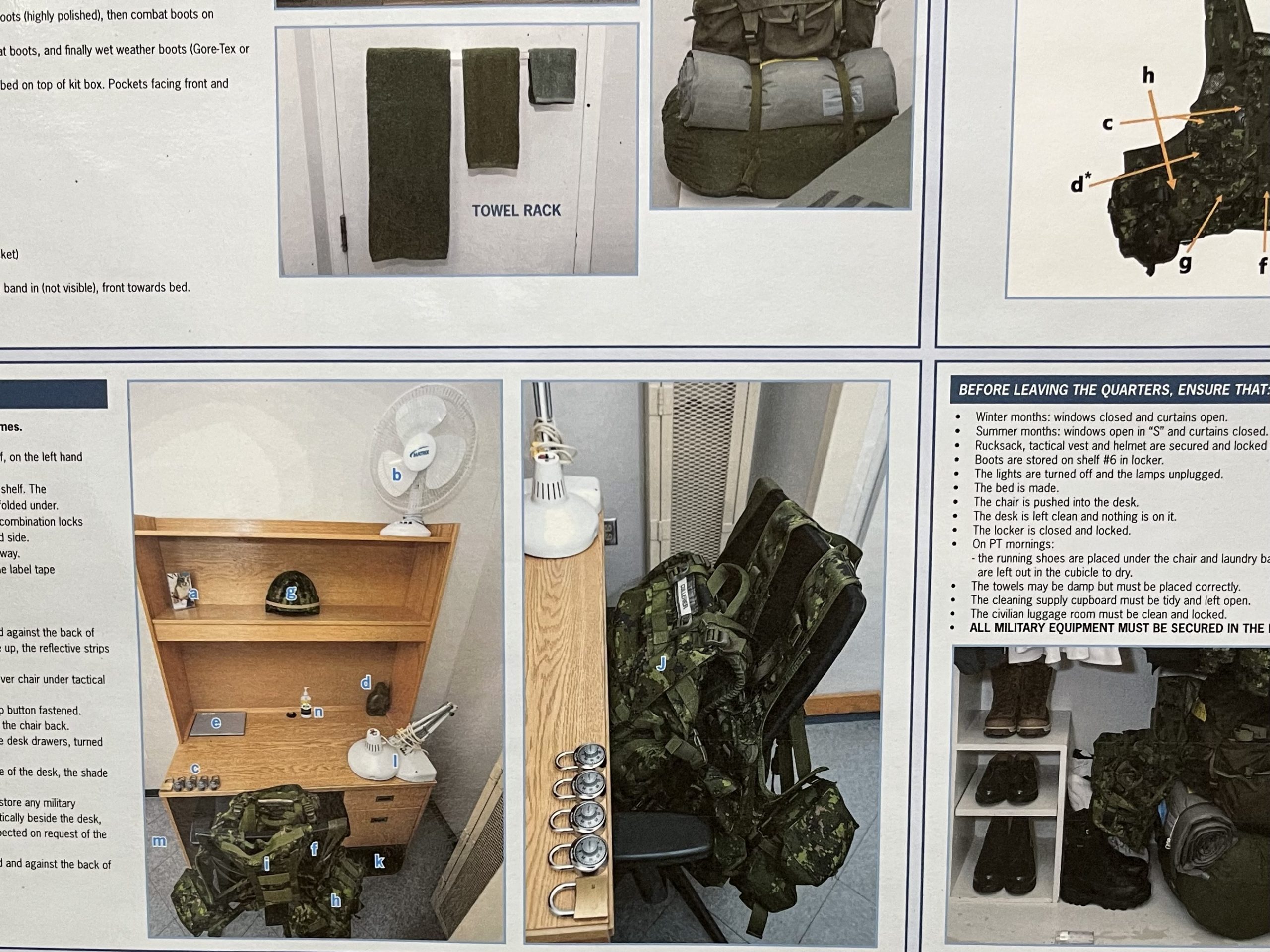
Uniform treatment in everything. An inch here or there equals 25 pushups, credit – CFLRS.
To get a glimpse into what the training would look like for the emergency response model, I reached out to a fellow Psychology Honours student at Capilano university – Mika H, who also happens to be a forest fire fighter with BC Wildfire Service since 2023. She’s seen some action over the past summers while being deployed across Canada. While her training is particular to wildfires, parts of it can carry over to other disaster management models as well and can provide some reference points. It also has some obvious parallels to the basic military training model in the CAF. She explained that it’s a competitive process to get in which incorporates a one-week bootcamp. During that week, candidates stay in ranger tents and follow a regimented schedule which is physically demanding. They go through safety procedures, equipment handling, first aid procedures and controlled firefighting training. “So, before you even get accepted into boot camp, you have to pass a fit test, which is a national fit test and is timed”, she said. This is very similar to the Force test in the CAF, which is a yearly requirement for all personnel and also compulsory to pass. Asking her about candidates who would be interested, but have physical limitations –
“There are lots of operations, like, in communications where people work at fire centers and just coordinate. Like from radio comms to organizing crews. There’s lots of different roles that don’t require the physical aspect.”
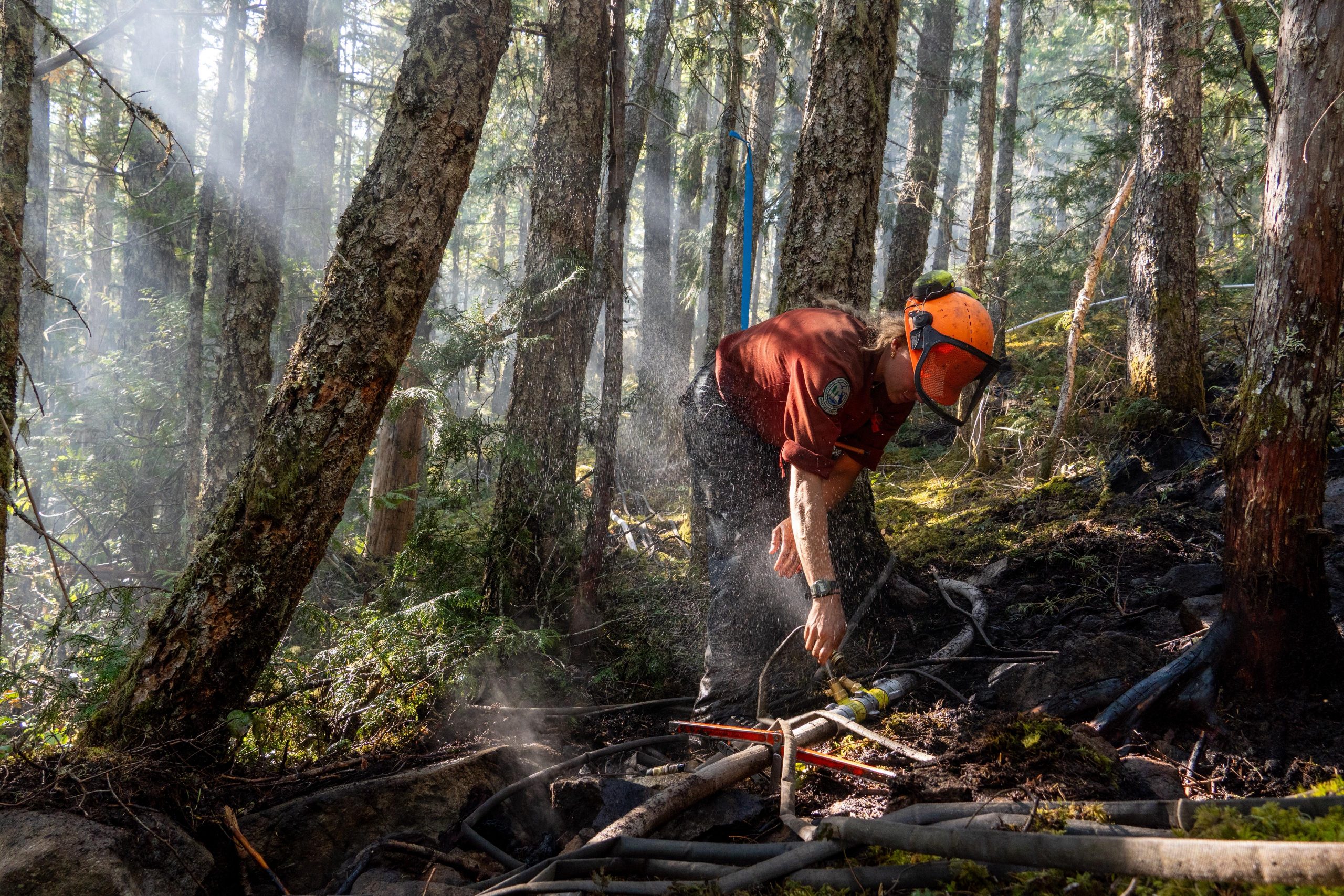
Mika H. in action, working on some equipment during an active forest fire, credit – Mika H.
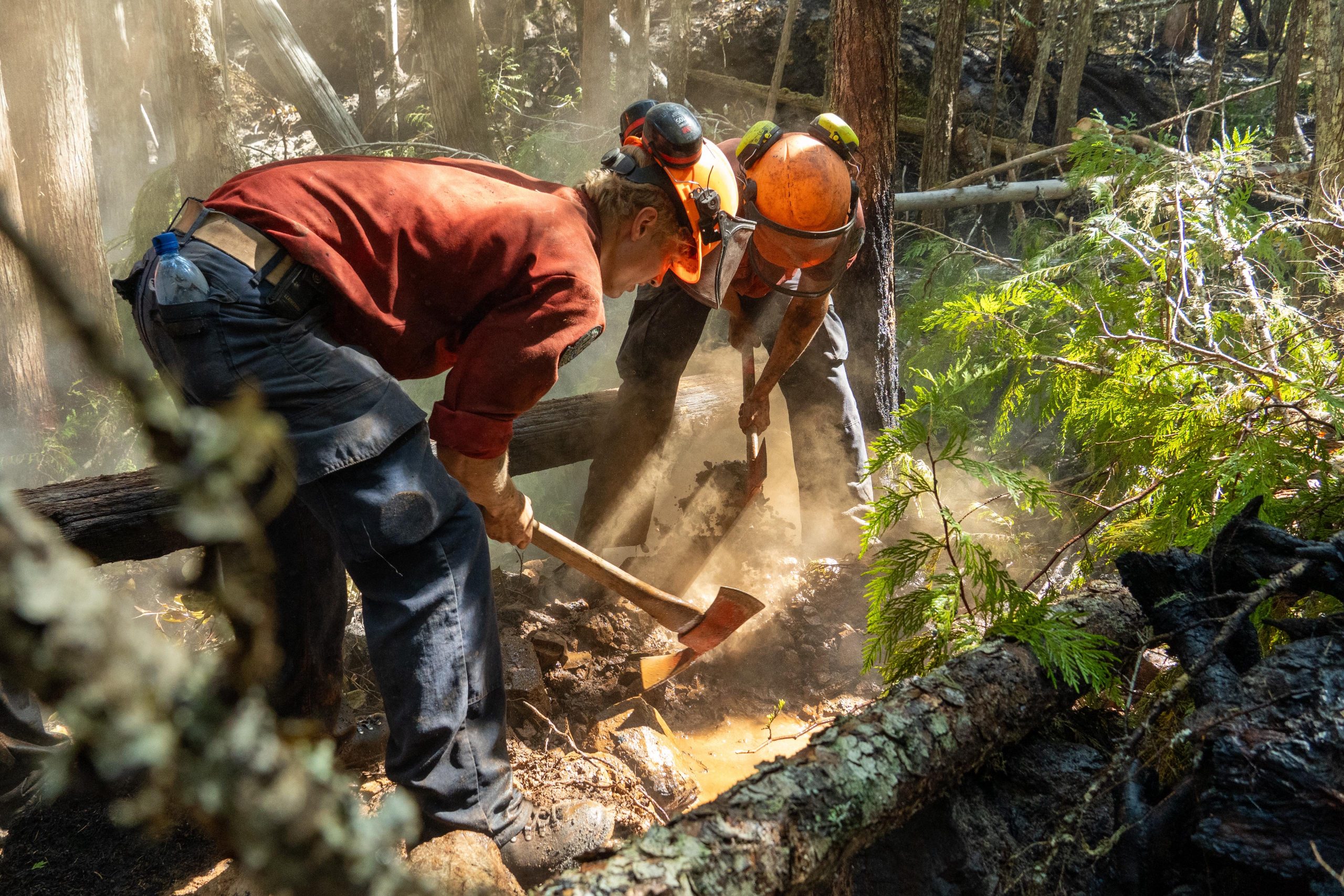
Getting physical in the elements, credit – Mika H.
It’s important to design training models that are inclusive and equitable when it comes to a national level service. As of now, BC Wildfire offers a ‘Junior program’, currently offered in Kamloops and Smithers, it allows high school seniors to take a training course in their final year and then join the crew as juniors. After graduating in June or July, they work for a short season, gaining hands‑on experience by assisting and learning on the job, though with limited responsibilities. The program gives 17 and 18 year‑olds practical exposure and a pathway into the field. She said that joining an adult crew gives juniors valuable early development in competence and critical thinking. Their season is short, often ending before October and while they gain hands‑on experience, they must still complete boot camp afterward.
The proposed program would include a two-month-long training model, wherein after two weeks of bootcamp involving basic elements pertaining to teamwork, discipline and physical training are followed by a few weeks of specific training for wildfires, floods, storms and such, followed by intermediate and advanced first aid training, with the final few weeks meant for OJT (on the job training). The basic military training also involves basic first aid training, firefighting skills and a lot of military specific training such as gas hut training, weapons handling (range day), navigation, drill, military formations etc. Once the candidates complete their training, they can pursue careers as firefighters, paramedics, police or if they choose the military route, they can become a part of reserves. This will provide them with baseline and familiarity with these trades, if they choose to further their careers in them. Alternatively, they can carry on with their own interests in other fields while still possessing valuable and possibly lifesaving skills. Making this training a part of the curriculum in the final phase of graduating high school also makes sure that they are not wasting time or having to do this training out of their way, another aspect which supports their autonomy.
An additional positive element of this plan would be assembling youth from different parts of Canada to train together which provides them with options to explore the country. During my basic training, my platoon had cadets from every corner of the country, from Nunavut to Halifax, all working towards a common goal together. Mika was deployed to Ontario this year during the wildfire season. It’s an opportunity to admire our vast and beautiful country. This system will also help to serve and assist with emergencies in our Northwestern territories, which are inhabited scarcely and disproportionately affected. It will also provide the residents of those smaller communities to serve in other provinces. Capt. Kaine, the Public Affairs Officer at the Vancouver based 39 CBG stated that there’s a new Canadian military modernization in the works in which, the reserve regiments and the Canadian Rangers will be put together under the defense of Canada division. Canadian Rangers operate exclusively in our Northern territories as they possess local knowledge of the land and are primarily of First nations origins.
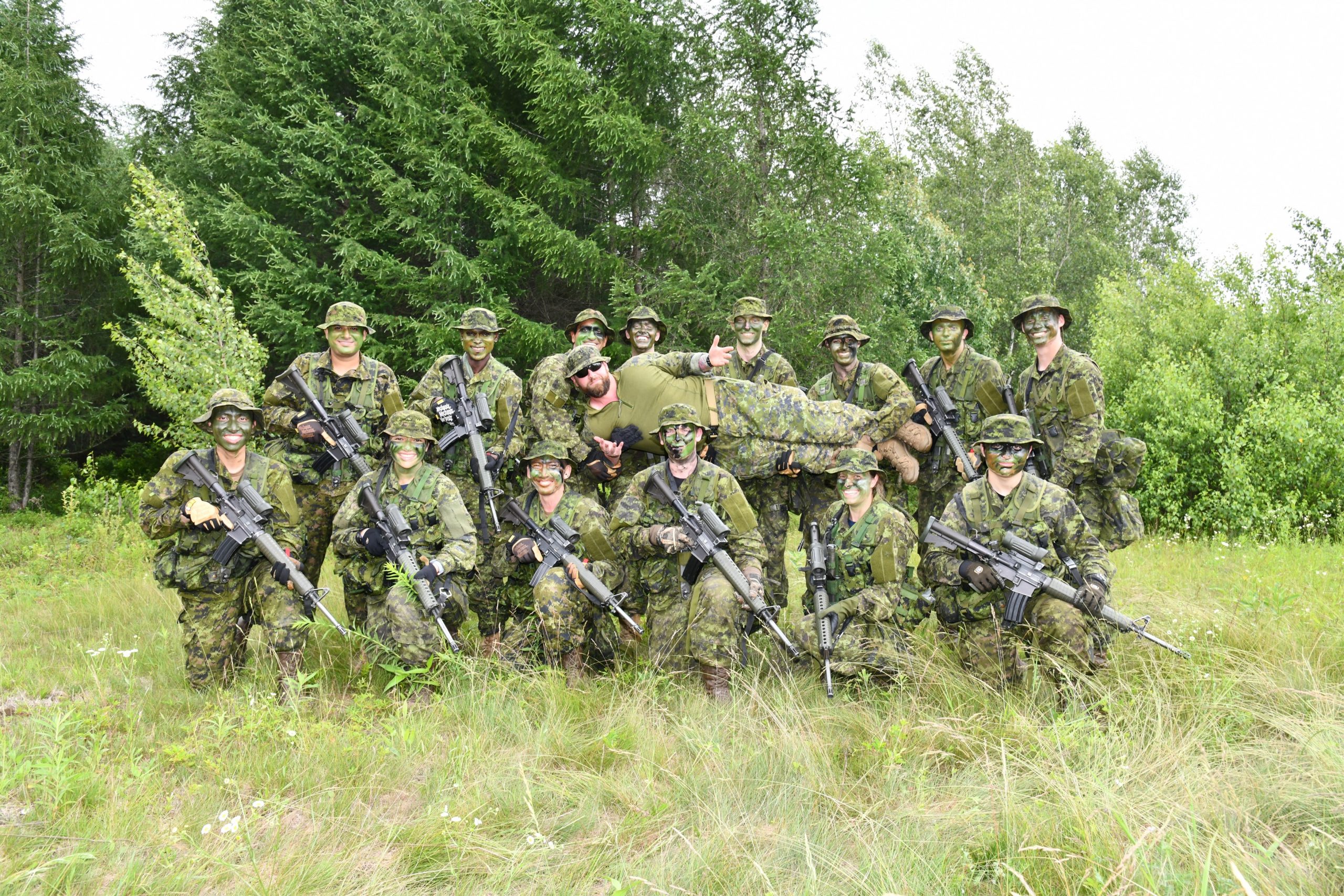
My section during basic with our Sgt. in our lap, credit – author.
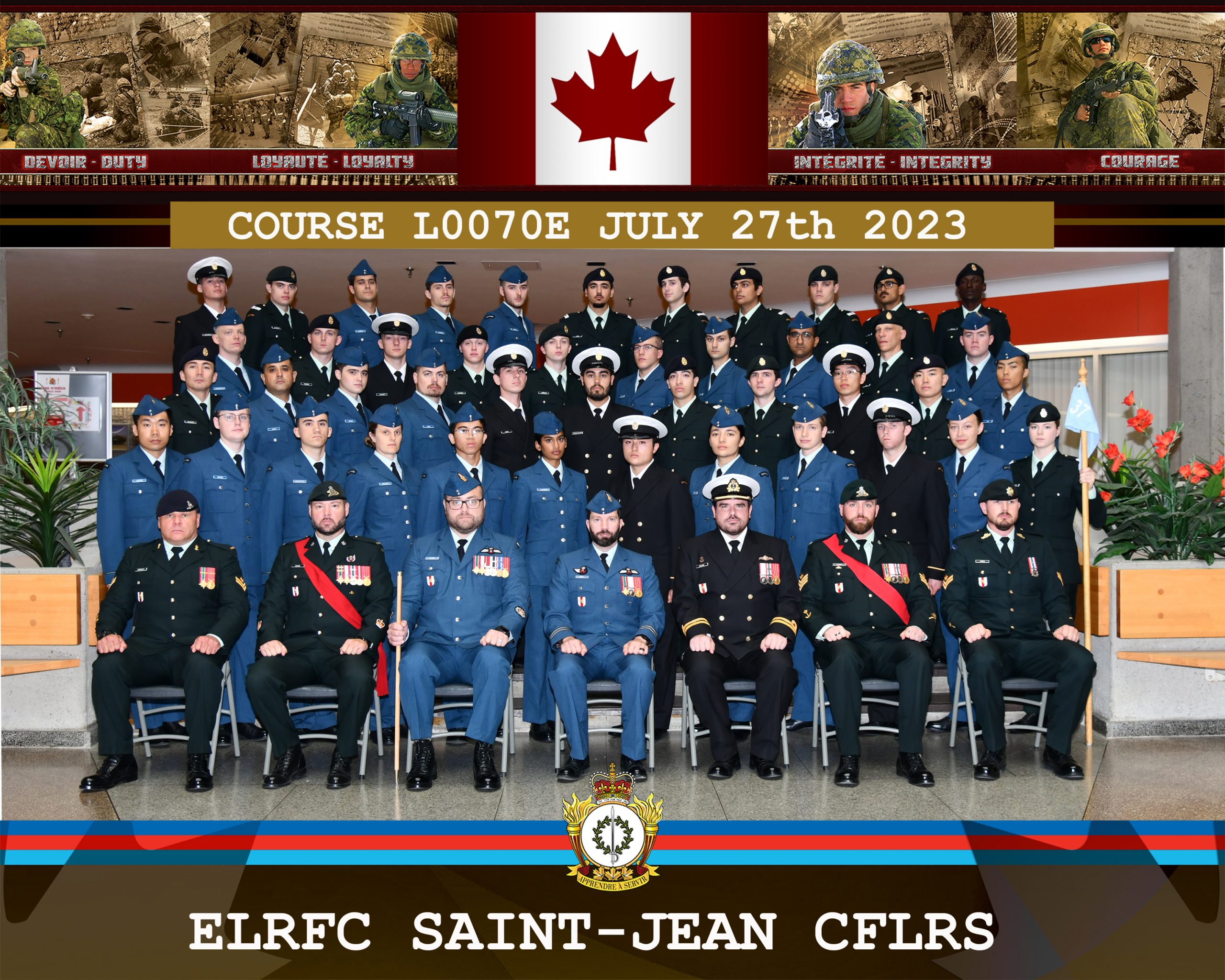
My platoon, Charlie 37, after graduation in our DEU’s (Distinctive Environmental Uniforms), credit – author.
Of course, all this sounds swell, but implementing this would come with its own challenges indeed. For instance, recent European mandatory service models are increasingly relying on volunteerism, as fostering a culture of service in a population without recent military traditions or mandatory service models require time and debate (ECC). Even where mandatory service is viable, governments and the military must invest heavily in restructuring personnel systems. Expanding personnel in any department demands significant resources for recruitment, housing, equipment, and training, with ongoing costs to sustain a capable reserve force. Absorbing such a massive pool of high school graduates would require some serious framework design. Questions pertaining to the initiation of certain legislative acts, increasing budgets to absorb the costs associated with such training models and their implementation needs to be figured out.
Clearly though, there is a demand for these services. In a very recent article featured in the Globe and Mail, Canada’s Chief of Defense Staff, General Jennie Carignan announced that she intends to present the Carney government with options by spring of 2026 for a national mobilization strategy. The plan would recruit up to 400,000 volunteers into a reserve force to support responses to natural disasters or military emergencies. She emphasized that the reserve could be scaled according to circumstances, highlighting the increasing demands on the CAF to address climate-related crises such as widespread forest fires (Chase). “Whereas before, we may have deployed once every five years, like this year only, it’s seven times in six different provinces that we’ve had to respond to various events,” she said. She emphasized the importance of communities across Canada being ready to respond, with clear roles and responsibilities in place. According to her, when the military arrives in a community that already has a plan and established networks, challenges can be managed far more effectively. In contrast, communities without preparation or coordination struggle, as residents are uncertain about where to turn or how to act (Chase).
In my relatively recent experience of serving in the CAF, I have realized that training is an ongoing endeavor. We are always training, and it makes sense to do so. The confidence built through preparedness is what propels success in the face of a given adversity. A proactive, rather than a reactive approach. Our rights come with responsibilities, and these responsibilities are paramount in the protection of those very rights, and the lives of our fellow Canadians.
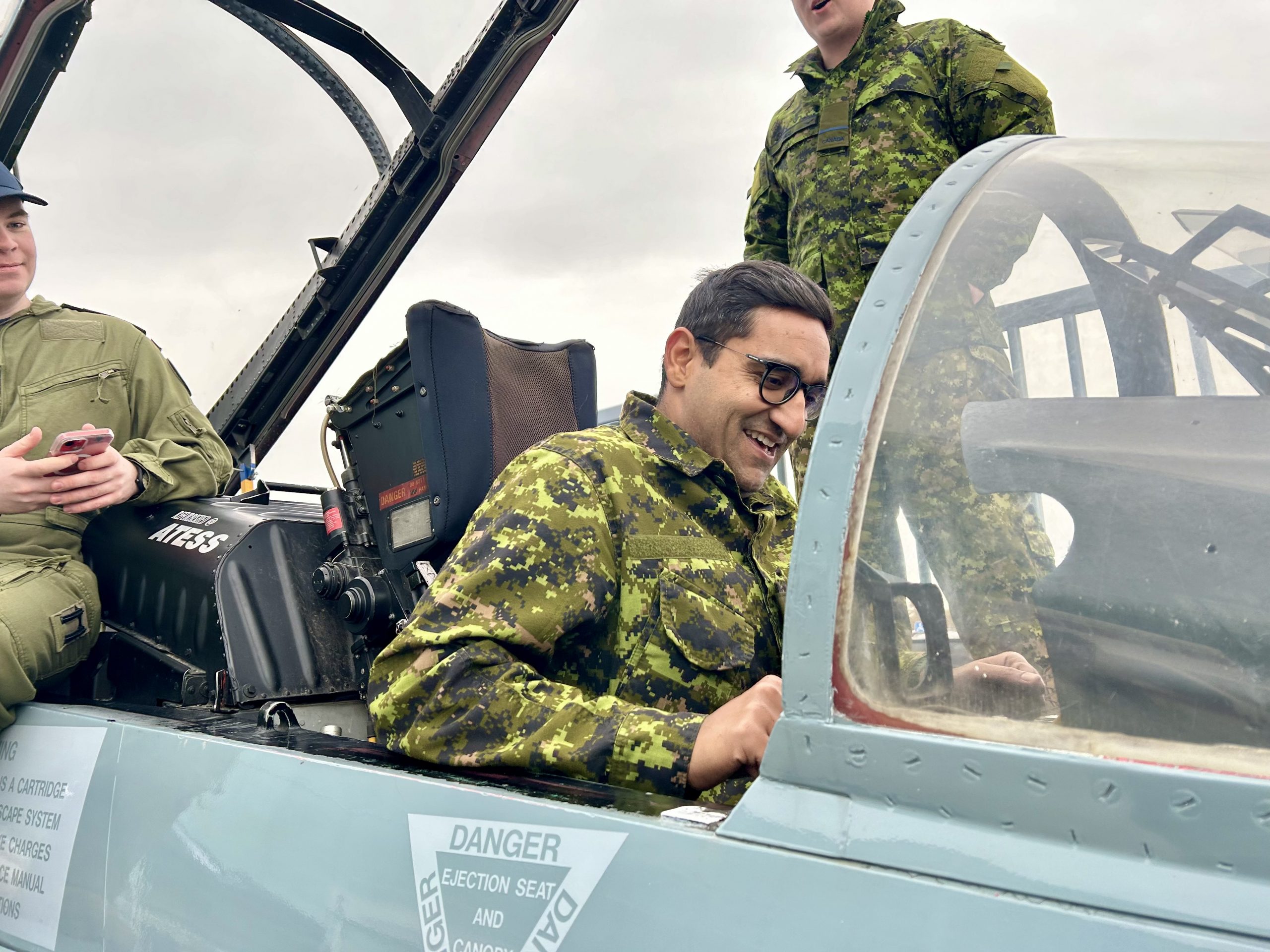
The author appreciating the cockpit of a CF-18 Hornet.
Works Cited
Lee, J. “The Canadian Armed Forces and Domestic Disaster Relief in the Context of Climate Change.” The Kingston Consortium on International Security (KCIS), www.thekcis.org/publications/insights/insight-4-1. Accessed 17 Nov. 2025.
Taylor, Scott. “The Canadian Armed Forces Is a Shrinking Tribe.” The Hill Times, 26 Sept. 2025, www.hilltimes.com/story/2025/09/29/the-canadian-armed-forces-is-a-shrinking-tribe/475117/.
Jhanjee, Kunal. “Behaviourism in Education.” Psychological Roots, pressbooks.bccampus.ca/psychologicalroots/chapter/behaviourism-in-education/. Accessed 17 Nov. 2025.
Plante, Caroline, and Morgan Lowrie. “Half of Quebecers Don’t Have First Responder Services in Their Communities, Report Says | CBC News.” CBCnews, CBC/Radio Canada, 22 May 2025, www.cbc.ca/news/canada/montreal/quebec-first-responder-services-auditor-general-report-may-2025-1.7541092.
Canada, Public Safety. “Advancing a Pan-Canadian Civilian Response Capacity.” Public Safety Canada, 7 Mar. 2025, www.publicsafety.gc.ca/cnt/rsrcs/pblctns/2025-cvln-rspns/index-en.aspx#s5.
Government of Canada, Office of the Auditor General of Canada. “Report 8-Emergency Management in First Nations Communities-Indigenous Services Canada.” Government of Canada, Office of the Auditor General of Canada., www.oag-bvg.gc.ca/internet/English/att__e_44162.html. Accessed 17 Nov. 2025.
(ECC) Europe’s Conscription Challenge: Lessons from Nordic and Baltic States | Carnegie Endowment for International Peace, carnegieendowment.org/research/2024/07/europes-conscription-challenge-lessons-from-nordic-and-baltic-states?lang=en. Accessed 18 Nov. 2025.
Chase, Steven. “Top General Plans Sweeping Expansion of Reserves for Disasters, Military Attacks.” The Globe and Mail, The Globe and Mail, 18 Nov. 2025, www.theglobeandmail.com/politics/article-top-general-jennie-carignan-expansion-reserves-disasters-military/.
Government of Canada, Statistics Canada. “Labour Force Survey, July 2025.” The Daily – , 8 Aug. 2025, www150.statcan.gc.ca/n1/daily-quotidien/250808/dq250808a-eng.htm.
Forster, Sam. “Canadian Forces Face ‘mission Creep’ as Domestic Deployments Surge.” Canadian Affairs, 10 Nov. 2025, www.canadianaffairs.news/2025/08/20/domestic-operations-strain-canadian-forces/.
Great insight into what should part of curriculum to achieve the goal for the future of Canafa.
It has been an eye opener and should be reinforced in Canada for better and equipped for better resource managent of manpower resources.
Great article and Govt looks into the amendments and auotour should be honoured for the thought.
Great insight into what should part of curriculum to achieve the goal for the future of Canada
It has been an eye opener and should be reinforced in Canada for better and equipped for better manpower resources.managent of manpower resources.
Great article and Govt should looks into the amendments and authour should be honoured for the thought.