


Holly Elliot
Holly Elliot (she/her) is a psychology major at Capilano University with a special interest in how culture impacts individual experience. During her studies, she has had the opportunity to showcase her knowledge by achieving Dean’s List and by collaborating with local organizations such as the North Shore Women’s Centre. After graduation she hopes to travel and gain even more knowledge that can be applied to a future career in human resources. With a position in human resources, she hopes to have the opportunity to foster wellbeing and positivity in workspaces in Vancouver.
Imagine – it’s twelve pm on a weekday in Italy, when workers leave their office to rest and indulge in home cooked meals, a concept that would leave Canadian workers with a “check-in” from their boss. Because I grew up in Vancouver, a city that is notorious for being so unaffordable that most people need to work overtime to be able to afford living here, I have always been shocked by the work-life balance that I see present in other cultures. A couple of years ago, I travelled to Italy for the first time and was fascinated by their emphasis on rest, along with their lengthy maternity leaves and vacation times that are available to all full-time workers. Initially, it made me frustrated to witness a culture that supports their workers in a way that Vancouver still hasn’t reached.
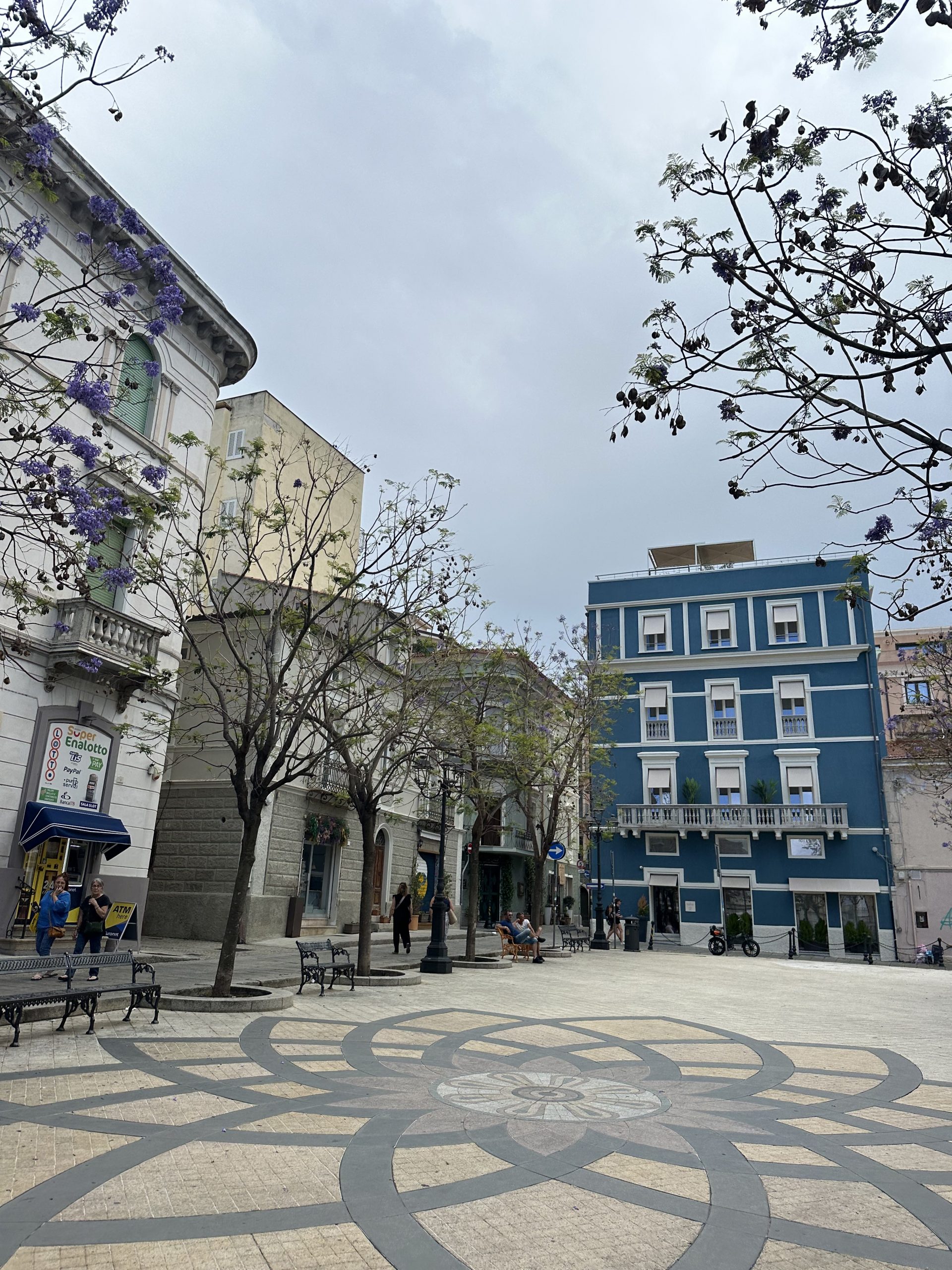
A popular tourist area in Sardegna, Italy during that became startingly quiet during lunch hours.
Ever since that trip, I have been thinking a lot about what could be the cause of the work culture being so different in Vancouver and how we can be inspired by Italian systems to pivot our values to ensure employee wellness.

When you search what life is like in Vancouver, articles with these titles show up. (Ali, 2025a; Ali ,2025b; Chai, 2026; Grace, 2025; Kulkarni, 2024)
I am tired of watching my friends slowly lose their passion in life because a job that they thought aligned with their wants started to deplete their needs as a human being. A lot of people say that they thrive as “workaholics,” but I really believe that that type of lifestyle should be a choice that someone makes, not something that is forced upon someone in order for them to keep their job. Due to this, working overtime has become an expectation among between coworkers and bosses in Vancouver’s work culture.

A table of people working on their laptops in a cafe on a Sunday afternoon in Vancouver.
It is time to make changes so that people can regain and explore their passions outside of work, knowing they are respected employees who deserve it.
My position on work-life balance is what has led me to want to pursue a career in Human Resources. I am hoping that I will be able to find a position in an office that values wellness and taking genuine care in their employees and that I am trusted to implement practices that will increase those ideals. Post-graduation, I really want to learn more about how a work-life balance can be prioritized more in Vancouver and how it can be implemented through specific practices in office spaces. I am hoping that through my research on both work cultures, I will have the knowledge in my HR position to cultivate a workspace that promotes wellness for employees of all life-goals. If North American businesses encourage schedule flexibility and wellness-based practices in their offices, then all aspects of the work culture will improve.
The Main Discrepancies Between Italy and Canada.
According to the Government of Canada, they describe work-life balance as “devoting a sustainable amount of time and energy to work, as well as to other personal commitments”, with the goal of minimizing burnout and increasing creativity among employees (2025a, para.1). What I find interesting about their wording is that it is still very business-centered, rather than highlighting the importance of balance for the individual and their happiness outside of work. It highlights the issue that in the Canadian context, a successful life is determined by monetary achievements, rather than by overall happiness and positive experiences.
The first difference that I noticed in Italy were their scheduled lunch breaks, where everything, including shops, shut down for an hour or two. Regardless of the inconvenience that a visitor like myself may experience, it is such a common practice to them. My experience with lunch breaks is that workers hardly take them away from their office, and that most people that I know in Vancouver eat their lunches at their desks, while they are still working. I spoke to someone who has been working in a corporate position and asked about why they don’t take lunch breaks away from their desk and they confirmed this unfortunate reality: “I eat at my desk and work through lunch because I have too much to do. Please don’t speak to me, every second you speak my anxiety about not working grows” (personal communication, April 2nd, 2026). So, they never actually feel like they can get a break from their work, or from screens. In a conversation that I had with Ms. Milla Zaenker, the Vice Chair of the School of Business at Capilano University, Milla described how “It’s a myth that humans are productive for eight or nine hours, even after an hour or two in front of the screen. It comes to the point that everything is a blur” (personal communication, February 27, 2026). Milla also discussed how humans need that time to step away from their work to provoke new ideas that would otherwise be overshadowed by the unrealistic expectation to constantly be working without a break (M.Zaenker, personal communication, February 27, 2026). Technology is so involved in every part of our lives, so we need to make sure that we understand how humans are affected by it and how we can minimize its negative impact on us. Minimizing the amount of time that you are continually in front of a screen can be one of many changes that an individual can make to have a healthier environment at work.
However, these differences go much further. There is no emphasis in Vancouver on prioritizing vacation time or how vital it is for parents to be able to have adequate space to support a new child with a leave from work. In Italy, workers are entitled to at least four weeks paid vacation time, not including holidays (EURES, 2025). Additionally, mothers get a five- month maternity leave that includes being paid 80% of their salary for the duration of the leave (EURES, 2025). In British Columbia, only two weeks paid vacation is mandatory for employees, and employers actually have the right to cancel vacation time if they think that they don’t have a sufficient number of staff to sustain the time-off (Ministry of Labour, 2024). In comparison to Italy, maternity leave in Canada is only financially covered up to fifteen weeks long, with a maximum coverage of $729 per week (Government of Canada, 2025b). All of this is to say that there are big discrepancies when it comes to prioritizing the well-being of staff through government-mandated time-off. The effects of reduced time-off can be detrimental to employees and can cause work and personal life to blur in a very toxic way. In an article by Maclean’s, they discuss the gendered aspects of work culture and how being in a workplace that doesn’t respect time boundaries with childcare can generate increased anxiety (2017). They continue by stating that “constant anxiety compromises the immune and cardiovascular systems, making people more likely to catch colds and flus, and to suffer from conditions like high blood pressure” (Maclean’s, 2017, para.2). There are real-life consequences to the high levels of anxiety and stress caused by an unhealthy relationship with work.
The economic status and overall cost of living differences between Vancouver and Italy are also important to point out.
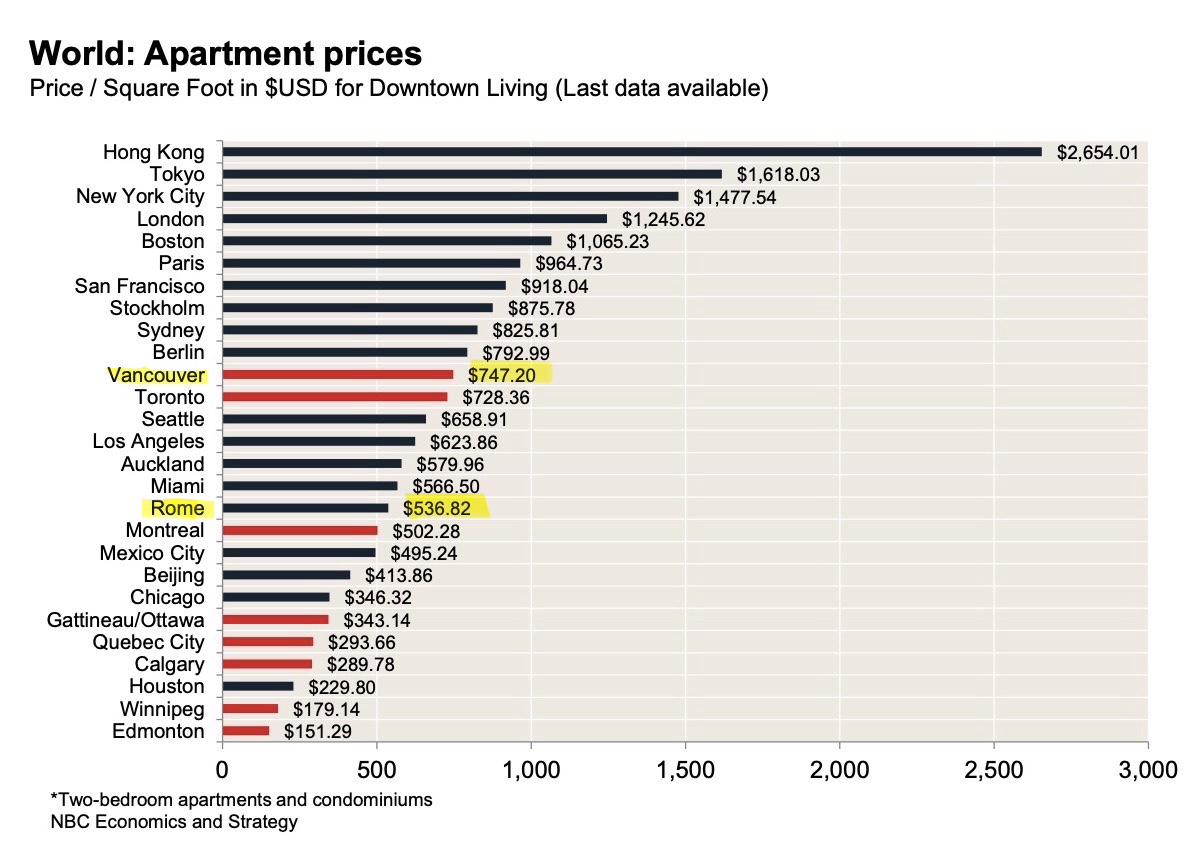
This is a comparison of the housing prices in different downtown areas; you can see that houses in Vancouver cost almost 40% more for the same sized space in Rome. (Dahms & Ducharme, 2026)
Pree, a biologist who moved from the United States to Rome in 2020 reflected that “Even though salaries are much lower across professions, the cost of living is affordable, and much better if you live outside of the city” (Cinzia, 2021). Which is important to not because it is likely that a lower salary could contribute to the “relaxed” work environment that is present in Italy, because the stakes are less high than a place like Vancouver, which is a lot more expensive. Since the cost of living is high, there is a lot of financial stress for Vancouverites. In a CBC article, they describe how grocery expenses are one of the biggest stressors that are financially impacting people in Vancouver: “… the average family of four will spend $17,571 on food this year, up to $994 more than in 2025. Food prices are now 27 per cent higher than they were five years ago” (CBC, 2026). Since cost of living is higher here, employees can feel pressured to perform in toxic levels to maintain their positions and get raises to help support themselves financially.
Why Are There Differences Between Our Work Cultures?
An article by Bouchard & Ferme argues that the reason for Italy to be so employee-focused rather than employer-focused is because the industrial revolution combined with their communist political leaders caused a “heightened consciousness of the worker’s status, self-fulfillment, and agency” (2014, para.5). Communism is centered around the idea of collective work being a better system than an individualistic one that prioritizes profits, like capitalist ideologies that shaped systems in Canada (Luke, 2014). I have seen how detrimental a quantity over quality mindset, spearheaded by capitalism, can be to an individual. Canada’s economy has also made a huge impact on the welfare of Canadian workers. In an article by Luke, he describes how the 2008 recession created so much job insecurity that workers felt like they had to show their employers how dedicated they were to their work, which created a new unrealistic expectation from bosses for employee performance (2014). Since workers were so concerned about losing their jobs, they overcompensated by working harder than they ever should. In comparison, while Europe also experienced the 2008 recession, the effects were different (a decade on, 2019). When the recession first hit, European countries focused on fixing their situation with banks, rather than mass-unemployment (a decade on, 2019). So, although the recession was detrimental to them as well, employees were not faced with the same level of job insecurity that Canada or other countries experienced.
A similar pattern happened in the way that covid-19 has also been a factor that has created an unhealthy work culture all over the world (Takami, 2023). During the pandemic, everyone was forced to work from home, which universally increased both work and life conflicts for workers (Nordenmarck & Vinberg, 2023). From my experience in Vancouver, I have witnessed two different outcomes with workplaces and how they’ve changed post-covid. The first thing that I noticed was that there was an increase in remote jobs available, because it is a lot cheaper for businesses to not have to supply employees with an office space. Although it’s appealing when you are a student looking for a job to do while studying, it can be hard to trust that the businesses who have turned to remote have your best interest in mind. For many offices, they recognized the detrimental effects to their productivity, so they asked employees to at least do half of their week in-office, if not the whole week. An interesting result of this work shift is that it gave employees all over the world the opportunity to assess what works for them, and what they want to prioritize in their work life (Partridge, 2025).
In Italy, they were able to recognize their appreciation and return to the system that they had before Covid, which was the method of work that helped most people flourish in their personal lives (Partridge, 2025). In Canada and other places that had struggled with a workplace culture that didn’t prioritize work-life balance, it became a top career goal for many workers who realized how important it was for them (Partridge, 2025). Given that people spend so much of their lives working, I think that the pandemic gave a lot of people clarity on how valuable their time is. It is clear that work-life balance should be a big consideration for businesses trying to create an office environment that works for their employees and their needs.
Is Italy’s Work Culture *Actually* Better?
Beautiful beaches, amazing food, rich culture, and long vacations make it easy as an outsider to find it hard to understand why anyone would be unhappy living in Italy. American director Michael Moore interviewed Italian workers and businesses to discuss their perspective on their worker benefits (2019). His interview shows that everyone, including the people who run the office, are pleased with the way that vacation time is prioritized in Italy (Moore, 2019). They say that not only does it benefit the employees who get to reset their minds on vacation, but that it in turn creates more passionate and happy employees which increases their quality of work produced (Moore, 2019). There is quite a bit of evidence that supports their testimony that a happy employee is mutually beneficial for a business.
In an article about work-life balance by Wilson et al., the authors explain that a business that prioritizes the mental health of their employees fosters an environment where employees are more dedicated to their work (2025). They continue this idea by stating that “committed employees contribute significantly to an organization’s success by demonstrating heightened awareness of product quality, high productivity, proactive problem-solving, and a willingness to exceed expectations” (Wilson et al., 2025, Employee Commitment section, para.2). However, I spoke to someone who has lived in Italy and has observed some downfalls to their work systems. They explained to me that the flexibility can also create negative work experiences due to a lack of structure (personal communication, March 10, 2026). They told me that “there are a lot of issues with sexism in the workplace” because they don’t have the human resources regulations and structures that we have in Vancouver businesses (Anonymous, personal communication, March 10, 2026). They described instances where judgements or inappropriate remarks were made in the office and there were no strict contracts and procedures in place to support the employee in these kinds of situations. Of course this is not representative of all Italian workplaces, but it did give me a helpful perspective on how “relaxed” office practices can only be beneficial in certain aspects of an office system. It also makes me curious if other forms of discrimination could be happening without employee support.
So, although there is so much to admire about Italian work culture, it is important to acknowledge that there are some aspects of their system that could benefit from being structured more like what we have in Vancouver. Their perspective is interesting because although sexism is still an issue in Canada, we have a lot of strict conduct rules in place to maintain respect and boundaries between coworkers (Workplace rights, n.d.). Sexism in the workplace is not tolerated and as someone who will be entering an office job soon, I am thankful that there are employee protections in place in Vancouver. In the possibility that I get put in an uncomfortable position at work, I am comforted by the knowledge that at least the BC government has processes that should help protect my rights as an employee.
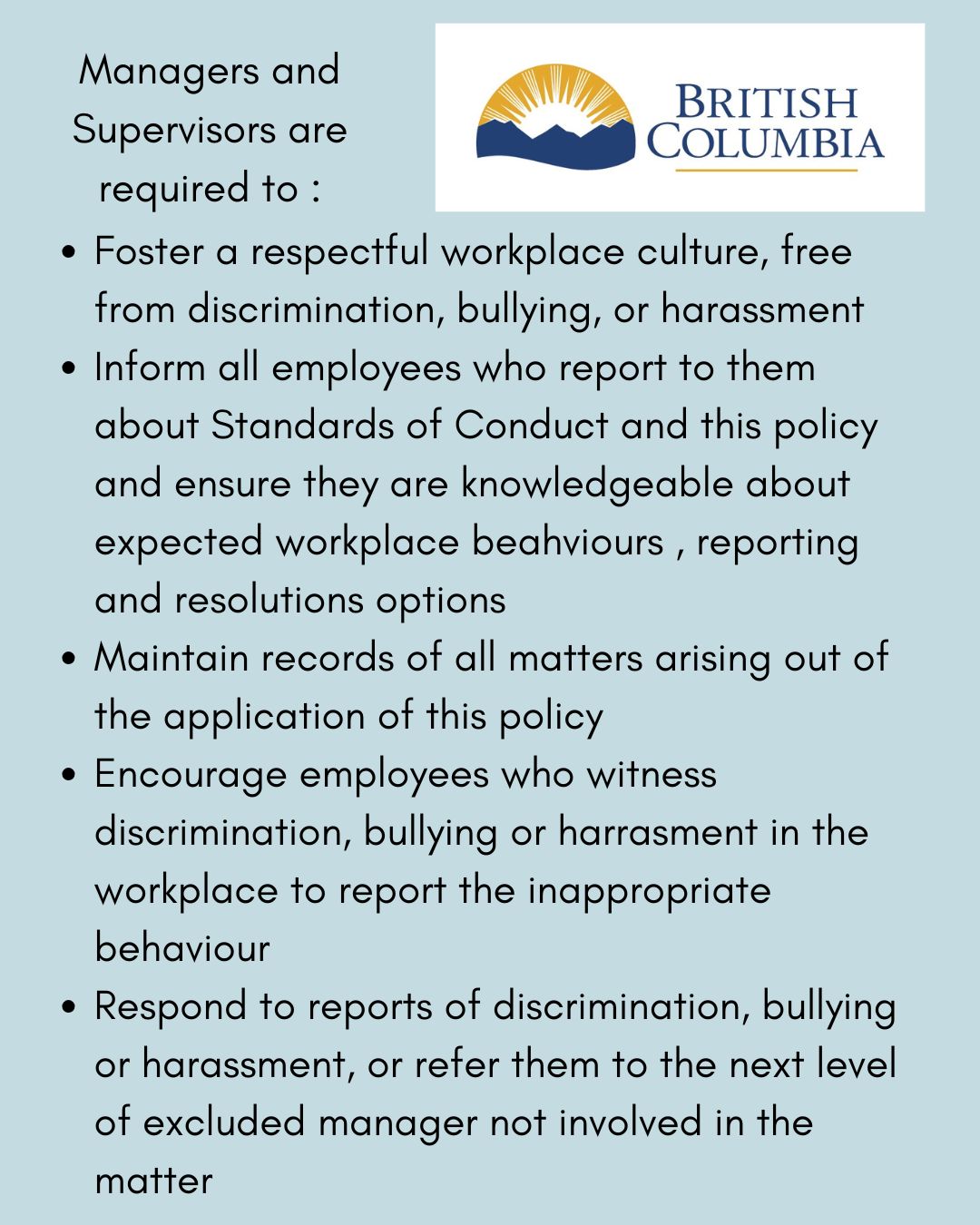
The expectations of supervisors and managers, according to the Government of BC’s HR policy 1 – Discrimination, harassment, and bullying in the workplace (2024).
Having these kinds of support is crucial for a productive workplace that prioritizes wellbeing.
What Vancouver Needs to Change
In an ideal world, having at least four weeks of paid vacation, flexible lunch breaks, and extended maternity leave for workers in Vancouver would be amazing. However, I understand that that is not a realistic expectation for something that can be easily implemented in office spaces here. Change will take time but moving to Italy is not the solution. I can confidently say that the hardworking people and beautiful nature we have are more than worth staying for.

Some of my favourite things to do to decompress is to snowboard on Cypress Mountain, which is just a short 30 min drive away from Downtown Vancouver.
In a conversation I had with someone working in Downtown Vancouver who had recently moved here, they said, “I appreciate all of the opportunities for access to nature here, it really helps me de-stress from life when my work feels overwhelming” (personal communication, April 2nd, 2026). Their statement shows how impactful the resources that Vancouver gives us access to can be to our mental health and maintaining a balanced work life.
There are also things that we should be grateful for when it comes to workspaces here, such as detailed employee rights against gender-based discrimination. However, there are specific practices that can be put in place to increase employee wellness in Vancouver. In an article about increasing work-life satisfaction, Valcour discusses how adding extra resources to an office can positively impact wellness-based results (2007). Valcour says that “Having greater resources to draw on for managing work and family roles increases people’s ability to meet multiple roles demands and thereby increases perceptions of work-family balance” (2007, Job Complexity section, para.1). Examples of resources that can foster these increases include on-site counseling services, flexible hours, and managerial support (Valcour, 2007). Managerial support is the most crucial of the resources because I see this as a top-down issue. If we start the changes from the positions with the most control in an office, we can help increase positive impacts. Managers are in the position where they can implement work schedules that work best for their employees and can monitor workload to make sure that everyone is given an appropriate amount of work per week. They can also be the ones to foster a community during team lunches, so that people actually take breaks away from their computers and talk with each other. These efforts made by people in managerial roles, along with HR support can help Vancouver get closer to a positive work-life balance among workers.
One day I hope to see bigger changes in Vancouver in terms of an increased length in mandatory vacation and maternity/family leave but until then I think that implementing these smaller changes can make a big impact on the wellbeing of employees. In my future position in HR, I hope to implement as many wellness-based practices as I can so that everyone can have the ability to appreciate everything that life in Vancouver has to offer. It is important that research on employee wellness continues and that offices use this research to create a better working environment for their employees. Without workers, no one has a business, and without happy workers, no one has a successful one.
References
A decade on from the crisis: Main responses and remaining challenges | think Tank | European Parliament. Think Tank. (2019, October 17). https://www.europarl.europa.eu/thinktank/en/document/EPRS_BRI(2019)642253
Ali, A. (2025a, June 25). Vancouver woman moves back to Calgary after the “worst decision” of her life: Daily hive: Urbanized. Daily Hive | Urbanized. https://dailyhive.com/vancouver/vancouver-woman-calgary-condo-decision
Ali, A. (2025b, September 19). Unlikely Metro Vancouver city named among worst in Canada for a “comfortable” life: Daily hive: News. Unlikely Metro Vancouver city named among worst in Canada for a “comfortable” life | Daily Hive | News. https://dailyhive.com/vancouver/metro-vancouver-city-uncomfortable-life
Bouchard, N., & Ferme, V. (2014). Italian Cultures of Work (To William van Watson, unsung laborer of our profession). Annali d’Italianistica, 32, 17–30.
CBC/Radio Canada. (2026, January 1). What will cost more and what won’t for British Columbians in 2026 | CBC News. CBCnews. https://www.cbc.ca/news/canada/british-columbia/what-will-cost-more-and-what-wont-in-2026-9.7024334
Chai, D. (2026, January 13). Vancouver’s quality of life continues plummet down ranking of world cities: Daily hive: Urbanized. Daily Hive | Urbanized. https://dailyhive.com/vancouver/vancouver-quality-of-life-index-ranking
Cinzia. (2021, October 7). Life and work in Italy as an expat: An interview. Instantly Italy. https://instantlyitaly.com/life-and-work-in-italy-as-an-expat-interview/
Dahms, K., & Ducharme, A. (2026). Two-Year Streak: Housing Affordability Improves Through 2025Q4. In National Bank of Canada. https://www.nbc.ca/content/dam/bnc/taux-analyses/analyse-eco/logement/housing-affordability.pdf
EURES. (2025, June 17). Living and working conditions: Italy. EURopean Employment Services. https://eures.europa.eu/living-and-working/living-and-working-conditions-europe/living-and-working-conditions-italy_en
Government of British Columbia. (2024, August 29). 1 human resources policy 11 – discrimination, bullying and harassment. Gov BC. https://www2.gov.bc.ca/assets/gov/careers/managers-supervisors/managing-employee-labour-relations/hr-policy-pdf-documents/hr_policy_11_discrimination_bullying_and_harassment_in_the_workplace.pdf
Government of Canada. (2025a, October 3). Conduct and Culture Data Centre. Canada.ca. https://www.canada.ca/en/department-national-defence/services/conduct-and-culture/conduct-and-culture-data-centre/conduct-and-culture-data-centre-accessible-version/work-life-balance.html
Government of Canada. (2025b, December 31). Employment and Social Development. Canada.ca. https://www.canada.ca/en/services/benefits/ei/ei-maternity-parental.html
Grace, M. (2025, September 13). 7 things I secretly miss about Toronto life after moving back to Vancouver. Narcity. https://www.narcity.com/vancouver/things-i-miss-about-toronto-after-moving-back-to-vancouver
Kulkarni, A. (2024, February 21). Metro Vancouver residents report Lower Life Satisfaction, sense of belonging than rest of B.C. | CBC News. CBCnews. https://www.cbc.ca/news/canada/british-columbia/metro-vancouver-mental-health-bc-1.7120747#:~:text=Statistics%20Canada%20says%20those%20living,%22belonging%20to%20their%20community.%22
Luke, P. (2014, January 11). Longer hours, more stress: The new reality in the Canadian workplace | the province. The Province. https://theprovince.com/business/longer-hours-more-stress-the-new-reality-in-the-canadian-workplace
Maclean’s. (2017, July 5). Why do so many women feel overwhelmed, stressed out and tired? . Maclean’s Canada. https://macleans.ca/society/why-do-so-many-women-feel-overwhelmed-stressed-out-and-tired/
Ministry of Labour. (2024, January 31). Annual vacation. Province of British Columbia. https://www2.gov.bc.ca/gov/content/employment-business/employment-standards-advice/employment-standards/time-off/vacation
Moore, M. (2019). Where to Invade Next (Italy)- Work Hours & Vacation Days. YouTube. https://www.youtube.com/watch?v=Ux0l2GtBkdw
Nordenmark, M., & Vinberg, S. (2024). Working from home, work/life conflict and mental wellbeing in Europe during the COVID-19 pandemic. Work, 78(2), 295–304. https://doi-org.ezproxy.capilanou.ca/10.3233/WOR-230271
Partridge, J. (2025, January 21). Work-life balance more important than pay for employees worldwide. The Guardian. https://www.theguardian.com/business/2025/jan/21/work-life-balance-pay-workers-covid-pandemic
Takami T. (2023). Remote work and well-being in the post-COVID-19 era. Industrial health, 61(3), 171–172. https://doi.org/10.2486/indhealth.61_300
Valcour, M. (2007). Work-based resources as moderators of the relationship between work hours and satisfaction with work-family balance. Journal of Applied Psychology, 92(6), 1512– 1523. https://doi-org.ezproxy.capilanou.ca/10.1037/0021-9010.92.6.1512
Wilson, J., Arulandu, S., & Sammanasu, J. M. (2025). Dynamic Information Technology Workforce: Examining the Influence of Resilience, Well-being, Work Culture, Work-life Balance, and Self-efficacy on Workplace Commitment. International Review of Management & Marketing (IRMM), 15(4), 361–370. https://doi-org.ezproxy.capilanou.ca/10.32479/irmm.18385
Workplace rights. WorkBC. (n.d.). https://www.workbc.ca/access-employer-resources/manage-employees/workplace-rights