
Samin Salahi
Samin Salahi (she/her) is in her final year of the Bachelor of Arts in Psychology program at Capilano University. She was born in Iran and immigrated to Canada at the age of twelve. She has long held a passion for sports such as soccer and volleyball, both of which she grew up playing and continues to play. Her experience volunteering at her high school library sparked a deep interest in books, particularly psychological literature. Her favourite books are No Longer Human by Dazai Osamu, Unflattening by Nick Sousanis, and Crime and Punishment by Fyodor Dostoevsky. Samin plans to pursue a master’s degree in counselling psychology and aspires to become a youth counsellor in the future.
INTRODUCTION
September 16, 2022, Mahsa Amini, an innocent civilian in Iran, was detained by the Islamic regime’s morality police for allegedly having some of her hair peek out of her headscarf. According to eyewitnesses, she was beaten, forced into a van, and later died while in state custody (Amnesty International, 2023). Laws that are designed to police women’s bodies have gone too far. In Afghanistan, dress code restrictions that had previously existed under the Taliban were reinstated after the group regained power in 2021, once again requiring women to wear a burka (a loose black cloth) that covers their entire body from head to toe when stepping outside their homes (Mohamed, 2022). These restrictive, misogynistic laws harm women and reinforce systems that limit their autonomy. This article will delve into the history of hijab’s origin, Iran and Afghanistan’s hijab laws, stories of Iranian people who have fought for women’s freedom, and what potential solutions can look like for the future of women in both countries.
Growing up in Iran, as a kid I was somewhat of a tomboy. I played soccer with my brother and his friends every day. I didn’t hang out with my female friends as much as I hung out with my brother’s friends. I always strived to be as good as my brother in soccer, and I wasn’t letting anything get in the way of my goal. Once I hit puberty and got taller and curvier, I was expected to start wearing a hijab, which consisted of a headscarf and a long-sleeve loose shirt that had to go down to my knees. You can imagine how hard it would be to play soccer while wearing such loose clothing, so I used my short height to my advantage and didn’t wear a hijab. However, at that age (12 yrs.), my grandmother started nagging me to stop playing soccer with men and to stay inside or tend to flowers instead. I could always feel people glaring at me in the park for being the only girl among all the men playing soccer. I knew what they were thinking. They hated me for not abiding by the hijab rules and engaging in “sinful, un-Islamic” acts. I paid them no mind. I pretended I didn’t hear them whispering about me, but deep down I knew soon enough I would also have to abide by the rules, or I would get in trouble with the Iran’s morality police. At those times, I wished so badly that I had been born a boy. I wished I wasn’t different from my brother and the friends I played soccer with at the park. I wished they didn’t treat me so differently the moment I hit puberty. For so many women, misogyny begins the moment we are born. Misogyny starts when a parent is disappointed upon learning the news that the gender of their newborn is a girl. Misogyny starts when little girls are told to only play with “girly” things or cooking toys. Misogyny starts when girls are discriminated against just for wanting to play the same sports that boys play. For me, misogyny started the day I was born as a girl in Iran.
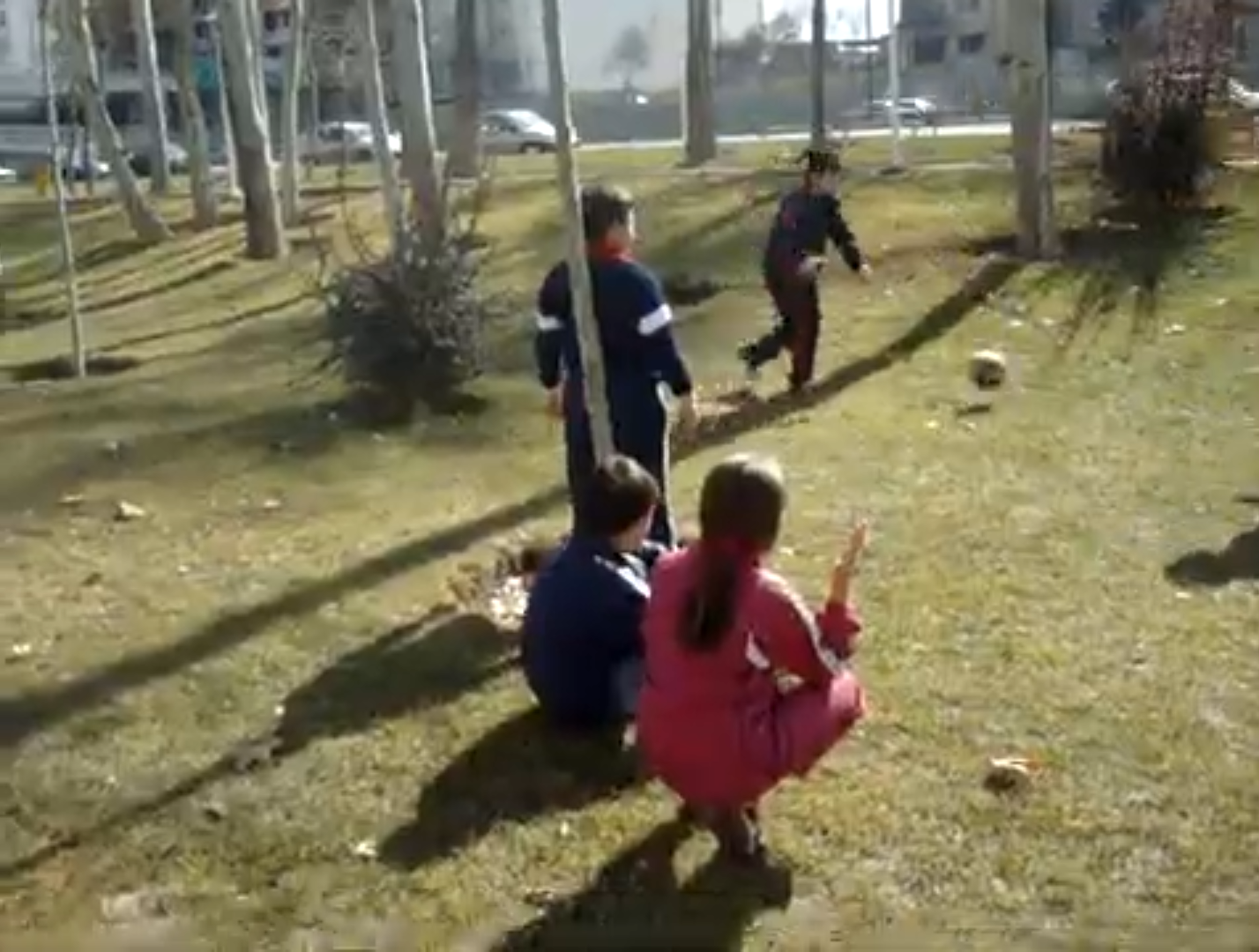
Me (in pink) at around eleven years old, playing soccer with my friends at the park. I was often told by elders to wear a hijab and to stop playing soccer with boys because it wasn’t considered ‘appropriate’ for a Muslim girl.
The word “Hijab” is an Arabic term meaning “cover,” but its meaning has varied over time. Since the 1970s, hijab has been used to describe a wide range of coverings, from a scarf worn with a long coat and pants to the state’s preferred form of covering, a chador, which is a full-body loose black cloth (Maranlou, 2022). When Iran was ruled by a king, Mohammadreza Pahlavi, he tried to push for modernizing women’s clothing and to “liberate” women from wearing hijab by banning all veils in 1936 (Abd Munaf, 2023). Near the end of the king’s ruling era, many religious female university students began wearing the hijab again as a form of resistance against the king’s alleged “Western” ideologies. During this period, political Islam is what inspired young women to put on the hijab, and wearing it became a symbol of Islamic activism, while removing it represented Westernization enforced by the king (Abd Munaf, 2023).
In 1979, when the king’s monarchy was overtaken by Ayatollah Ruhollah Khomeini and his supporters during the Islamic revolution, the compulsory hijab law was enforced shortly after (Askew, 2023). Under the Islamic Penal Code, not wearing a hijab or wearing it “improperly” is considered a criminal act and is punishable by law. Article 102 of the 1983 Code specifically designates the failure to observe hijab as a “Ta’zirat,” which is a discretionary crime (Human Rights Council, 2024). The exact law reads: “Women, who appear in public places and roads without wearing an Islamic hijab (hejab-e-shar’i), shall be sentenced to ten days to two months imprisonment or a fine of 50,000 to 500,000 Rials.” (84). Iran’s morality police drive around in vans and keep an eye on all women to make sure they’re abiding by the hijab rule. They are authorized to stop and detain people whom they believe are dressed ‘‘inappropriately’’ (Askew, 2023).
Women in Afghanistan are suffering from a similar misogynistic and restrictive dress code, but at an even more extreme level. Since May 2022, the Taliban have mandated that women wear burqas or black hijabs that covers their entire bodies from head to toe, including their faces (Fetrat, 2025). Prior to the Taliban’s 2021 re-takeover, Afghan women had substantial rights during earlier democratic and reformist periods. They gained the right to vote in the 1920s, women made up more than 15% of legislators by 1977, and by the early 1990s they accounted for half of government employees (Litty, 2025).
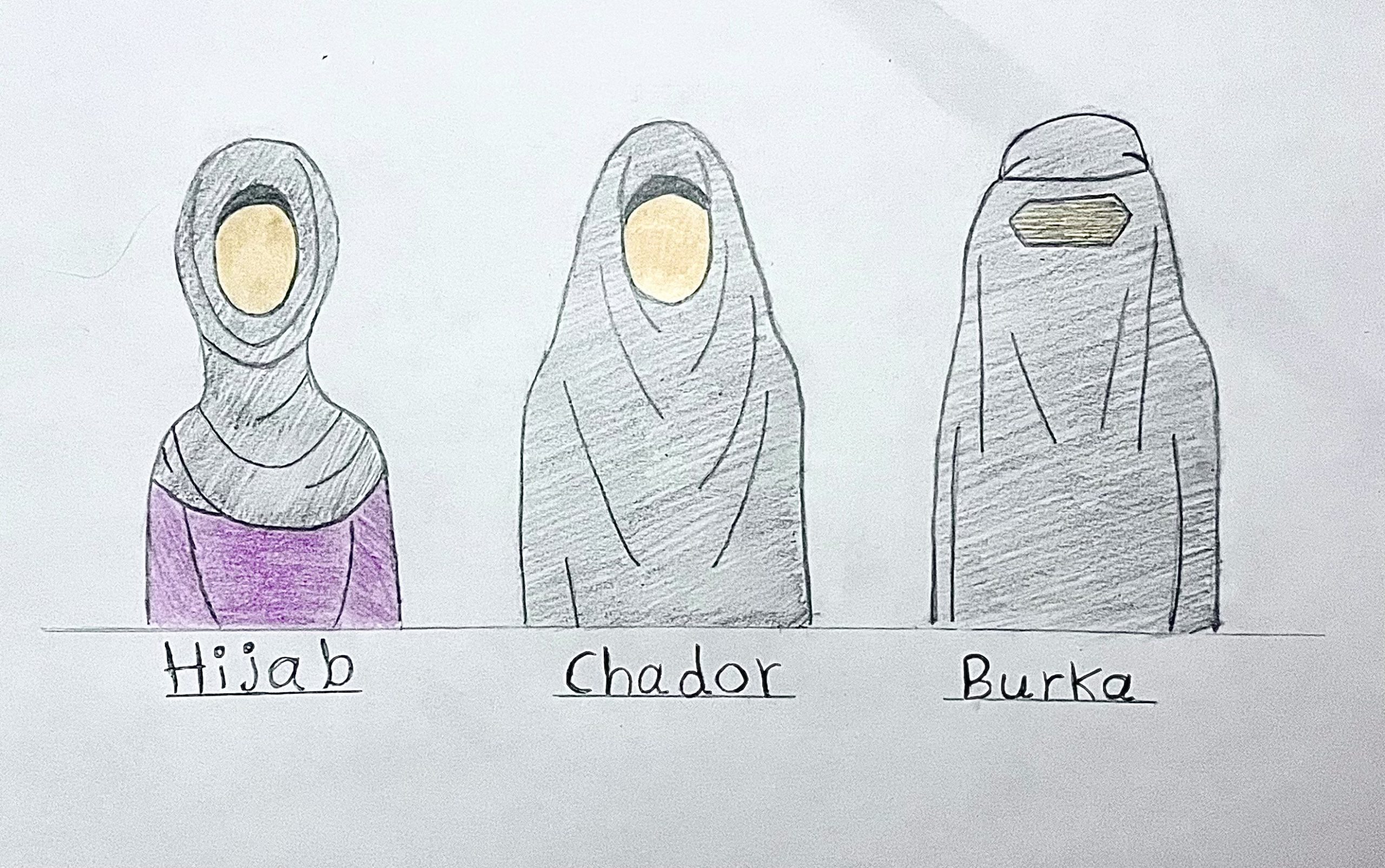
Drawing of different types of hijabs. In Afghanistan, women are forced to wear burkas that cover their whole face; they can only see through a sheer cloth in front of their eyes. Illustration by the author.
Today, under the Taliban, Many Afghan women have reported being whipped with electrical cables for wearing “Western style” pants, and girls as young as ten years old have been beaten for not covering their faces in school. The Taliban have gone as far as instructing principals in elementary schools to examine young girls’ bodies for any signs of puberty and to remove them from school if they are showing any signs of maturation (Litty, 2025).
The Taliban’s misogynistic laws extend far beyond forced hijab. They have banned women’s voices from being heard in public, denied women the right to education, and have also prohibited women without a male guardian from using transportation (Amnesty International, 2024). These rules that are created and enforced by men exist solely to control women in any way they can, to strip them of their autonomy, and to violate their basic human rights. This is an ongoing issue that keeps getting worse, and no one in power seems willing to step up and help the women in Afghanistan escape from the Taliban’s grasp.
WOMEN LIFE FREEDOM MOVEMENT
“The death of Miss Mahsa Amini was the breaking point of everyone’s patience,” said an Iranian civilian who took part in protesting for Mahsa Amini in 2022. Another interviewee stated, “In my opinion, the death of Mahsa Amini made people realize that something like this could happen to them or their loved ones, which caused individuals to worry about their future and their loved ones. Everyone protested because this personal feeling permeated their actions” (Rahimi & Rezaei, 2025). On September 16, 2022, Mahsa Amini was murdered at the hands of Iran’s morality police because she was not wearing her head scarf ‘properly’. The footage of Mahsa being physically assaulted and forcibly pulled into a van was spread online. Everyone in Iran and other Iranians around the world were concerned and were wondering what happened to her and if she was going to be okay. Unfortunately, the news of her death came out the next day and everyone in Iran knew exactly what happened even if the Iranian government tried to lie and deny being responsible for her death.
I still remember exactly where I was the day I heard the news of Mahsa Amini’s passing. I was on my way to my Psychology of Sustainability class, when I couldn’t hold it in anymore and I broke down crying. I felt so awful knowing my Iranian sisters are suffering in Iran, while I was free here. I was depressed for several months after Mahsa Amini’s death. It’s a feeling that is hard to fully explain unless you are an Iranian woman yourself. We all knew that she was severely beaten to death by the morality police, even if Iranian officials claimed that her death was linked to a childhood medical condition (Gambrell, 2024). Her death sparked widespread outrage within Iranian civilians and everyone began to protest in her name, starting a movement called WOMEN LIFE FREEDOM. The protests caught the attention of news media’s worldwide and women all around the world also started protesting for the freedom of Iranian women. There were protests that took place in Vancouver and I participated in one of them. We marched the streets of downtown with our Women Life Freedom signs in our hands, and chanted Mahsa Amini’s name. It felt incredibly powerful seeing all women from different backgrounds come together and unite as a voice for Iranian women during such painful times.
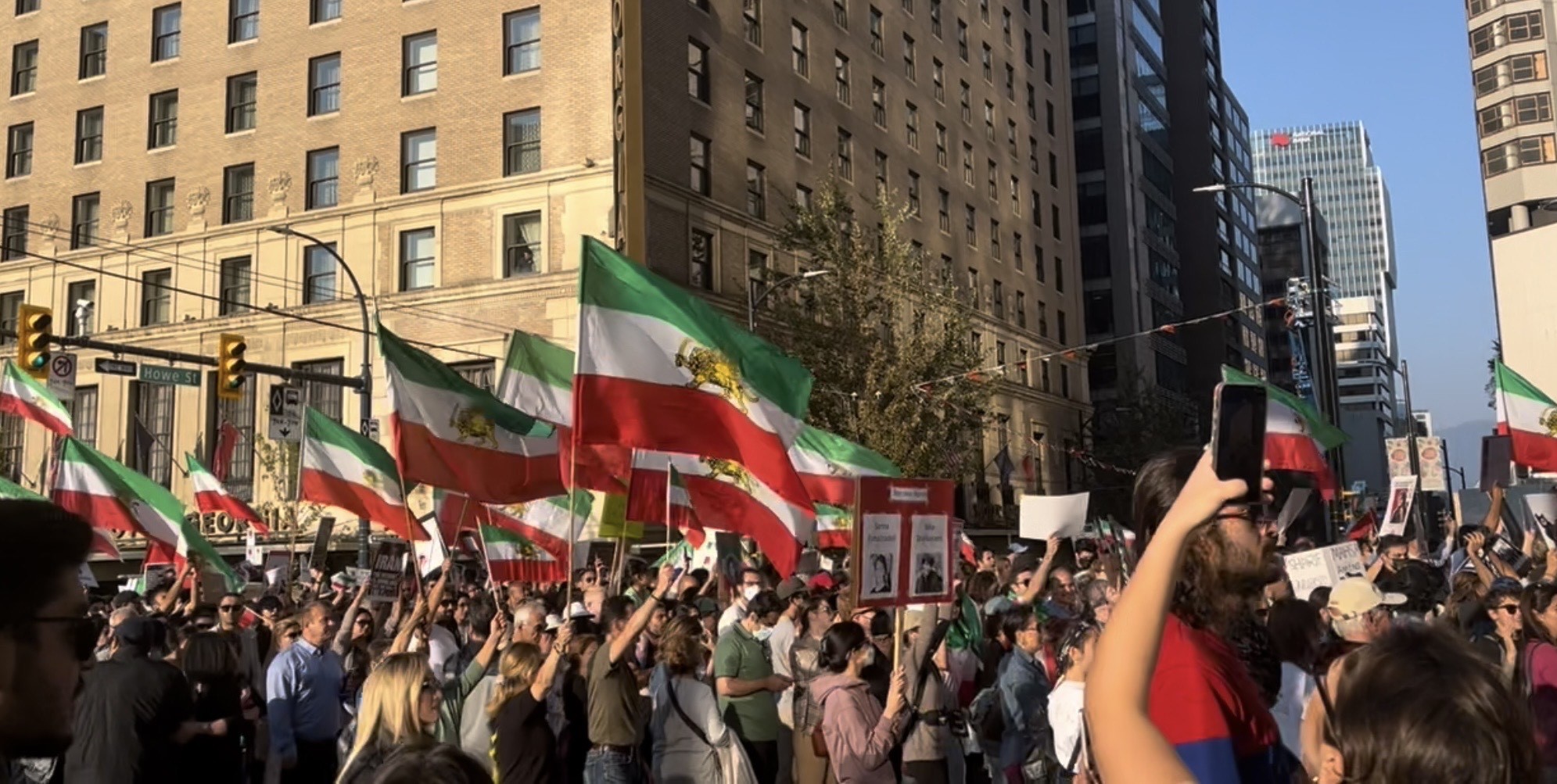
Women Life Freedom protest in Downtown Vancouver. Protesters are waving the original Iranian flag with the lion and sun emblem on it which symbolizes the period when Iran was under the Pahlavi dynasty (led by King Mohammad Reza Shah), before the country was overtaken by the Islamic regime.
The protests were ultimately effective in shifting public opinion, as the number of women who refused to wear hijab outnumbered those who were enforcing it. After years of protest and resistance since 2022, women in major Iranian cities such as Tehran and Isfahan are now finally able to leave their homes without covering their hair for the first time in decades. Although the hijab law still has not been officially repealed, Iranian women are sticking together and fighting against the system by not wearing a hijab when leaving their homes (Gambrell, 2025).
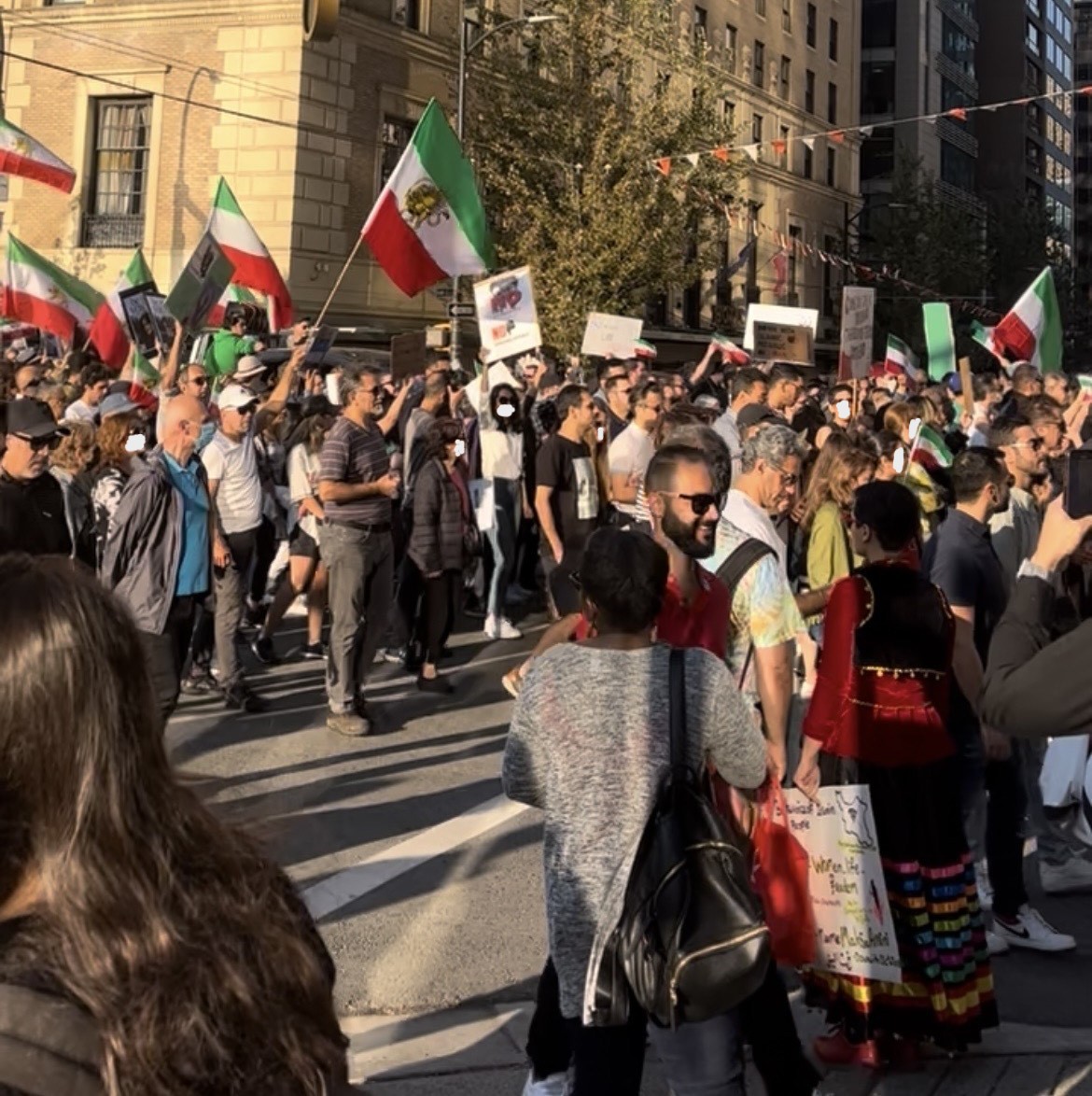
People from diverse backgrounds walking alongside Iranian protesters in Vancouver. The woman in red in the bottom right corner is wearing traditional Iranian clothing.
I interviewed an Iranian woman who just recently moved to Canada, and I will refer to her as E because she wished to keep her identity anonymous. When I asked E about whether she had personality witnessed or experienced harassment from the morality police in Iran regarding her clothing, E described one incident where she witnessed morality police getting out of a van and brutally attacking a very young girl who was not wearing her headscarf fully. The agents dragged her on the ground and pulled her into the van and drove off. E explained that in the best-case scenario, the girl’s father would have to come to the police station and pay a fine to bail her out. However, if they don’t have the documents to free that girl, she would have had to stay in the police station until further notice. When I asked E about her thoughts on hijab law being more rooted in political control rather than religion, she responded that hijab in Iran is indeed being used by the government as means of control to achieve its political goals. She noted that there are many Islamic countries around the world like Turkey and Indonesia, but none of them force their women to wear hijab, it’s up to the women to decide whether they want to wear it or not.
Some people argue that hijab is a religious or cultural tradition and that banning or criticizing it is a form of Islamophobia. However, what they fail to consider is that in countries like Iran and Afghanistan, hijab is not a personal choice, it is a state enforced rule backed by violence. The issue is not the hijab itself, but the fact that it has been transformed into a sexist political tool created and enforced by men to control what women can and cannot wear. When a woman faces arrest, beatings, or even death for showing her hair, the conversation is no longer about religion, it is about human rights and bodily autonomy. Even in countries where hijab is optional, many women still experience pressure and judgment from Muslim men and their families when they wear mildly revealing clothing, which shows that the issue goes beyond faith, and is deeply rooted in patriarchal control.
PROPOSED SOLUTIONS
Just as the Woman Life Freedom movement marked a turning point in Iranians’ collective resistance to compulsory hijab, another mass protest needs to take place directly aimed at repealing the hijab law. Many Iranian women now refuse to wear a hijab out of sheer bravery, but the law itself remains in place (Center for Human Rights in Iran, 2024). Iranian women will not be free until the law is repealed. When I asked E if she thinks that the Women Life Freedom movement has permanently changed how Iranian people view hijab, she responded, “Now they know that the beliefs of the Iranian people and the beliefs of the Iranian government are two completely different things, and that realization has made people in Iran, especially young people and girls braver. Now in many restaurants and cafés in Tehran and larger cities, more people don’t wear hijab or a headscarf, and they live their daily lives wearing more comfortable clothing.” It is clear that the Iranian government has long used hijab as an oppressive tool to control women and take away their autonomy.
While another mass protest could create change, it is important to take into account the consequences of participating in such protests in a country that is heavily militarized and does not hesitate to kill its own people. According to Amnesty International (2024), authorities responded to the Women Life Freedom protests by beating protestants with batons, firing shotguns loaded with metal pallets directly at their eyes, and even going as far as sentencing protestants to the death penalty. In 2023, it was reported that executions reached their highest levels in eight years, as authorities used capital punishment to instill fear in people (Amnesty International, 2024). Additionally, the Iranian Guardian Council is retaliating against the movement by finalizing a new bill called the “Hijab and Chasity” bill, which imposes much tougher punishments for women who don’t follow the mandatory hijab rules, including extremely high fines, longer jail sentences, and travel bans (OHCHR, 2024).
When I asked E about what she thinks needs to happen in order for women in Iran to be truly free, she responded:
“The issue with the Iranian government is that they are a very violent and cruel government, and they will do anything to defend themselves. They are armed and mercilessly kill people. Iranian people are empty-handed, and without other countries’ support, they can’t stand against the Iranian government. Therefore, it is necessary that other governments help the Iranian people in an armed way so they can gain power and stand up to the Iranian government.”
She makes a valid argument stating that the only real way to stop Iranian government’s dictatorship over its people, is if other countries helped Iranian civilians. The same is true for women in Afghanistan. If the women in Afghanistan were to join together in protests, the likely outcome would be mass killings. The only effective way to fight back against these dictatorships is by having a strong support system, potentially including assistance from other countries, as well as support from men within their own communities.
Another proposed solution that could have a long-lasting effect without the bloodshed associated with protests, is increasing access to outside knowledge and awareness. In countries like Iran and Afghanistan, their internet access is extremely limited, and many civilians have very little understanding of how other countries operate culturally. From an early age, children in Iran are exposed to an education system that tightly intertwines schooling with religious and political ideology. As someone who was born in Iran, where Islam is embedded into nearly every aspect of public life, I experienced this conditioning firsthand. Although subjects such as Farsi, literature, history, and ethics appear secular on the surface, many of the textbooks used in schools are infused with Islamic doctrine and political messages. According to an analysis of Iranian school materials, even textbooks that are not explicitly religious begin with images and quotations from Ayatollah Khomeini or Khamenei, and emphasize themes such as sacrifice for Islam, loyalty to the supreme leader, and resistance against Western influence (Science Applications International Corporation, 2007). All other religions in Iran are viewed as something sinful, and if authorities discover that someone wants to convert to any other religion but Islam, they will be labeled as “کافر” (disbeliever) and potentially sentenced to death. Growing up in an environment where alternative belief systems were dismissed or demonized created a narrow worldview that discouraged questioning and limited exposure to diverse perspectives. Hence why Increasing exposure to global ideas, beliefs, and cultures would challenge these inflexible ideologies and allow Iranian civilians to understand that alternative ways of living exist.
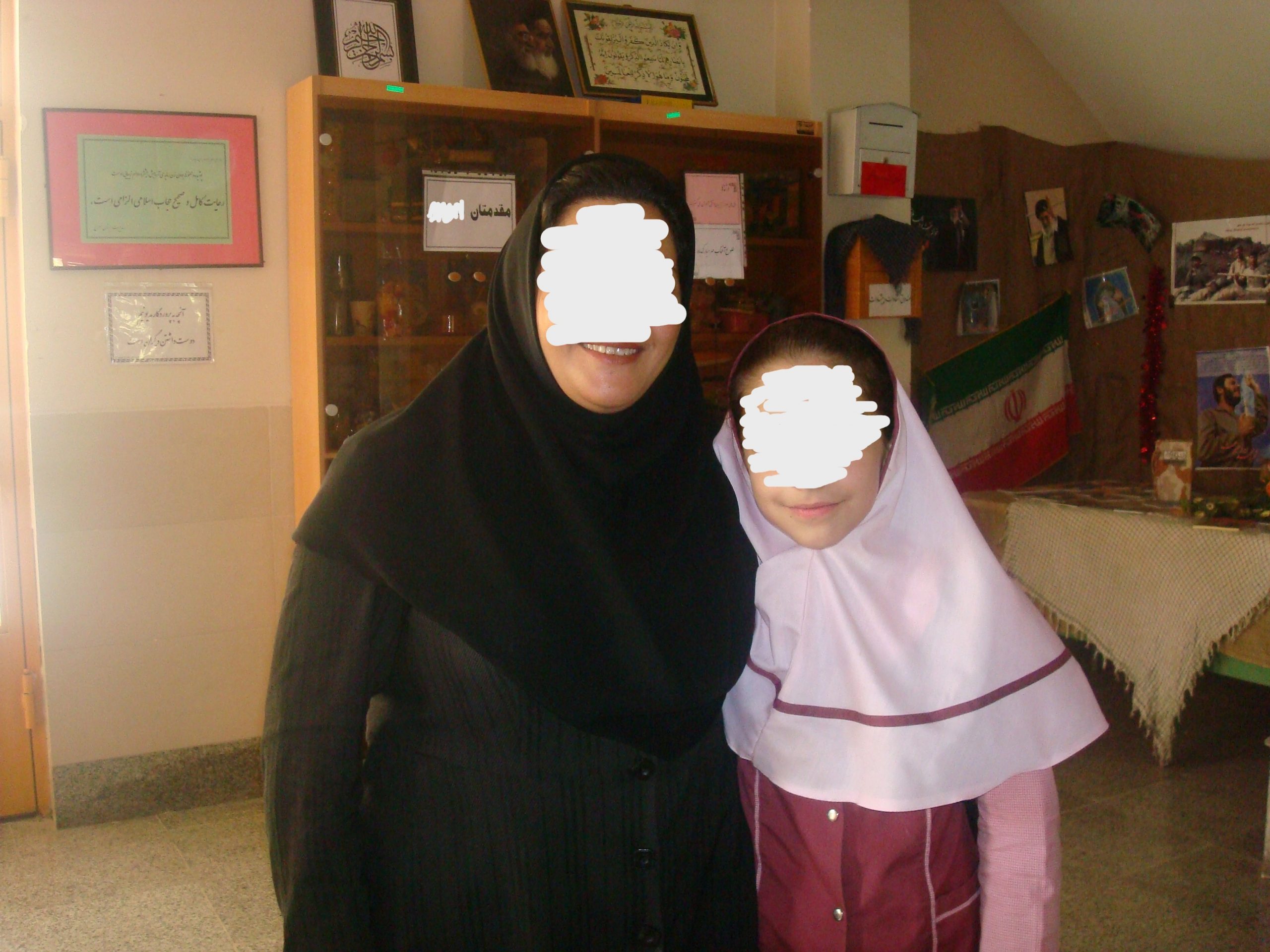
My elementary school teacher and I posing for a photo at my school. All schools in Iran from elementary to university are segregated by gender, and all girls (as young as seven) are required to wear compulsory hijab uniforms, a policy implemented by the 1979 Islamic revolution.
CONCLUSION
Women in Iran and Afghanistan face similar restrictive hijab laws which are set up by the Islamic regime to have control over women’s bodies. From the history of compulsory hijab to the brutality faced by women like Mahsa Amini, it is clear that these laws are designed to strip women of their autonomy and reinforce a system where obedience to patriarchy is valued more than human life. The Women Life Freedom movement where women worldwide joined together in solidarity to protest for women’s freedom in Iran after Mahsa Amini’s death, proved that when women stand together, change becomes possible, even under the most violent regimes. After 46 years, women in Iran are finally stepping outside their homes without wearing hijab. However, true freedom will never be achieved until men stand alongside women, the legal systems that criminalize women’s existence are dismantled, and other countries provide support for people of Iran and Afghanistan as they fight for their basic human rights. The fight against the forced hijab law is not a fight against religion, it is a fight against violence, misogyny, and state power built on controlling women. Iranian and Afghan women deserve a future where their bodies are not political battlegrounds but their own, and the world needs to stand with them until that future becomes reality.
References
Abd Munaf, M. (2023, December 7). Women’s dress in Iran: From the Islamic sitr to the political hijab. The Washington Institute. https://www.washingtoninstitute.org/policy-analysis/womens-dress-iran-islamic-sitr-political-hijab
Amnesty International. (2024, December 10). Iran: Two years after ‘Woman Life Freedom’ uprising, impunity for crimes reigns supreme. https://www.amnesty.org/en/latest/news/2024/09/iran-two-years-after-woman-life-freedom-uprising-impunity-for-crimes-reigns-supreme/
Amnesty International. (2024). Afghanistan 2024. https://www.amnesty.org/en/location/asia-and-the-pacific/south-asia/afghanistan/report-afghanistan/
Askew, J. (2023, July 18). Explained: Why the Islamic headscarf is crucial in Iranian society. Euronews. https://www.euronews.com/culture/2023/07/18/explained-why-is-the-hijab-significant-in-iranian-society
Center for Human Rights in Iran. (2024, September 11). A quiet revolution continues in Iran two years after the Woman, Life, Freedom uprising. https://iranhumanrights.org/2024/09/a-quiet-revolution-continues-in-iran-two-years-after-the-woman-life-freedom-uprising/
Fetrat, S. (2025, November 19). Taliban’s mandatory burqa in Herat assaults women’s autonomy. Human Rights Watch. https://www.hrw.org/news/2025/11/19/talibans-mandatory-burqa-in-herat-assaults-womens-autonomy
Gambrell, J. (2024, March 8). Iran is responsible for the “physical violence” that killed Mahsa Amini in 2022, UN probe finds. PBS. https://www.pbs.org/newshour/world/iran-is-responsible-for-the-physical-violence-that-killed-mahsa-amini-in-2022-un-probe-finds
Gambrell, J. (2025, November 28). With Iran’s regime wary of widespread dissent, Tehran women let their hair down | The Times of Israel. (2025, November 28). The Times of Israel. https://www.timesofisrael.com/with-irans-regime-wary-of-widespread-dissent-tehran-women-let-their-hair-down/
Human Rights Council. (2024, March 19). Detailed findings of the independent international fact-finding mission on the Islamic Republic of Iran. Abdorrahman Boroumand Center. https://www.iranrights.org/attachments/library/doc_828.pdf
Iran intensifying efforts to repress women and girls on second anniversary of nation-wide protests, un fact-finding mission says | OHCHR. Office of the United Nations High Commissioner for Human Rights. (2024, September 13). https://www.ohchr.org/en/press-releases/2024/09/iran-intensifying-efforts-repress-women-and-girls-second-anniversary-nation
Litty, H. (2025, January 5). The Taliban’s ‘Gender Apartheid’: The Reality of Women in Afghanistan . North Carolina Journal of International Law. https://scholarship.law.unc.edu/cgi/viewcontent.cgi?article=2173&context=ncilj
Maranlou, S. (2022, October 12). Hijab law in Iran over the decades: The continuing battle for reform: Blog: University of Essex. Blog | University of Essex. https://www.essex.ac.uk/blog/posts/2022/10/12/hijab-law-in-iran-over-the-decades-the-continuing-battle-for-reform
Mohamed. (2022, May 19). IntelBrief: Taliban reverts to form on women’s rights. The Soufan Center. https://thesoufancenter.org/intelbrief-2022-may-19/
Rahimi, R., & Rezaei, S. (2025). The 2022 Iran Protests: The View from the Streets. Middle East Policy, 32(3), 51–63. https://doi.org/10.1111/mepo.12809
Science Applications International Corporation. (2007). Iranian textbooks: Content and context. SAIC.