


Nirosh Saravanan
Nirosh Saravanan is completing his Bachelor of Arts in Interdisciplinary Studies with a minor in Sociology from Capilano University. Originally working on a Bachelor of Engineering, he moved from designing mechanical systems to observing social ones. In his studies, he has focused on themes relating to class relations, technological development and society and environmental policy. Outside of class, he participated in Enactus, a club focused on addressing the UN sustainability goals through social entrepreneurship. He is also a staff member at 525 Royal Canadian Air Cadet Squadron, where he aids in youth development. In the future, he looks to join the civil service in policy analysis.
Introduction
While a small spiritual sect, Falun Gong has been able to create influence in Western politics to persuade the public on issues pertaining to China. Its leadership and organizational structure were able to leverage multiple avenues of media and Western skepticism towards China to further its political goals.
In its outwards presentation, Falun Gong shows itself as a benign spiritual group; representing Chinese thought supposedly lost to communist meddling. They achieved this through a multinational media empire that has been able to sway discourse on the PRC. Conversely, the Peoples Republic of China (PRC) has sought influence in the west both in and outside the Chinese diaspora. Falun Gong therefore represents an under-examined facet of disinformation campaigns in the context of security; campaigns run by non-state actors.
Beginnings
With the PRC starting to move away from the ideological rigidity of Chairman Mao, religious and other spiritual practices started to proliferate. One popular practice was Qi Gong, a meditative practice focused on breathing movements.
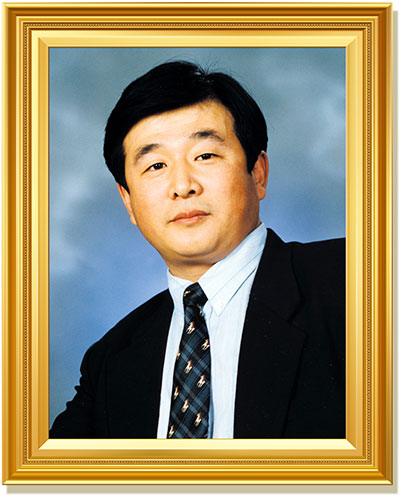
Li Hongxi (image rights to falundafa.org), the Enigmatic founder of Falun-Dafa. He was born on the 13th of May 1951 (although state records list him allegedly changing his birth date to align with a Budhist figure (Penny, 2003)). Before founding the practice, he would find work at a grain processing facility until he founded Falun Dafa in 1992. Details on his early life are conflicting between bio released from Falun Dafa and State records (Penny, 2003), one reason being the biographies role as a religious piece opposed to a traditional biography (Penny).
Li Hongxi started to preach Falun Gong in 1992 (Penny, 2003), following a revitalization of religion in the PRC. Early on, Falun Gong enjoyed support from the state to as it was seen as a means to address citizen health and wellbeing, even rivaling the Communist Party of China (CPC) in membership (Noakes, 2010). In 1996, the text Zhuan Falun, became a national best seller bringing the scrutiny of the state (Junkers, 2014). Yet, by the summer, all books pertaining to Falun Gong had been banned by authorities. This prompted practitioners to mobilize in large-scale protest against the regime. While not originally called for by Li, by August he had canonized protesting as a means of “cultivation” or a step towards the equivalent of enlightenment for Falun Dafa practitioners, later seeing activism as a means to separate true believers from the herd (Junkers, 2014). The group took to protesting peacefully, often outside government offices and eventually at Tiananmen Square in Beijing (Junkers, 2014).
In 1999, Paramount Leader Jiang Zemin brought the full force of the Chinese state to crackdown on what was viewed as “a threat to the socialist cause” (Noakes & Ford, 2015), likely owing to the group’s ability to organise at scale in public (Owenby, 2001). This resulted in the creation of the “610 office” to focus on cracking down on Falun Dafa (Noakes 2010). As well, those who protested faced repercussions, being detained and often forced into re-education through labour programs (Junkers, 2014).
Thus, as they were banned in China, those in the Diaspora took to protesting in addition to different avenues of spreading the word of Li Hongxi. They continued their strategies that worked in China, in person protest and distributing media. Soon, this would include a host of websites, newspapers and other media outlets managed by followers.
Falun Dafa and politics
Falun Gong originally had a disconnect between its leadership and practitioners regarding political action. Li Hongxi started off as being apolitical while his followers felt a need to organize against the government (Junkers, 2014). Li took to spreading Falun Gong between 1991 and 1999, with himself eventually settling down in New York with a permanent residence. Between 1999 and 2000, Li disappeared leaving a power vacuum. Meanwhile in May 1999, the Minghui website was established, essentially an archive of Falun Dafa thought, for other practitioners. This would mark the start of their online presence. Soon after in 2000 in Mandarin and 2003 in English, The Epoch Times would be founded by John Tang in Atlanta (Reactionary.international).
Interestingly, instead of his position being filled by another charismatic figure, Falun Gong kept its grass roots approach to mobilize and protest. Following this, Falun Gong faced increased persecution from the state, including crackdowns on protest and societal repercussions. After returning, Li appropriated his follower’s call to mobilization as part of Falun gong Dogma (Junkers, 2014).
“Indeed, it is no exaggeration to call Falun Gong the largest, most cohesive expression of opposition to Communist rule that exists as of 2009″ (Noakes, 2010).
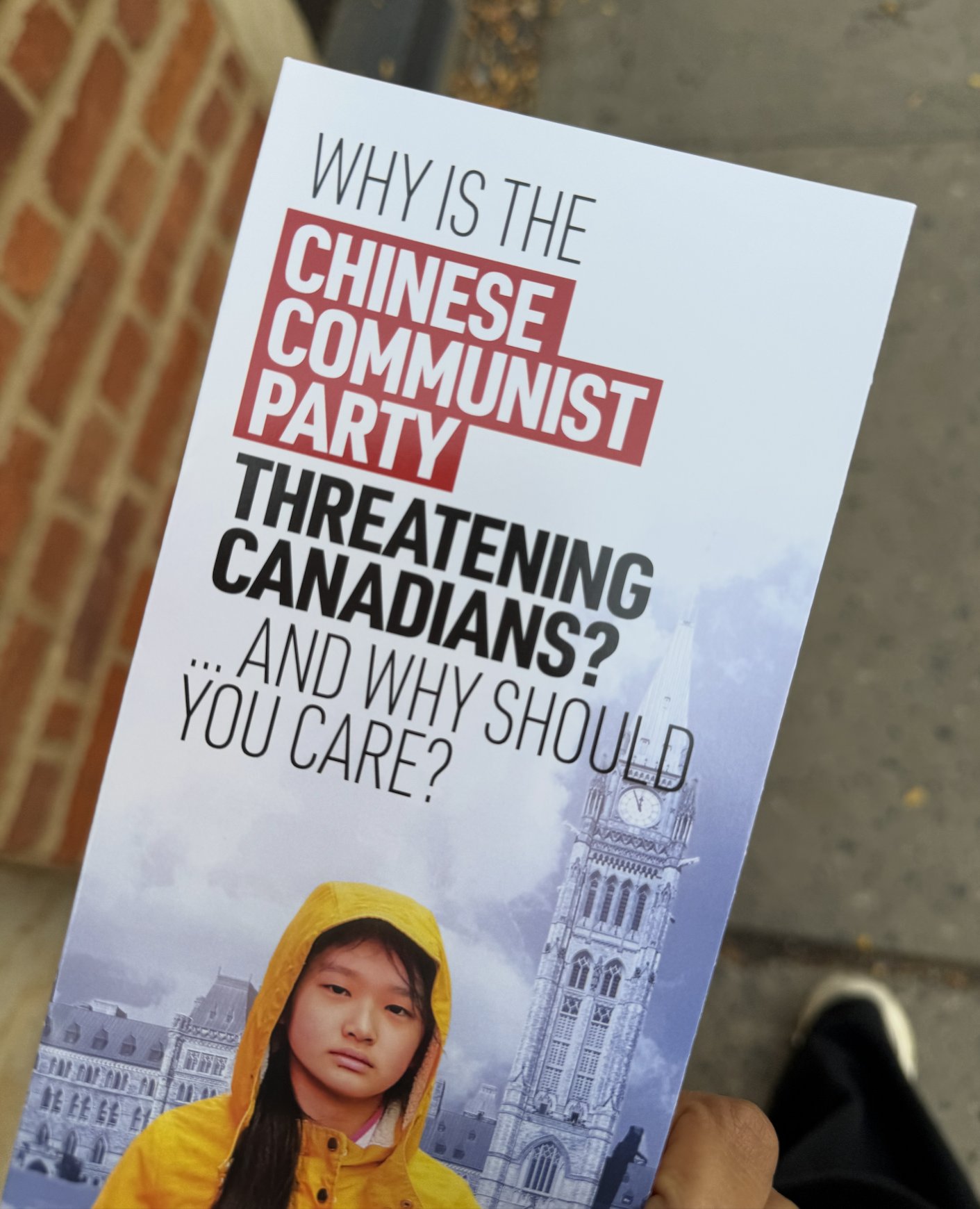
Image of a pamphlet being handed to a student in Montreal.
Even before being expelled from China, Falun Gong has had success in mobilizing its followers for protesting and the dissemination of information. In fact, one of the reasons they were banned was because of the perceived threat they posed to the CPC. As Dr. David Matijasevich (interview, October 29th, 2025) points out, religions & spiritual associations cannot function as political entities in China and face high levels of scrutiny from authorities. Thus, as Falun Gong started to organize demonstrations in the 90’s, this came into conflict with how the state viewed religion’s role in the PRC.
The structure and organization of Falun Gong have allowed it to be agile in its expansion. Per Junkers, follower agency (i.e. how much a follower is able to dictate their actions), has been key to the group’s success in expanding. While Li sets the goals and doctrine of the group, he is no stranger to appropriating and canonizing ideas created by his practitioners (i.e. codifying ideas and practice developed by his followers into dogma). Without his disappearance, it’s unlikely that his followers would be as emboldened to act on their own accord. One example is the notion of clarifying truths by his practitioners (Junkers, 2014). Li canonized these practices, laying the foundation for Falun Gong’s media empire. In 2017, The New York Times was able to access an internal email regarding their Facebook presence. This presence was to be used to spread the teachings of Falun Dafa, to “save sentient beings” (Roose, 2020). Thus, as a living God, Li sent forth his messengers.
Spreading the word
Falun Gong hasn’t limited themselves to protesting in person, although as Noakes (2010) points out: “publications like the Epoch Times have sometimes hurt rather than helped the group’s credibility”. Contributing factors include editorial slant, lack of external resources, its decentralized structure (Cooke, 2024) and a lack of operational transparency.
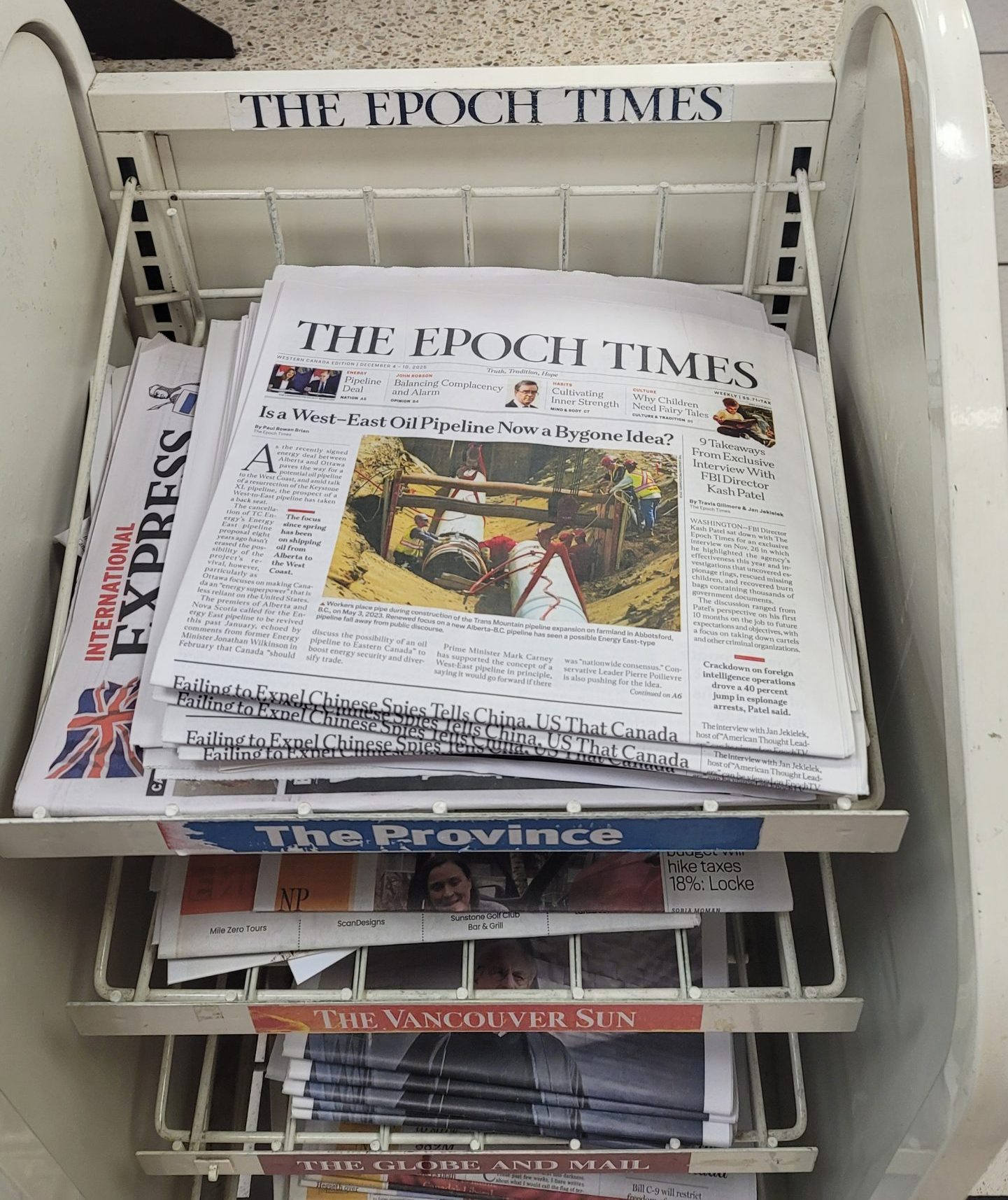
Image of Epoch Times space in North Vancouver 7-Eleven.
Starting off, they have newspapers and websites like the Epoch Times and New Tang Dynasty. Second, they have a menagerie of YouTube channels associated with them (McCullough, 2020); from channels covering behind the scenes of the dance troupe Shen Yun, to beauty and wellness to China in Focus, a news channel with an anti-Chinese slant. Interestingly, like many other outlets owned by Falun Gong, they promote the notion of a persecuted Falun Gong while not disclosing their ownership by the group or affiliation. In fact, a tell-tale sign of Falun-Gong ownership is the claim that Falun Gong practitioners are facing a systemic organ harvesting campaign by the state with practitioner organs being desired for some type of organ purity (Gutmann, N.D.). However, this misconstrues the ordeal. Instead of organ harvesting being the end goal, it is the unfortunate result of practitioners dying either during torture or protest. donations (Chalawa, 2017) although this has been difficult to verify.
This hasn’t stopped Falun Dafa from leveraging the circumstances to organize an information campaign regarding the alleged organ harvesting. Early on this involved trying to work with groups like Amnesty International to pressure the PRC to stop an alleged organ harvesting practice and prevent the abuse of its followers at the hands of the government. The group would later find itself courting favour from the right wing of western politics, owing to both trying to counter influence from the PRC.
Disinformation
Disinformation is the deliberate spreading of false information with the intent to deceive the recipient. In a similar vein, misinformation is the deliberate misinterpretation of something that is true with the intent of deceiving the recipient. Falun Dafa affiliated media outlets have tended to go with the latter.
The ability for non-state actors to create and disseminate disinformation is not novel. Some examples are companies deliberately advertising a product with the wrong specifications or defamation. What is new, with social media, is the ability for bad actors to artificially create what seems to be a natural discussion on an online platform. With bots and AI, the ability to create large volumes of engagement with what would have been done by an intelligence agency a couple year prior.
Falun Dafa’s claims usually have some basis in reality. However, they often exaggerate or create claims that misconstrue the truth. An example was in a paper published by The Falun Gong Association of Canada (2024), ironically posted to the Forum on Disinformation in Canada. While looking at the sources in the paper, many of the sources are either old (over ten years or greater) or reference to other Falun Gong affiliated media. One example was when the paper made by the Falun Dafa Association of Canada, made reference to a specific UN envoy visit (reference to https://docs.un.org/en/E/CN.4/2006/6 ), claiming that the UN document stated that 66% of torture victims in China were practitioners of Falun Dafa. However, looking into the UN document, there was no explicit mention of Falun Gong but instead:
“…[The UN Special Envoy, Manfred Nowak] concluded that the practice of torture, though on the decline, still remains widespread in the country. He was particularly concerned about the continuing practice of forced re-education of persons with dissident or non-conformist opinions …”
Falun Dafa’s decentralized approach to structure makes holding the group accountable difficult. In their reading of “The Slaughter”, Gutmann (N.D.) highlights some of the difficulty of verifying data pertaining to organ donations in the PRC. On the one hand, doctors in the PRC are told not to divulge the origin of organ donations. Yet at the same time, it was possibly being incentivized to claim a body came from a Falun Dafa practitioner due to their supposedly better health than other prisoners (Nelson, 2014). Additionally, it is notoriously difficult to verify claims from within the PRC (Penny, 2003). For example, for the UN special envoy to visit and interview torture victims in China, instead of gaining access through a letter giving “unimpeded access”, he was accompanied by the minister of Foreign Affairs for the duration of his inspection (Nowak, 2006). So, without reliable means to verify claims, studying the Falun Dafa movement, especially quantitatively becomes a difficult task.
The news not concerning Falun Gong on its own outlets (such as The Epoch Times and New Tang Dynasty) also had issues pertaining to its factuality and bias. To their credit, the Epoch times is looking to improve their factuality (Otero, 2025) following changes in staff. Yet this does not negate the sheer number of falsehoods perpetrated by Falun Dafa affiliates. Owing to their far-right slant, stories were editorialized and avoided coverage of issues that may go against their narrative. One example was coverage pertaining to the 2016 Pulse Nightclub Shooting (Cooke, 2024).
“We weren’t allowed to cover stories involving homosexuality, but that bumps up against them wanting to cover Islamic terrorism. So I wrote four articles without using the word ‘gay,’”
—Steven Klett, speaking to the New York Times on being a writer for the Epoch Times
With the lack of reliable third-party information, it becomes easy for Falun Gong and the PRC to control the narrative.
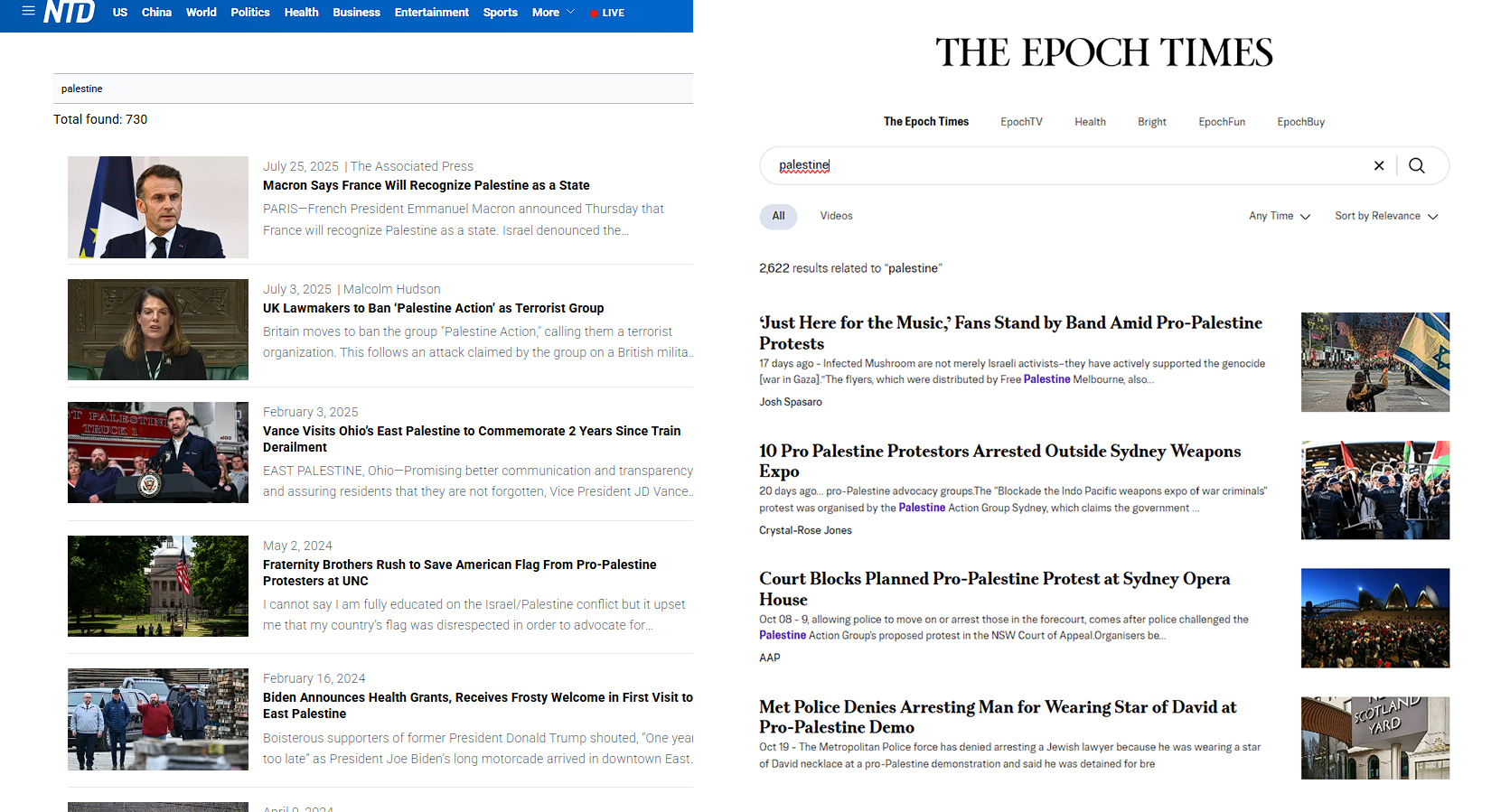
Screenshot of search results for Palestine in both The Epoch Times and New Tang Dynasty. Interestingly, neither publication goes into detail on the conflict in the Occupied Territories. The Epoch Times focuses more on negative impacts caused by civil disobedience while New Tang Dynasty results cover a train crash in an American town named Palestine.
Is it foreign, and does it matter?
It should be remembered, within a Canadian context that there are practitioners that are stake holders in Canada’s foreign policy and its democratic process. Whether as citizens or permanent residence. However, Falun Dafa affiliated news outlets are foreign entities with a political agenda.
The aspect of being foreign does not make an influence campaign intrinsically malevolent. Living next to the United States brings a large amount of political soft power vying for influence over Canadian policy. Recently the Doug Ford faced backlash from Trump over a media campaign using clips of Ronald Reagan (Lum, 2025). On a daily basis, we see people vie for influence on the internet, which itself is often viewed as a proxy for public sentiment. Where foreign influence does become problematic is when it becomes deceitful, which Falun Gong affiliates have become (Thomas, 2024) (Roose, 2024).
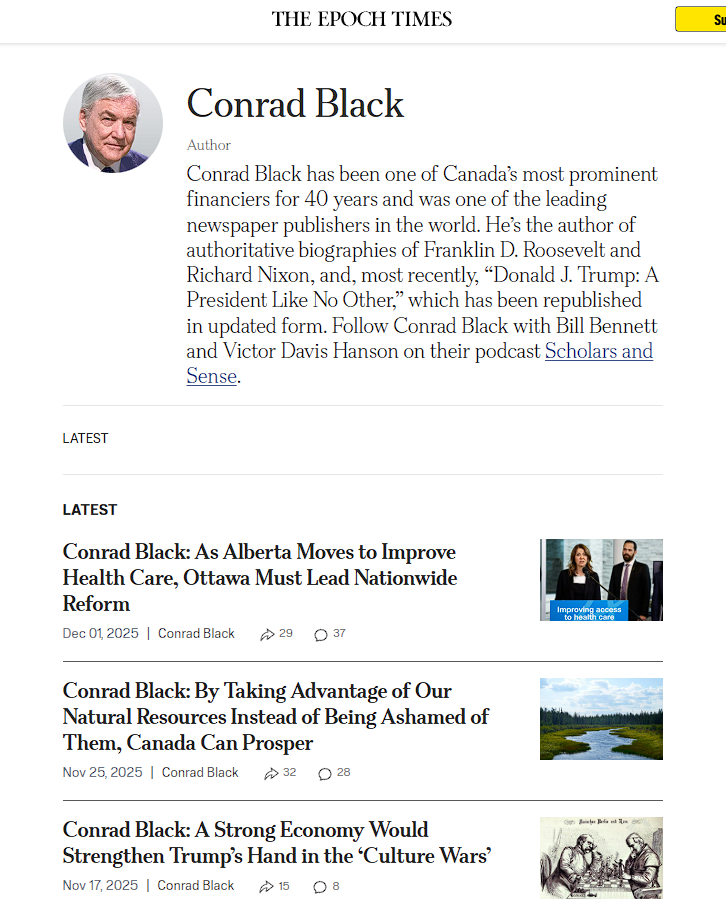
Conrad Black, right-wing Canadian media mogul, often writes opinion pieces for The Epoch Times.
Currently, discussions on foreign interference focus on State actors. From a western standpoint discussion often focus on the actions of “Rogue States”; those which look to challenge the hegemony of the US and its allies such, as China and Russia. For example, elements tied to the Kremlin and the PRC sought to influence politics in Africa (Wassserman, 2023). They did so by “gaining control of the editorial narrative while obfuscating the origin of planted stories” (Wasserman, 2023). Through content creation, such as through state owned media pieces such as RT or CGTN, or though controlling local editorial boards, these actors were able to create information spaces where they shape the narrative. Another example is the Internet Research Agency managed by Yvgeny Prisgozin, the infamous founder of Wagner PMC (Chernova& Kraver, 2023).
“The US Treasury Department sanctioned the IRA in 2018, accusing it of having “created and managed a vast number of fake online personas that posed as legitimate US persons to include grassroots organizations, interest groups, and a state political party on social media.”
—Chernova & Kraver, 2023
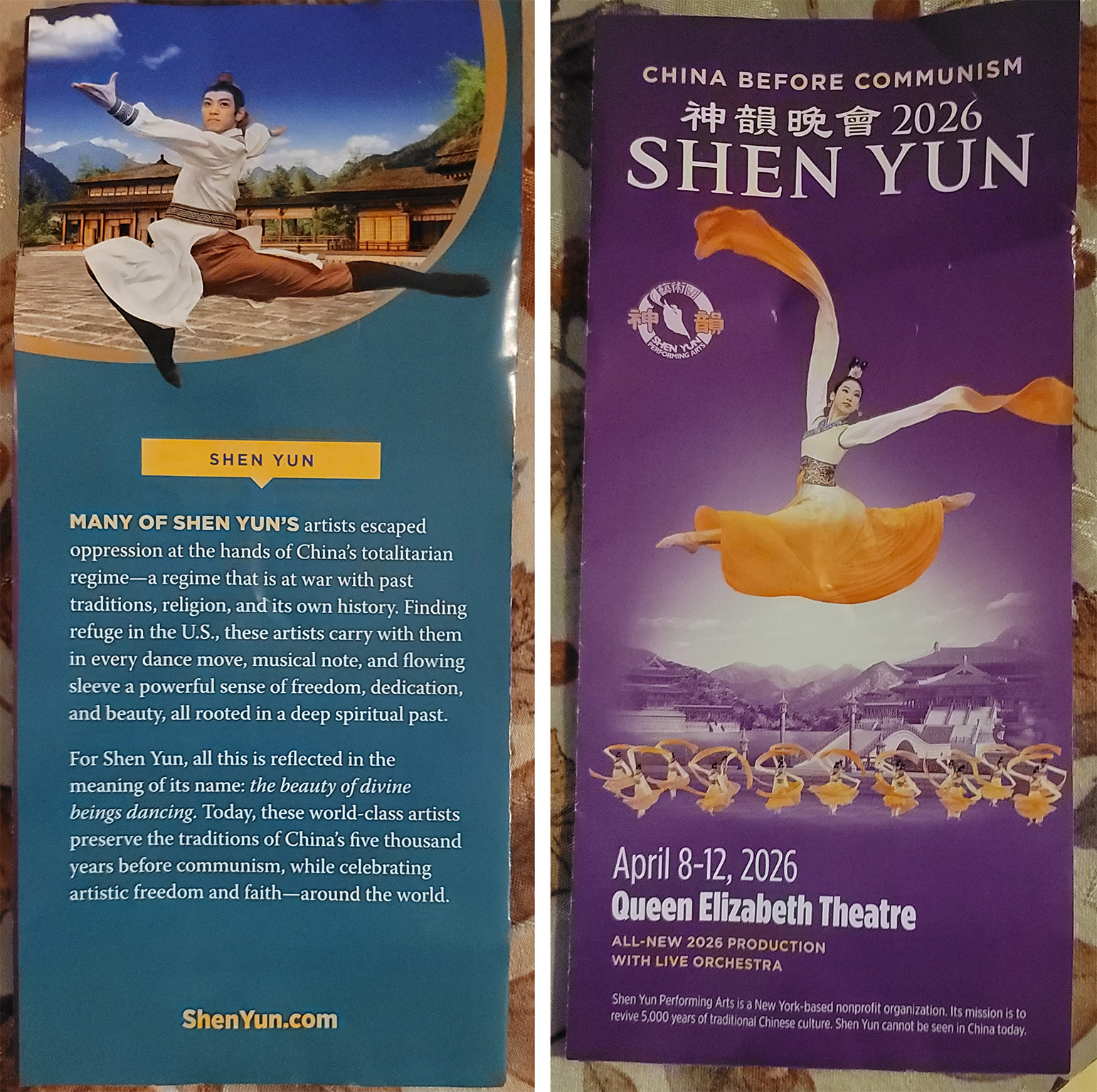
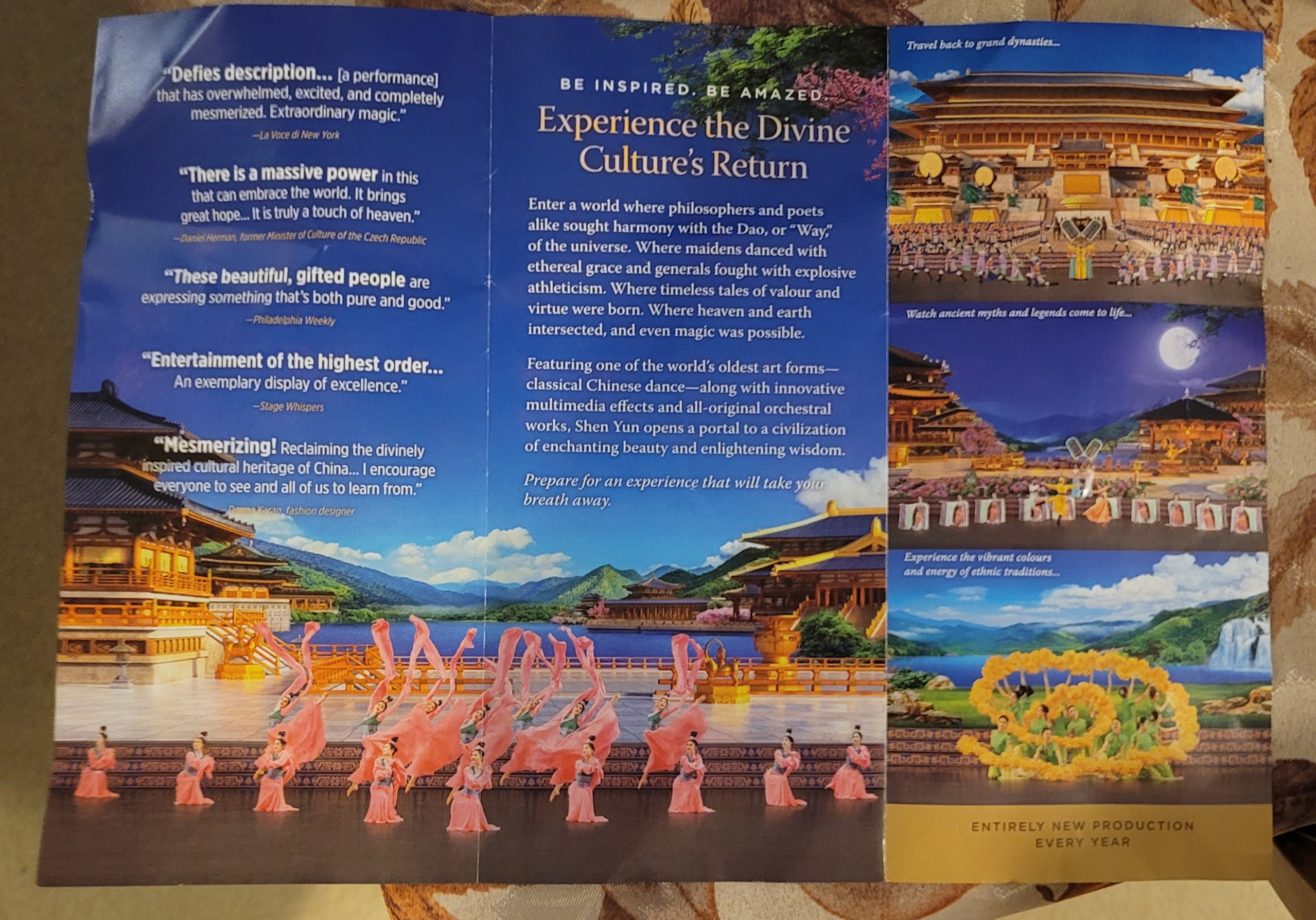
Photos of a pamphlet for the Shen Yun dance troupe. Going on New Tang Dynasty and The Epoch Times websites will have a large number of advertisements for the Falun Dafa ran show. The pamphlet was handed out in the Park Royal shopping centre.
Where does a cult known for its dance troupe and breathing exercises come into the realm of foreign influence and disinformation? While the West does not have the same level of informational fragility (Chernova & Kraver, 2023) that these bad actors are able to exploit, the detached ownership of Falun Dafa affiliated media and lack of a media presence from the PRC in the west has allowed Falun Gong to shape the narrative on China. To the outside observer, the variety and volume of Falun Dafa affiliated media creates a veneer of organic discourse. Similar to state run bot networks, Falun Gong affiliated accounts have been able to artificially increase engagement with a narrative shaped by Falun Gong (Thomas, 2020). This was achieved by funneling users from social media sites to their own affiliated networks. As a result, they had their advertising abilities revoked on the platform, something the editorial team wore as a badge of honour (Cooke, 2024). Previously, the idea of a bot network was associated with state actors as they require both expertise, coordination and resources to conduct such operations. With increasing access to technology, it is easier for non-state actors to artificially influence dialogue in such a matter that suits their own agenda.
While Orden and Pamment in “What Is So Foreign About Foreign Influence Operations?” caution against viewing foreign influence broadly as malicious from the aspect of its foreignness, Falun Gong as a transnational actor looks to shape political discourse to fit their needs. Within the framework of a liberal democracy such as Canada, they present a challenge in countering disinformation in that their credibility derived from them being a persecuted group from China.
Conclusion

Image of online ad taken out by Epoch Times.
Conclusion
With Canada having a large Chinese diaspora, Falun Gong and the PRC inevitably become focal points of information and influence. Those in Canada, whether they belong to these communities or not, will inevitably have to deal with both groups vying for influence. With Canadian foreign policy viewing China as a hostile actor, it is important to veer away from believing that the enemy of my enemy is my friend (McCullough, 2020). Likewise, with the expansion and perceived credibility of social media it has become easier for different voices to be heard and the bar for credibility has lowered. From this, the ability of non-state actors to exert influence has increased. Living in a free, democratic society comes with the responsibility of being an informed voter. Thus, with the well of knowledge being tainted, it is crucial that we filter through the silt.
References
Book review: The slaughter: mass killings, organ harvestings, and china’s secret solution to its dissident problem, by Ethan Gutmann. (n.d.). THE INTERNATIONAL AFFAIRS REVIEW. Retrieved November 26, 2025, from https://www.iar-gwu.org/blog/2014/12/05/book-review-the-slaughter-mass-killings-organ-harvestings-and-chinas-secret-solution-to-its-dissident-problem-by-ethan-gutmann
Canada, C. S. E. (2018, October 22). Fact or fiction: Quick tips to help identify “fake news.” Canadian Centre for Cyber Security. https://www.cyber.gc.ca/en/guidance/fact-or-fiction-quick-tips-help-identify-fake-news
Canada, S. (2023, February 7). Online disinformation. https://www.canada.ca/en/campaign/online-disinformation.html
Canada, S. (2024, January 11). Learn about it. https://www.canada.ca/en/campaign/online-disinformation/learn-about-it.html
Chan, C. S. (2013). Doing Ideology Amid a Crisis: Collective Actions and Discourses of the Chinese Falun Gong Movement. Social Psychology Quarterly, 76(1), 1–24. http://www.jstor.org/stable/43186685
Chawla, D. S. (2017, February 6). Study retraction reignites concern over China’s possible use of prisoner organs. Science.
https://www.science.org/content/article/study-retraction-reignites-concern-over-china-s-possible-use-prisoner-organs
Chernova, M. K., Anna. (2023, February 14). Wagner chief admits to founding Russian troll farm sanctioned for meddling in US elections. CNN. https://www.cnn.com/2023/02/14/europe/russia-yevgeny-prigozhin-internet-research-agency-intl
Cooke, K (2024) The truth behind the epoch times billboards around denver | rocky mountain pbs. (n.d.). The Truth behind the Epoch Times Billboards around Denver. Retrieved November 26, 2025, from https://www.rmpbs.org/blogs/news/epoch-times-billboards-denver
Falun Gong Human Rights Group Hearing 2: Hearing before the The Foreign Interference Commission. https://foreigninterferencecommission.ca/fileadmin/foreign_interference_commission/Documents/Public_consultation/Falun_Gong_Human_Rights_Group_-_Meeting_2_Summary__EN_.pdf
Falun Gong Human Rights Group Meeting Hearing 1 EN: Hearing before the The Foreign Interference Commission. https://foreigninterferencecommission.ca/fileadmin/foreign_interference_commission/Documents/Public_consultation/Falun_Gong_Human_Rights_Group_-_Meeting_1_Summary__EN_.pdf
Foreign Interference & Repression of Falun Gong in Canada (No. HRC0000123). (2024). https://foreigninterferencecommission.ca/fileadmin/foreign_interference_commission/Documents/Exhibits_and_Presentations/Exhibits/HRC0000123.pdf
Griffiths, J. (2016, June 23). Report: China mass harvesting organs from prisoners. CNN. https://edition.cnn.com/2016/06/23/asia/china-organ-harvesting/index.html
How the conspiracy-fueled Epoch Times went mainstream and made millions. (2023, October 13). NBC News. https://www.nbcnews.com/news/us-news/epoch-times-falun-gong-growth-rcna111373
Jones, M. O. (2024). How do states and non-state actors use social media for deception and disinformation? In A. Reuss & S. Stetter (Eds.), Social Media and Peacebuilding: How Digital Spaces Shape Conflict and Peace (pp. 25–48). Springer Nature Switzerland. https://doi.org/10.1007/978-3-031-73917-0_2
Junker, A. (2014). Follower Agency and Charismatic Mobilization in Falun Gong. Sociology of Religion, 75(3), 418–441. http://www.jstor.org/stable/24580040
Lum, Z.-A. (2025, October 27). Ford doubles down on Reagan ad that got Trump fuming. Politico.
https://www.politico.com/news/2025/10/27/ford-doubles-down-reagan-ad-trump-tariffs-00624042
Misinformation, disinformation and malinformation | cmhr. (n.d.). Retrieved November 26, 2025, from https://humanrights.ca/resource-guide/misinformation-disinformation-and-malinformation
McCullough, J. J. [J.J. McCullough]. (2019, October 14). This Chinese cult is not your friend – the Falun Gong story (part 1) [Video]. YouTube. https://www.youtube.com/watch?v=2mQ8plzWl9g&t=9s
McCullough, J. J. [J.J. McCullough]. (2019, October 21). This Chinese cult is not your friend – the Falun Gong story (part 2) [Video]. YouTube. https://www.youtube.com/watch?v=1JaPzJKycxc
Nations, U. (n.d.). Countering disinformation. United Nations. Retrieved November 26, 2025, from https://www.un.org/en/countering-disinformation
Noakes, S. (2010). Falun Gong, Ten Years On: Review Article [Review of FALUN GONG AND THE FUTURE OF CHINA; QIGONG FEVER: Body, Science and Utopia in China; FALUN GONG: End of Days; FALUN GONG’S CHALLENGE TO CHINA: Spiritual Practice or Evil Cult?; POWER OF THE WHEEL: The Falun Gong Revolution, by D. Ownby, D. Palmer, M. H. Chang, D. Schechter, I. Adams, R. Adams, & R. Galati]. Pacific Affairs, 83(2), 349–357. http://www.jstor.org/stable/25698458
Noakes, S., & Ford, C. (2015). Managing Political Opposition Groups in China: Explaining the Continuing Anti-Falun Gong Campaign. The China Quarterly, 223, 658–679. http://www.jstor.org/stable/24742047
Nowak, M . (2006). Document viewer. Retrieved November 26, 2025, from https://docs.un.org/en/E/CN.4/2006/6
Orden & Pamment (2021) What is so foreign about foreign influence operations? (n.d.-a). Carnegie Endowment for International Peace. Retrieved November 26, 2025, from https://carnegieendowment.org/research/2021/01/what-is-so-foreign-about-foreign-influence-operations?lang=en
Ownby, D. (2001). Falungong and Canada’s China Policy. International Journal, 56(2), 183–204. http://www.jstor.org/stable/40203552
Penny, B. (2003). The Life and Times of Li Hongzhi: “Falun Gong” and Religious Biography. The China Quarterly, 175, 643–661. http://www.jstor.org/stable/20059033
PUBLIC INQUIRY INTO FOREIGN INTERFERENCE IN FEDERAL ELECTORAL PROCESSES AND DEMOCRATIC INSTITUTIONS: Hearing before the The Foreign Interference Commission . https://foreigninterferencecommission.ca/fileadmin/foreign_interference_commission/Documents/Submissions/Final_Submissions/2024-11-04_-_Concern_Group.pdf
Reactionary International. (n.d.). “Become regular media”: How Falun Gong built a propaganda machine to fuel global reaction. Reactionary International. https://reactionary.international/cases/immolations-extraterrestrials-and-anti-communism-the-falun-gong/en/
Reactionary International. (n.d.). John Tang. Reactionary International. https://reactionary.international/database/john-tang/en/
Romano, R., & Piazza, O. (2012). The use of organs from executed prisoners in china. Translational medicine @ UniSa, 3, 81–82.
Roose, K. (2020, October 24). How The Epoch Times became a giant influence machine. The New York Times. https://www.nytimes.com/2020/10/24/technology/epoch-times-influence-falun-gong.html
Thomas, E. (2020). Possible inauthentic activity promoting the Epoch Times and Truth Media targets Australians on Facebook. Australian Strategic Policy Institute. http://www.jstor.org/stable/resrep26985
Wasserman, H. (2023, March 27). Info laundering: China, Russia’s propaganda assault on Africa. Daily Maverick. https://www.dailymaverick.co.za/article/2023-03-27-info-laundering-china-and-russias-propaganda-assault-on-africa/
(N.d.-a). Retrieved November 26, 2025, from https://www.apa.org/news/press/releases/2023/03/fake-news-social-circles
(N.d.-b). Retrieved November 26, 2025, from https://www.apa.org/topics/journalism-facts/misinformation-disinformation