


Nimritpreet Singh
Nimritpreet Singh is a student at Capilano University, completing a Bachelor of Science in Biomedical Science. Born in India and raised in Europe before moving to Canada to pursue further education, Nimrit brings a diverse global perspective to their academic work and is fluent in five languages. At Capilano University, they have worked as a student research assistant in a mammalian cell culture laboratory and have volunteered with the Red Cross for over a year, demonstrating a strong commitment to community service. They have developed a strong interest in molecular biology and aging, which they explore through research using Caenorhabditis elegans. By studying how disruption of insulin-like signaling pathways can extend lifespan, Nimrit examines how these changes affect neuromuscular function over time. Nimrit plans to attend medical school and pursue a career as a surgeon, with the goal of integrating research and clinical practice to improve patient care.
At 47, tech entrepreneur Bryan Johnson spends nearly $2 million a year trying to slow down aging. His daily routine is tightly controlled. He carefully measures what he eats, works to optimize his sleep, and tracks his body using detailed health markers. He even takes around 100 pills a day. His project, Blueprint, aims to slow his biological aging so much that his body essentially stays the same age over time. In other words, even as the years pass, his goal is for his body not to age at all (Johnson, 2023).
At first, it sounds extreme, almost unreal. However, when you step back, it starts to feel more familiar than it should. Billionaires are investing heavily in longevity research, and across celebrity culture, people are trying to hold on to youth in ways that are becoming harder to ignore. The intention is to look younger, but sometimes the result feels off, like a slightly swollen, over-smoothed version of the same face, as if time has been edited rather than reversed.
Aging is not just a question for billionaires or influencers. The more we learn about how the body works, the harder it becomes to ignore how inevitable aging still seems. Even with detailed biological knowledge, the process unfolds in a surprisingly consistent way. Despite decades of scientific progress, aging continues to follow a familiar path. This raises a fundamental question: if aging can be manipulated, what actually drives it?
This paper argues that insulin signaling acts as a central regulator of aging by coordinating a biological tradeoff between growth and cellular maintenance. Interventions targeting specific biological pathways can extend lifespan, while external factors such as diet, stress, and physical activity produce measurable effects.
Aging has traditionally been understood as the gradual accumulation of molecular damage. Over time, DNA incurs damage, proteins lose their structural integrity, and cellular systems become less efficient. As Eugene Chu, a pathology-trained molecular biologist, explains, one of the defining features of aging is the progressive buildup of unrepaired DNA damage. Although cells possess sophisticated repair mechanisms, these systems are inherently imperfect, allowing damage to accumulate and contribute to functional decline over time (E. Chu, personal communication, February 25, 2026). This framework has long positioned aging as a largely passive process, similar to the gradual wear of a machine.
However, emerging research has begun to challenge this view by demonstrating that aging can be actively regulated. Studies in model organisms such as Caenorhabditis elegans show that reduced signaling through the daf-2 receptor, part of the cellular communication system, can extend lifespan by approximately twofold while also enhancing stress resistance (Oh & Kim, 2013).

Captio1n
These observations indicate that aging is not merely a passive decline, but a regulated process shaped by systems that adjust the body’s response to internal and external conditions. This shifts the focus from why aging occurs to how it is controlled. In particular, nutrient-sensing pathways play a central role by influencing how resources are allocated within the cell. Evidence from molecular biology and model organisms shows that modifying these pathways through genetic, metabolic, or lifestyle interventions can alter the trajectory of aging and extend not only lifespan, but also healthspan (Bartke, 2008; Siti Bazilah et al., 2022).
A central part of this regulation lies in pathways that sense and respond to the body’s environment, particularly those linked to nutrient availability. Among these, insulin signaling has emerged as one of the most important. As Eugene Chu explains, “Reduced IGF signaling … led to longer lifespans and a reduction in age-related changes like reduced locomotive function, disrupted protein homeostasis, and muscle cell death” (E. Chu, personal communication, February 25, 2026). IGF, or insulin-like growth factor, works closely with insulin as part of a broader hormonal system that signals when energy is abundant, telling cells when to grow and divide. Most people are familiar with insulin in the context of diabetes, where it helps cells take up glucose from the bloodstream and maintain stable blood sugar levels. However, its role extends far beyond glucose regulation. At a cellular level, insulin functions as a key signal of energy availability, coordinating how cells use resources and determining whether they prioritize growth or maintenance.
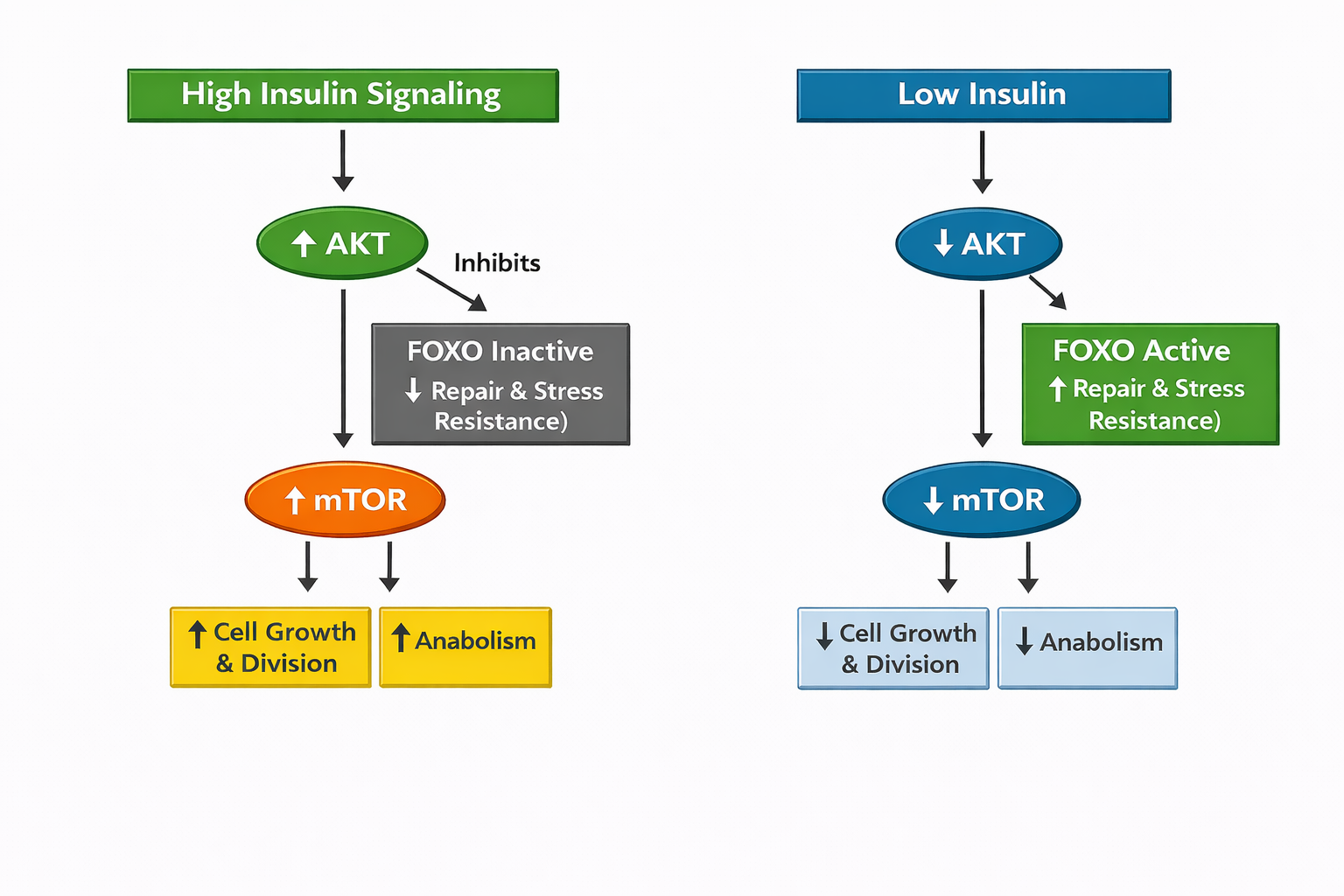
When nutrients are plentiful, increased insulin signaling activates pathways that promote growth and anabolic processes. This includes stimulating cell division, increasing protein synthesis, and directing cellular resources toward growth and tissue development (Bartke, 2008; Chahal & Drake, 2007). In this way, insulin signaling coordinates how cells allocate energy, effectively shifting the body into a “growth mode.” From an evolutionary perspective, this response is advantageous because it allows organisms to capitalize on favorable environmental conditions, using available resources to grow, reproduce, and build reserves that support survival during periods of scarcity (Bartke, 2008).
However, this state comes with an important trade-off. When resources are directed toward growth, fewer are available for maintenance (Chahal & Drake, 2007). Cellular systems responsible for repairing DNA, clearing damaged proteins, and protecting against stress become less active (Kenyon, 2011). While growth is essential for development and survival, this imbalance can gradually contribute to the accumulation of damage over time.
Consistent with this model, research demonstrates that reduced insulin signaling extends lifespan across a wide range of organisms, from worms to mammals. Conversely, chronically elevated insulin levels or insulin resistance are associated with metabolic disorders such as diabetes and are linked to reduced lifespan (Bartke, 2008).
A key player in this shift is a protein called FOXO, which can be understood as a molecular switch that determines whether the cell prioritizes growth or protection. As explained by Eugene Chu (personal communication, February 25, 2026), when insulin signaling is high, FOXO is kept inactive, and the cell continues focusing on building and expanding. However, when insulin signaling is reduced, FOXO is switched back on (Bartke, 2008). Once active, it turns on a wide range of genes involved in stress resistance, DNA repair, and antioxidant defenses. In other words, the cell shifts away from growth and begins investing in its own survival and stability (Bartke, 2008).
Captio2n
This idea reflects a broader pattern seen across biology. Systems that are highly beneficial early in life, particularly those that promote growth and reproduction, can carry hidden costs later on. Dr. Michael Kiraly, a neuroendocrinologist and professor at Capilano and Kwantlen Polytechnic University who studies how hormones influence metabolism and aging, explains that the body must constantly strike a balance. Too little insulin signaling can impair normal growth and physiological function, but too much can push the body toward processes that, over time, contribute to aging (M. Kiraly, personal communication, March 9, 2026). In this way, the same pathways that help us grow and thrive in youth may gradually shape how we decline with age.
Rather than acting in isolation, these signaling pathways shape how effectively the cell maintains its internal environment over time. The consequences of this regulation are not limited to broad outcomes like growth or repair, but extend to the systems that preserve cellular function at a molecular level. This raises a more precise question: how do shifts in metabolic signaling influence the cell’s ability to manage the constant turnover and damage of its own components? Among the most vulnerable of these are proteins, which must remain properly folded and functional to sustain cellular activity. As a result, the mechanisms responsible for monitoring, repairing, and removing damaged proteins become a critical point of intersection between upstream regulatory signals and the physical manifestations of aging (Koyuncu et al., 2021).
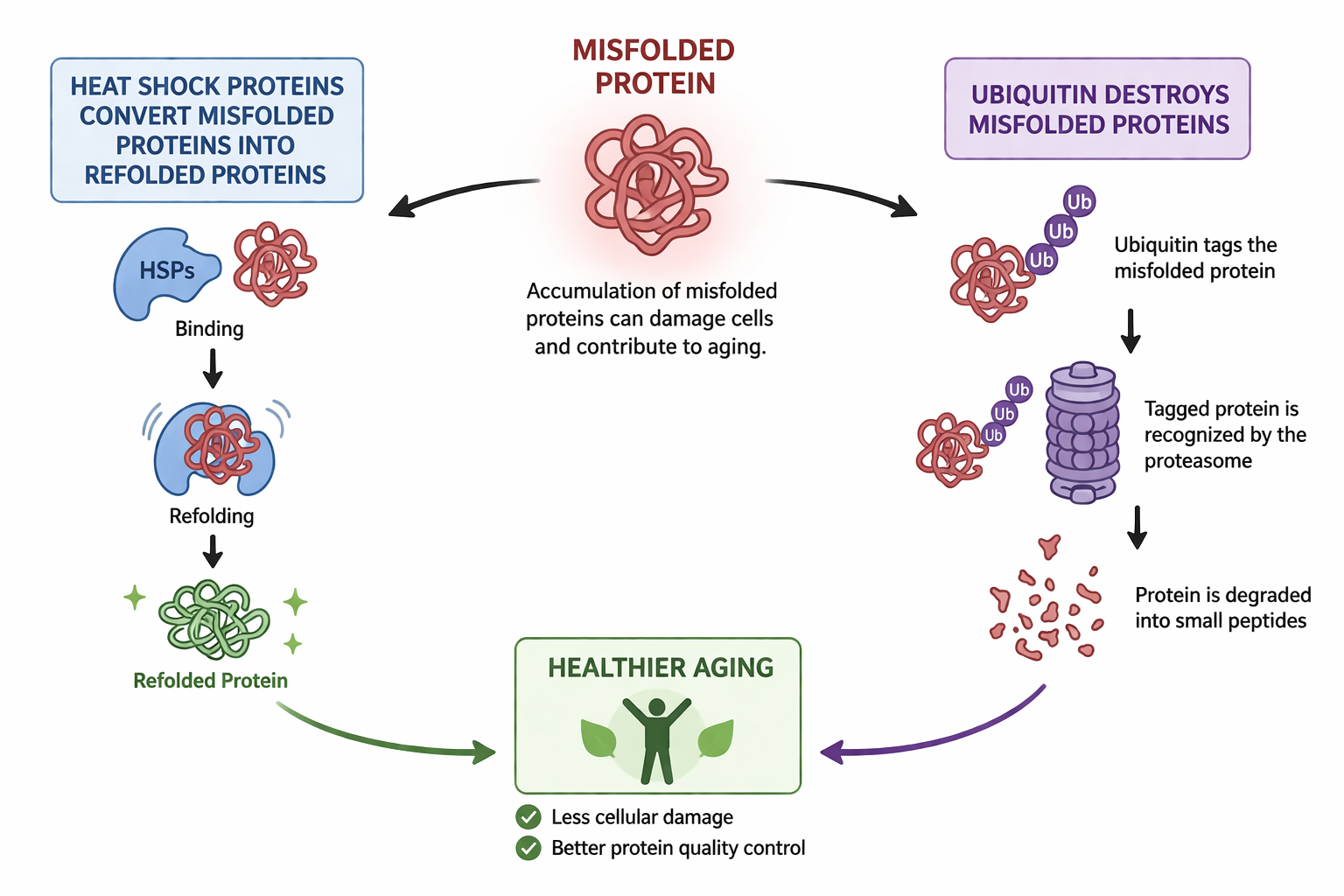
This connection becomes clearer when we examine how cells handle damaged proteins in practice. Inside the cell, one of the main systems responsible for protein cleanup is the ubiquitin–proteasome pathway. In simple terms, this system functions as a tagging and recycling process: proteins that are damaged or no longer needed are marked with a small molecule called ubiquitin, which signals that they should be broken down and removed. As Michael Kiraly explains, “It’s called the ubiquitin proteasome pathway… that’s our natural ability to target proteins that shouldn’t be there anymore” (M. Kiraly, personal communication, March 9, 2026). This process prevents harmful proteins from accumulating and interfering with normal cellular function; however, research has shown that the efficiency of this system declines with age (Koyuncu et al., 2021).
What makes this process especially important is that it is not simply a passive failure. As Michael Kiraly explains, “That pathway is dysregulated with chronically elevated insulin levels or insulin resistance… so that’s another area that people are attributing to premature aging” (M. Kiraly, personal communication, March 9, 2026). In other words, hormonal signals, particularly insulin, play an active regulatory role in determining how efficiently cellular cleanup systems function. High insulin levels act as an anabolic signal that suppresses the ubiquitin–proteasome system (UPS), the cell’s main pathway for breaking down damaged proteins. This also reduces the activity of the 26S proteasome, the structure responsible for carrying out this breakdown (Bennett et al., 2000). As a result, damaged or misfolded proteins accumulate inside cells, and over time, this impaired protein maintenance contributes to cellular dysfunction and accelerates aging-related processes (Koyuncu et al., 2021).
While the ubiquitin–proteasome pathway plays a critical role in removing proteins that are already damaged, it represents only one part of a broader cellular strategy for maintaining protein integrity. Relying solely on degradation would be inefficient, as it requires damage to occur before it can be addressed. This suggests that cells must also employ systems that act earlier in the process, minimizing the formation of dysfunctional proteins in the first place. As a result, protein quality control is not just reactive but also preventative, involving mechanisms that stabilize proteins before they misfold or aggregate. This broader perspective shifts the focus from protein removal alone to the full network of systems that preserve protein function, leading directly to the role of heat shock proteins (Leak, 2014).
Captio3n
Heat shock proteins function as molecular “repair tools,” helping proteins fold into their correct shapes and stabilizing them under conditions of stress (Leak, 2014). Together, these systems form a coordinated defense network that helps determine whether cells maintain their function or gradually decline with age. What makes heat shock proteins particularly important is that they are directly influenced by insulin signaling. When insulin signaling is high, protective systems like heat shock proteins become less active (Leak, 2014). In contrast, when insulin signaling is reduced, it leads to increased production of these protective proteins (Donovan & Marr, 2016).
This shift has major implications for aging. One of the key drivers of cellular decline is the accumulation of misfolded and damaged proteins, which can interfere with normal cellular function. Heat shock proteins help limit this buildup, supporting protein quality control and improving cell survival (Leak, 2014). Higher levels of these proteins have also been linked to slower progression of age-related diseases, particularly those involving protein aggregation in the brain (Leak, 2014). As Kiraly explains, “These molecular chaperones… serve as antioxidants,” emphasizing their broader role in protecting cellular health (M. Kiraly, personal communication, March 9, 2026).
Importantly, this protective system is not only regulated internally but can also be influenced by lifestyle. Physical activity, for example, increases heat shock protein production by raising body temperature and triggering a mild stress response (Sauder, 2024). This helps explain why higher levels of physical activity are often associated with healthier aging. By activating heat shock proteins, exercise supports the same cellular repair and protection systems that are turned on when insulin signaling is reduced.

Captio4n
While these protective systems operate at the level of individual proteins, their activity is not constant. Instead, they are tightly regulated in response to broader changes in the cell’s internal and external environment. This raises an important question: what determines when these maintenance pathways are activated or suppressed? The answer lies in how the body senses and responds to energy availability. Cellular protection systems, including those involved in protein stability, are deeply connected to metabolic signals that reflect whether resources are abundant or limited. As a result, shifts in energy balance do not simply affect metabolism, but also influence the extent to which cells invest in repair, resilience, and long-term maintenance (Bartke, 2008; Siti Bazilah et al., 2022; Kenyon, 2011). One of the most direct ways this regulatory system becomes apparent is during periods of nutrient limitation, such as fasting.
If we examine fasting at the cellular level, these shifts in energy availability are coordinated by a set of nutrient-sensing pathways that regulate how resources are used. One of the most important of these is a protein called AMPK, which functions as the cell’s energy sensor. When energy levels are low, AMPK becomes activated and signals that the cell must conserve resources by slowing down energy-intensive processes. As noted by E. Chu (personal communication, February 25, 2026), one of AMPK’s primary targets is mTOR, a pathway that promotes growth and protein production under nutrient-rich conditions. Rather than acting independently, these pathways work in opposition to balance cellular priorities. When energy is abundant, growth-related processes dominate, but when energy becomes limited, AMPK suppresses mTOR activity, shifting the cell away from building and toward conserving and maintaining its existing structures (Hwangbo et al., 2020).
At the same time, these changes reinforce earlier regulatory mechanisms. Reduced nutrient signaling allows transcription factors such as FOXO to become active, promoting genes involved in stress resistance and cellular protection. In this way, the same conditions that limit growth also enhance the systems responsible for maintaining cellular integrity, linking energy availability directly to the processes that influence aging over time (Bartke, 2008).
Kiraly emphasizes that this shift may be central to longevity, noting that periods of very low insulin, such as those reached during fasting, are associated with “anti-cancer effects and anti–telomere shortening effects,” and may contribute to improved long-term health outcomes (M. Kiraly, personal communication, 9 March 2026). Research supports this idea, showing that fasting and caloric restriction activate these same pathways and can extend lifespan across a range of organisms (Hwangbo et al., 2020). In this sense, fasting is not simply about eating less, but about creating a biological state that prioritizes the maintenance-focused state described earlier.
Importantly, fasting does not introduce entirely new mechanisms. Instead, it activates a response that organisms have relied on throughout evolution that we have discussed. Studies consistently show that both caloric restriction and intermittent fasting extend lifespan through overlapping biological processes, suggesting that these responses are built into our biology rather than artificially imposed (Hwangbo et al., 2020). Fasting involves voluntary shifts in hormonal regulation, which are responsible for these protective mechanisms.
What makes this even more compelling is that fasting is not just a laboratory concept. It has appeared independently across cultures for centuries. Practices such as Ramadan in Islam, Lent in Christianity, and many fasting traditions in Hinduism and Buddhism all involve periods of reduced food intake. These traditions were not developed with molecular biology in mind, yet they may unknowingly engage the same cellular pathways that modern science now links to longevity. This convergence raises an intriguing possibility: that cultural practices may, in part, align with biological mechanisms that support long-term health.

Captio5n
This perspective does not imply that aging can be completely controlled. Biological limits still exist, and damage cannot be entirely prevented. However, it suggests that aging is more dynamic than previously thought. It is influenced by a combination of genetic, metabolic, and environmental factors that interact over time.
Bryan Johnson’s experiment represents one extreme attempt to take control of this process. While his approach may not be practical or even desirable for most people, it reflects a broader shift in how aging is understood. Rather than being viewed as an unavoidable decline, aging is increasingly seen as a process that can be influenced, even if it cannot be fully stopped.
Aging may not be something that simply happens to us, but something shaped by how the body is regulated over time. The same insulin-driven signals that fuel growth and survival early in life can, when sustained, gradually limit the systems that protect and repair our cells. In this way, aging reflects not just damage, but the long-term cost of biological priorities that once kept us alive. This reflects a deeper biological principle. Aging is shaped not by a single cause, but by competing priorities that have been optimized through evolution rather than designed for indefinite survival.
Understanding insulin signaling in this context does not offer a simple solution to aging, nor does it suggest that aging can be stopped. Instead, it provides a framework for understanding why aging occurs the way it does. Rather than being an unavoidable and passive decline, aging emerges as a regulated process, one that can be influenced or slowed down, but not escaped, through the same systems that once enabled growth and survival.
References
Bennett, R. G., Hamel, F. G., & Duckworth, W. C. (2000). Insulin inhibits the ubiquitin-dependent degrading activity of the 26S proteasome. Endocrinology, 141(7), 2508–2517. https://doi.org/10.1210/endo.141.7.7575
Chahal, H. S., & Drake, W. M. (2007). The endocrine system and ageing. Journal of Pathology, 211(2), 173–180. https://doi.org/10.1002/path.2110
Donovan, M. R., & Marr, M. T. (2016). dFOXO activates large and small heat shock protein genes in response to oxidative stress to maintain proteostasis in Drosophila. Journal of Biological Chemistry, 291(36), 19042–19050. https://doi.org/10.1074/jbc.M309069200
Dowell, P., Otto, T. C., Adi, S., & Lane, M. D. (2003). Convergence of peroxisome proliferator-activated receptor γ and Foxo1 signaling pathways. Journal of Biological Chemistry, 278(46), 45485–45491. https://doi.org/10.1074/jbc.M309069200
Hwangbo, D. S., Lee, H. Y., Abozaid, L. S., & Min, K. J. (2020). Mechanisms of lifespan regulation by calorie restriction and intermittent fasting in model organisms. Nutrients, 12(4), 1194. https://doi.org/10.3390/nu1204119
Kenyon, C. (2011). The first long-lived mutants: Discovery of the insulin/IGF-1 pathway for ageing. Philosophical Transactions of the Royal Society B: Biological Sciences, 366(1561), 9–16 doi:10.1098/rstb.2010.0276
Koyuncu, S., Loureiro, R., Lee, H. J., Wagle, P., Krueger, M., & Vilchez, D. (2021). Rewiring of the ubiquitinated proteome determines ageing in Caenorhabditis elegans. Nature, 596(7871), 285–290. https://doi.org/10.1038/s41586-021-03781-z
Leak, R. K. (2014). Heat shock proteins in neurodegenerative disorders and aging. Journal of Cell Communication and Signaling, 8(4), 293–310. https://doi.org/10.1007/s12079-014-0243-9
Oh, K. H., & Kim, H. (2013). Reduced IGF signaling prevents muscle cell death in a Caenorhabditis elegans model of muscular dystrophy. Proceedings of the National Academy of Sciences, 110(47), 19024–19029. https://doi.org/10.1073/pnas.1308866110
Sauder, C. (2024). Give aging a little shock with heat shock proteins. Vail Health, ,
Siti Bazilah, Z., Geetha, G., & Goon, J. A. (2022). Uncoupling healthspan and lifespan in long-lived daf-2, pmk-3 and sgk-1 knockdown Caenorhabditis elegans. Med & Health, 17(2), 198–215 https://doi.org/10.17576/MH.2022.1702.15