


Venus Lawson (She/Her)
Venus Lawson is currently a student at Capilano University, graduating with a major in psychology this spring, 2026. Her academic interest focuses on mindset and psychological processes that form human behaviour, specifically in relation to personal growth. Throughout her studies, Venus has accomplished getting on the dean’s list and collaborating with the North Shore Women Center for both Psych 412 and 413, where she gained experience and knowledge of understanding how to collaborate and foster relationships with community partners and apply research to real-world issues. Upon graduation Venus will continue her studies by attending UBC this fall, 2026, for her master’s of management.
Have you ever looked at someone else’s success and wondered if it is just luck? Or do they simply have something you don’t? The world has taken the word “mindset” and created 30-second videos and slogans we’ve all heard before. “Think big” and “be the best version of yourself,” but what if there was actually a way to change the way you think? No slogan, no 30-second video, just proof. Psychological research argues that mindset is not fixed and can be changed through repetition, experience, and neuroplasticity, which is the potential to form new neural pathways over time. Aspects such as socioeconomic status, mental health, environmental stressors, and gender roles can affect one’s ability to shift their way of thinking. This article argues how changing your mindset can lead you to the person you’ve wanted to be, starting with a fixed mindset and then moving to a growth mindset through the practice of neuroplasticity. Even though this process might not be accessible to everyone. Through the integration of lived experience, interview, and research, the article will explore how mindset change can be achieved.
Social media is everywhere and is constantly being consumed by users. In the past couple of years, the topic of mindset has taken a large part of the conversation on social media. Mindset is often talked about on platforms like TikTok, YouTube, and Instagram, yet so much critical information is missed within these short videos. Most videos tell their viewers to think positively and instantly see a change in their life without acknowledging that changing the way you think takes time, effort, and repetition. They forget to mention to their users that changing your thoughts doesn’t happen overnight. These claims not only misrepresent psychological theories but also place pressure on individuals to believe that failure came from not thinking positively enough and that is the reason they did not see results in their lives.
The concepts of fixed and growth mindsets were created by psychologist Carol Dweck, who explained that a fixed mindset is a belief that your abilities and intellect cannot change. This could be why individuals with a fixed mindset give up more easily or believe when they fail that it is evidence that they are not capable, whereas a growth mindset is believing that your capabilities can improve over time with persistence and dedication. A growth-minded individual would perceive failure as a learning opportunity and a lesson to understand what they did wrong to not repeat it again, instead of seeing their failure as having given up or losing. Dweck stated, “You have a choice. Mindsets are just beliefs. They’re powerful beliefs, but they’re just something in your mind, and you can change your mind. As you read, think about where you’d like to go and which mindset will take you there.” (Dweck 21). It is important to understand that we have the power to shape our thoughts and beliefs. And each individual changes their way of thinking differently, and that’s okay. Instead of listening to what everyone else is doing and copying it, learn about yourself. Learn what motivates you to change your mind and follow that. I believe that when we are listening to others, at times we tend to lose our own thoughts and ideas because we get influenced by others, and I believe it is important to create your own way of thinking because a strategy could work for one person, but it could totally fail for another. This begs the question: How do individuals simply change their beliefs when they are formed by external factors and experiences?
Mindset describes to us how we think. Neuroplasticity explains to us how to change the way we think. Neuroplasticity is the brain’s ability to form new neural pathways in reaction to repeated actions, thoughts, and behaviours. What this tells us is that the way we think is not fixed but can change over time through new repeated actions, thoughts, and behaviours. This process is further demonstrated through Hebbian’s theory which displays how these changes occur in the brain. “Hebbian plasticity is a well-established framework for algorithmically representing the physiological changes induced by coincident activity between connected neurons.”(Triche et al.) Research on neuroplasticity displays that repetitive practice leads to physically changing the brain’s form. As Lazar et al. explains “These data provide the first structural evidence for experience-dependent cortical plasticity” Repeated experience can lead to further strengthening thoughts that can alter our brain structure. As Draganski demonstrates, “Our findings indicate that learning – induced cortisol plasticity is also reflected at a structural level” (Draganski 311). This process is not insistent; it takes time, effort, and repetition, but you will see a change. Unlike the 30-second videos on social media, neuroplasticity conveys to people that mindset change is possible but occurs gradually, not instantly.
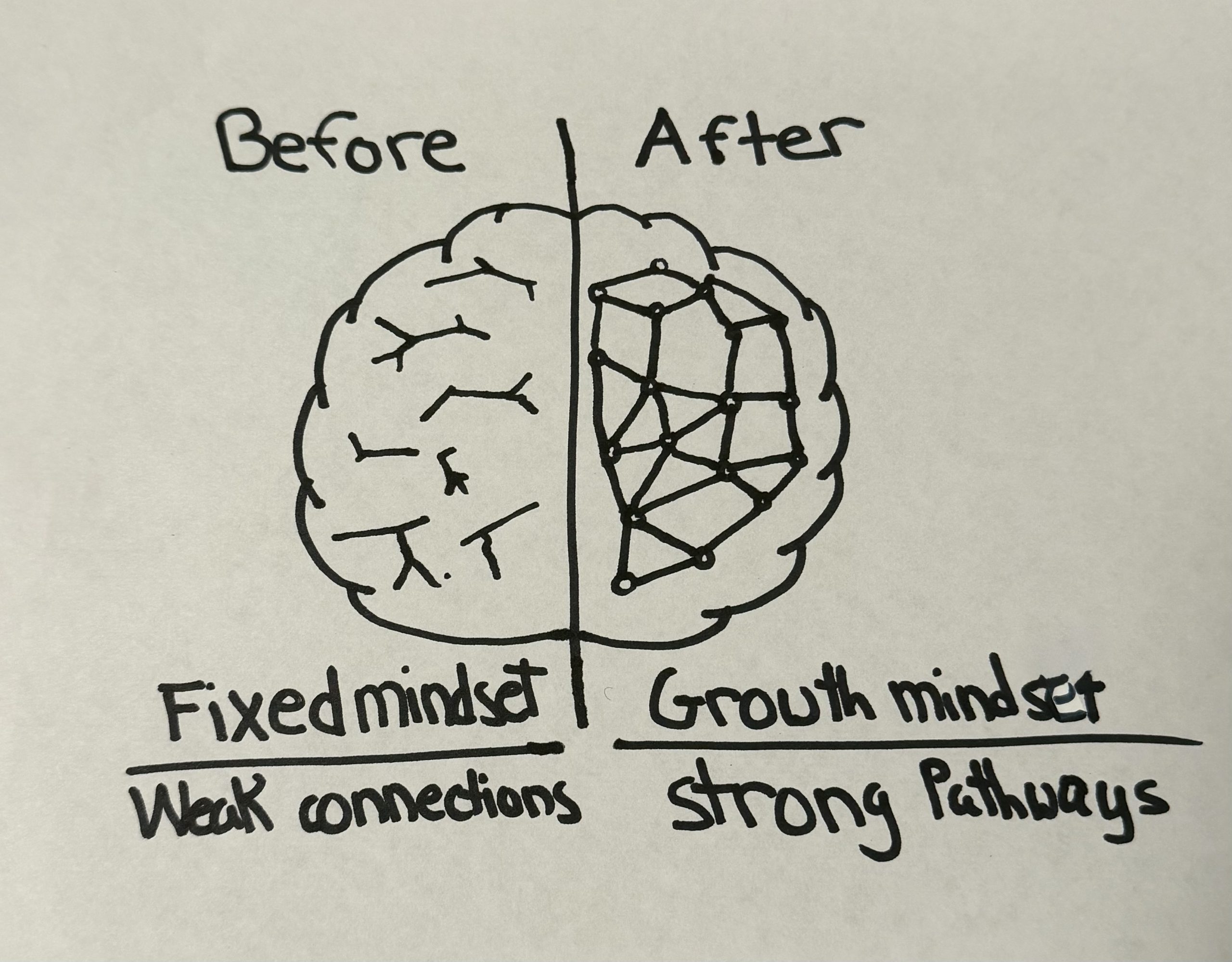
The photograph taken by the author represents neuroplasticity, displaying the brain’s ability to form new neural pathways over time.
While getting a psychological and scientific perspective of how mindset and neuroplasticity work, the lived experience of Cynthia Lawson reveals how these changes occur in real life. Cynthia Lawson, a Vancouver-based business owner of Lawson Tutoring, expressed how at the beginning of her company she had started with a fixed mindset where setbacks were seen as failures. At the beginning of building her company, she remembers not believing in herself and what she could achieve and saw any obstacle as a sign that growth is not attainable. But over time that perspective began to change; she started to shift the way she thought, acted, and behaved. Instead of seeing obstacles as problems, she began to see them as an opportunity to learn what she is repeatedly doing wrong and figure out what she could do to solve it. For example, losing a student or not missing a business opportunity was not seen as the end but instead pushed her to want to work harder and understand the actions she would have to take next. This lived experience reflects to us what mindset change looks like, transitioning toward a growth mindset where strategy and achievement replace quitting and self-doubt. She further highlights how her internal dialogue with herself changed over time, explaining how in the beginning her thoughts were often self-critical, which strengthened the feeling of having limitations. Whereas now her thoughts push her out of her comfort zone and limit reinforcing adaptability and persistence.Which conveys that repeated patterns can either reinforce a growth or fixed mindset. Cynthia’s lived experience demonstrated how one can shift from a fixed to growth mindset not instantly but with repeated effort and time, revealing that mindset is not just a belief but a process that changes through internal and external effects. Cynthia stated,”You just need to realize that those thoughts are affecting so much of your life by putting yourself down and telling yourself you’re not good enough or you can’t do this. You can’t do that; it’s honestly not doing you any good or anyone around you. I also think it makes the things you want to pursue in life harder to achieve because it makes those goals almost unattainable when you tell yourself that you can get there” (Lawson, personal communication).

The photograph taken by the author illustrates the role of time and patience in achieving significant cognitive change.
By now we know that mindset can change and adapt, but it is important to understand that circumstances also influence our brain. We have the perception at times to assume all individuals have the resources, stability, and time to regularly work on themselves. Factors such as financial burden, mental health, exterior circumstances, and expectation have an effect on developing a new way of thinking. Furthermore, that does not mean that circumstances in life define outcomes or where one wants to get in life. Most importantly, if you have a goal and a vision, your circumstances might make it hard but not impossible to change your way of thinking. In research they found that most growth comes through hardship “posttraumatic growth is the experience of positive change that occurs as a result of the struggle with highly challenging life crises” (Tedeschi et al. 1). In a way, struggle is sometimes good; at times it takes an individual being at their worst to understand their potential and to learn from their mistakes and to see them as lessons because when we are at our worst, we learn so much about ourselves, including how resilient and strong we are as humans. Our mistakes and failures do not define us or the person we want to be. Instead it reflects the version that our mind is at currently. When we realize that thoughts have so much power over our lives, we begin to change the way we think of ourselves. At times it is only through hardship that we learn who we truly are and the worth that we have, which leads us to developing a new mindset or a new way of defining ourselves not only to us but to others. In the moments when we are at our lowest, we often want to repress the feeling, but instead embracing the way you feel no matter what you are going through could sometimes help us move through the emotion instead of blocking it away because going through allows us to understand ourselves better and move closer towards how we want to think and who we want to be. As Masten explains “the capacity for developmental recovery when normative rearing conditions are restored is amazing” (Masten 233). While circumstances have an influence on us, they do not define our future.

The photograph taken by the author represents how, just like in a flower blooming, mindset develops gradually through repetition and care.
In today’s world most of us all have social media, and we’ve all been victims of swiping through it, where we sit on our phones and scroll for hours each day. Creating a pattern of instant gratification, swiping, liking, and new content every second provides the viewer with immediate reward. In contrast to changing the mindset, which takes effort, time, and reception, it is not instant like what we are used to from getting from social media platforms. From a neurological point of view, social media can condition the brain to seek immediate rewards instead of delayed outcomes. As researchers convey “Dopamine drives learning, habit formation, and goal-directed actions by reinforcing behaviors that lead to pleasure.”(Guy-Evans). Therefore, individuals may struggle with continuing to change their way of thinking because there isn’t immediate gratification, and in neuroplasticity, consistency is key to developing a growth mindset. Further, it creates a gap between how to change the way you think and how it is shown on social media. My favourite example is the one of going to the gym; if you go once, you won’t see a change in the way you look, but if you go everyday and train a bit, you will start to see a change. Just like our minds, changing the way we think is like going to the gym to see results; it takes consistency, time, and effort; it is not instant. This can be attributed to why many individuals may have a hard time moving from a fixed to a growth mindset. Furthermore, being on social media, we are constantly comparing ourselves to others. When success is shown to look easy on social media, individuals with a fixed mindset might think they are not good enough, which further reinforces the fixed mindset and makes the individual feel more of the self-doubt they might already be feeling and continue to be stuck in a negative headspace. The digital environment has a habit of misrepresenting mindset and also forming how individuals think and perceive themselves. The internet makes it a hard place to implement the process of repetition, consistency, and effort, which are key components to changing your thoughts.

The photograph taken by the author represents gradual change that happens step by step rather than an instant transformation.
Understanding mindset takes time and consistency. Bandura described “expectations of personal efficacy determine whether coping behavior will be initiated, how much effort will be expended, and how long it will be sustained in the face of obstacles and aversive experiences.” (Bandura 191). A way to begin the journey of changing your mindset is through self-talk. That internal voice we all have in our head is what could reinforce a fixed mindset versus a growth mindset. For example, if you find yourself saying “I can’t do this” change the wording in your head and tell yourself “I am becoming capable” and then with practice and repetition of saying that, later on you can start saying “I can do it” because this creates a more gradual and realistic approach. Starting small reduces the pressure to perform immediately Instead when you build yourself up to that then when you can easily transition to start saying “I can do it” you won’t feel that intense pressure to perform you’ll feel ready because you’ve been building yourself to that point instead of jumping from 1 to 100, you meticulously created steps to work toward changing your mind and thoughts so you don’t fall back into a pattern of a fixed mindset, which I believe can happen when you want immediate results. I have noticed a lot of social media platforms videos that tell people to immediately change their wording but I think it sets you up for failure because even if you keep telling yourself “you can” it puts too much pressure and stress for you that you start resisting what you’re telling yourself, and instead when you take it step by step you will build a strong foundation into reshaping how your brain responds to difficult situations. Behaviour also plays an important role in mindset change by continuing through challenges, and the progression of the mindset change is slow; it helps build the new neural pathways that connect with effort and learning. This is exactly what neuroplasticity is, where we repeat actions, which then gradually create new pathways, which then rewire the way we think and our brain, but this process is a combination of combining your thoughts, behaviours, and experiences together to create new patterns, and by understanding this process, it allows individuals to integrate a growth mindset into their life as a long-term practice and not a quick fix.
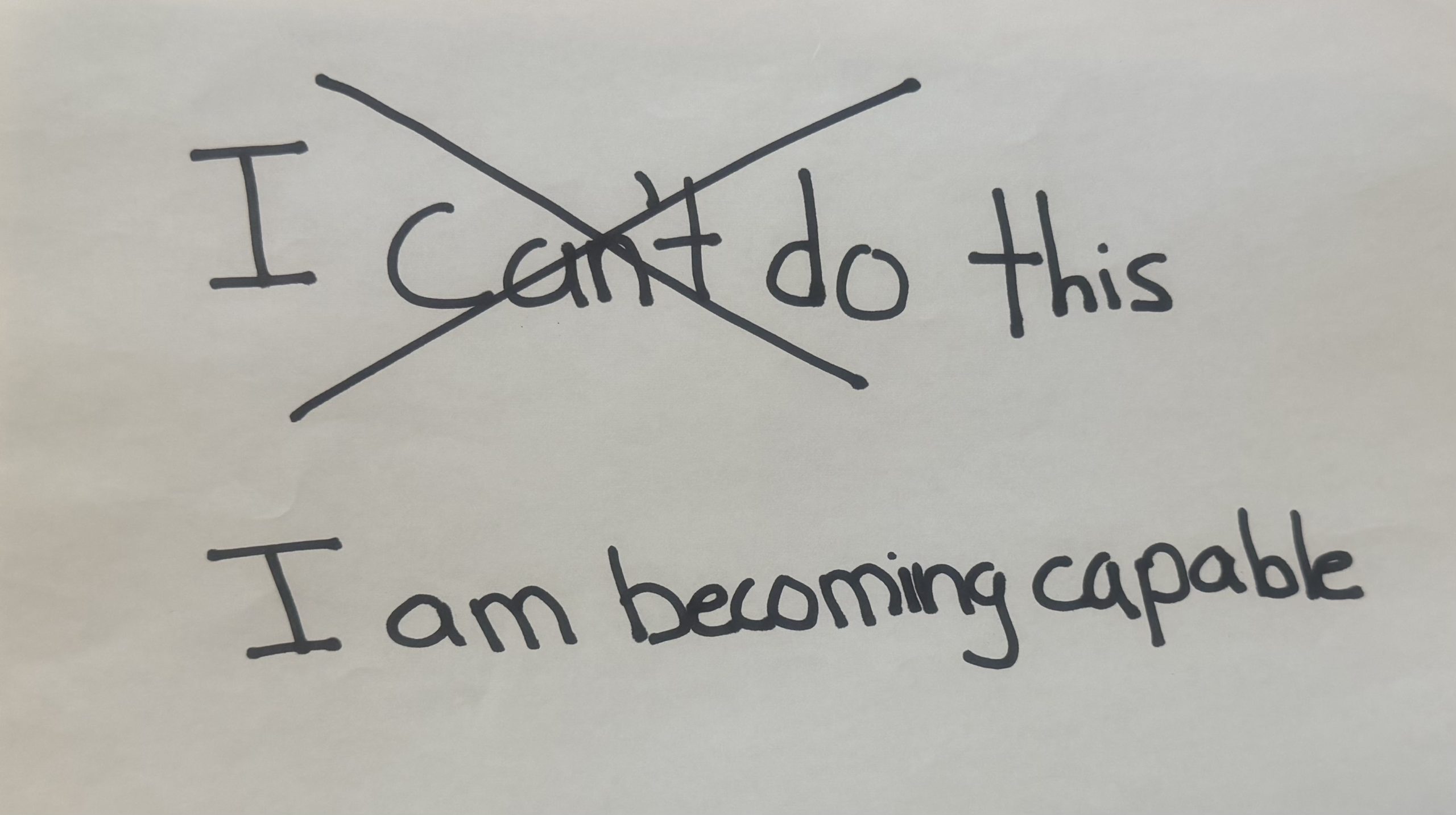
The photograph taken by the author demonstrates a shift of self-talk from “I can’t do this” to “I am becoming capable,” which reflects the transition from a fixed to growth mindset.
If you’ve come to the end, you are now closer to the version you want to be. You’ve realized that mindset is not fixed, and by wanting to implement a new way of thinking, it is not just motivation that changes the way you think; it is an intentional practice you decide to integrate into your life each day to shift your mind. Through repetition your brain starts to form and add new neural pathways of thinking. The way you think is not fixed; it is a pattern that can be changed. It is important to remember, whatever circumstance you are in now, that it does not define the person you are or want to achieve to be. Focus on self-love and if you want to change the way you think, just start small and start now.
Works Cited
Bandura, Albert. “Self-Efficacy: Toward a unifying theory of behavioral change.” Psychological Review, vol. 84, no. 2, 1977, pp.191-215. https://dradamvolungis.com/wp-content/uploads/2011/06/self-efficacy-unifying-theory-of-behavioral-change-bandura-1977.pdf
Draganski, Bogdan, et al. “Neuroplasticity: Changes in Grey Matter Induced by Training.”Nature, vol. 427, no. 6972, Jan. 2004, pp. 311–12. EBSCOhost, https://doi-org.ezproxy.capilanou.ca/10.1038/427311a.
Dweck, Carol S. “Mindset: The New Psychology of Success Dweck : Free Download, Borrow, and Streaming.” Internet Archive, 28 Feb. 2006, archive.org/details/mindset-the-new-psychology-of-success-dweck. Accessed 01 Mar. 2026.
Guy-Evans, Olivia. “Brain Reward System.” Simply Psychology, 30 June 2025, www.simplypsychology.org/brain-reward-system.html. Accessed 11 Apr. 2026.
Lazar, Sara W, et al. “Meditation Experience Is Associated with Increased Cortical Thickness.”NeuroReport, Vol.16, no.17, 2005, pp.1893-1897 surfer.nmr.mgh.harvard.edu/pub/articles/Lazar_Meditation_Plasticity_05.pdf. Accessed 11 Apr. 2026.
Masten, Ann S. (2001). “Ordinary magic: Resilience in development.” American Psychologist, vol. 56, no.3, 2001 pp.227-238.
Tedeschi, Richard G., and Lawrence G. Calhoun. “Posttraumatic Growth: Conceptual Foundations and Empirical Evidence.” Psychological Inquiry, vol. 15, no. 1, Jan. 2004, pp. 1–18. EBSCOhost, research.ebsco.com/linkprocessor/plink?id=54fbe358-c89d-347b-a22b-2941f4fdcb05.
Triche, Anthony et al. “Exploration in neo-Hebbian reinforcement learning: Computational approaches to the exploration-exploitation balance with bio-inspired neural networks.” Neural networks : the official journal of the International Neural Network Society vol. 151 (2022): 16-33. doi:10.1016/j.neunet.2022.03.021