


Freya Isham-Turner
Freya Isham-Turner (she/her) is completing her Bachelor of Arts with a Major in Interdisciplinary Studies. During her time at Capilano University, she has earned recognition on the Dean’s List numerous times. Her diverse coursework has allowed her to take different disciplinary lenses and apply them to historical contexts to help strengthen ideas and arguments about the past, something she is incredibly passionate about. Upon graduation, Freya plans to pursue a Master’s in History. She has recently begun volunteering at the Museum and Archives of North Vancouver MONOVA as a curatorial assistant to gain experience in a historical career.
The year is 1908, and a small statuette of a woman, dating between 28,000 and 25,000 BCE (Mercadal), is discovered in Willendorf, Austria, her body stands out starkly against those who discovered her; her large breasts and naked body are evident. She is named Venus of Willendorf, though Venus would not be an accurate name. Venus, or Aphrodite, was the shared Greek and Roman goddess of “feminine beauty, sex-appeal, and love” (Marcovich 43). A figure in mythology who has been seen as a sexual object, a goddess whose “gorgeousness, voluptuousness, and sensuousness” body has been “established as scholarly facts” (Marcovich 44). That is not this statuette. Today, we better understand her outside of this vision of a sexual object; we see her detailed hair and body as a symbol of a woman with important power within the Paleolithic world. She does not represent a specific person, but rather women as a whole. This statuette may have been seen as a religious symbol, one of fertility (Mercadal). Further than just a religious symbol, McDermott, a researcher of feminist theory in relation to the Paleolithic period, writes, “these early figurines embodied obstetrical and gynecological information and probably signified an advance in women’s self-conscious control over the material conditions of their reproductive lives” (McDermott 227). When she was found, this was not understood; contemporary assumptions impacted her, impacted how we saw women of the past. For example, in 1949, Karel Absolon wrote an article on similar statuettes to the Venus of Willendorf, the article states, “the origin of these statuettes is due to sexual-biological, erotic motives” (Absolon 204). This is not an accurate description of these statuettes, but contemporary beliefs impacted and created this narrative. Venus has since been renamed to the Woman of Willendorf, and this is a more accurate name for a statuette that represents something much greater than her body.
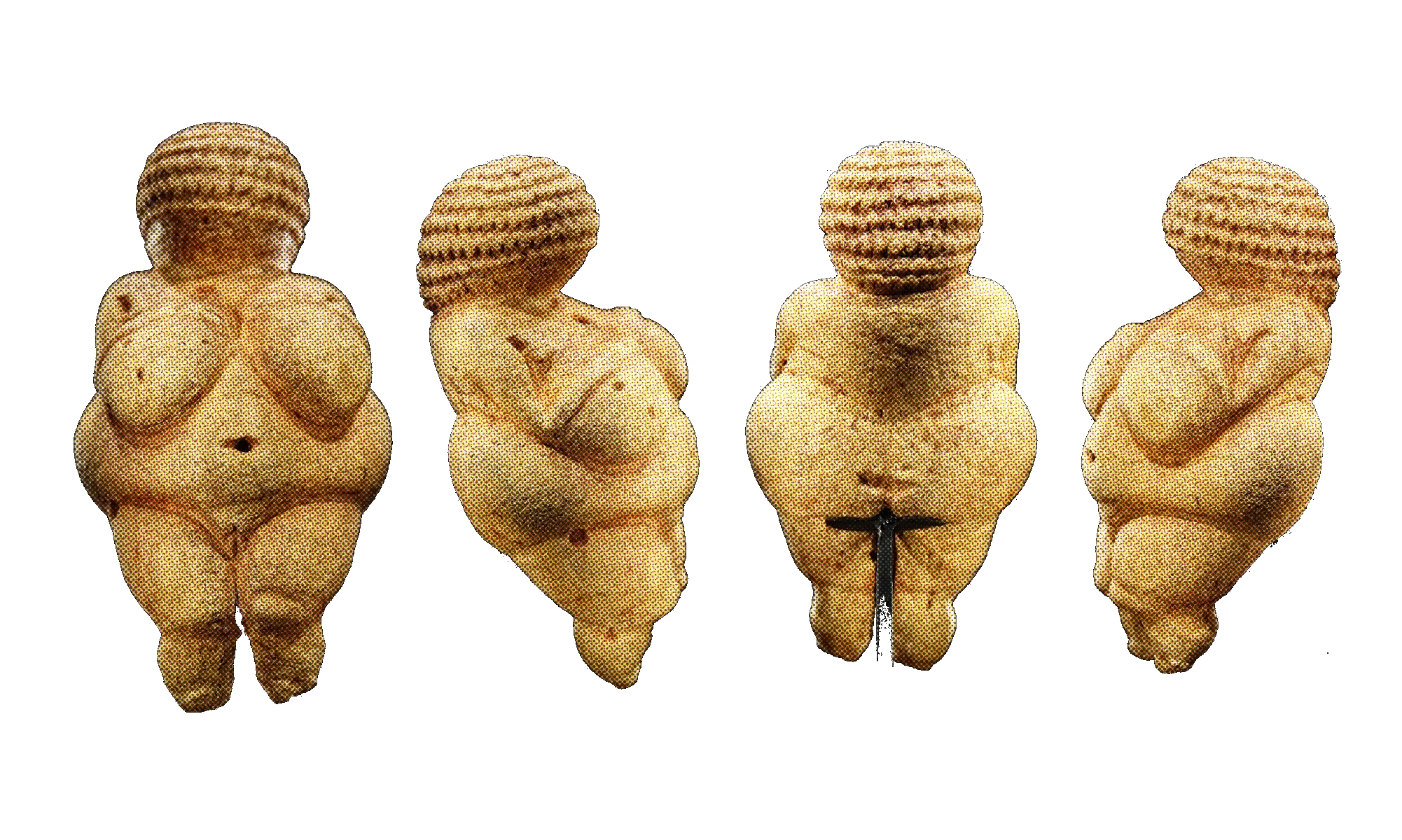
The Woman of Willendorf, dating between 28,000 and 25,000 BCE, is a palm-sized statuette that, when first discovered, was believed to represent sexual imagery. Now this statuette is understood as a fertility symbol or as a tool used to understand gynecological information during the Paleolithic Period.
(Edited image originally sourced from Bjørn Christian Tørrissen, Venus of Willendorf, photograph, Wikipedia, 2020, https://en.wikipedia.org/wiki/Venus_of_Willendorf#/media/File:Venus_of_Willendorf_-_All_sides.jpg.)
Art, especially art of the ancient world, often doesn’t show accurate representations of the natural world or people. Art was often idealised in order to represent a specific idea rather than the whole truth. This does not mean that art should not or cannot tell us about the ancient world, for it is an incredible way to see into the past, to learn and discover the thoughts and beliefs of those who came before us. Unfortunately, when looking into the ancient world, our contemporary lives and beliefs often influence how we view the past; it is inevitable. We as humans are always going to take our own lives and apply it to the ancient world, whether this is subconscious or not. Oftentimes, this can help us understand the past, and can help us make interpretations about the past, especially when history is sometimes guesswork. This paper will argue, by looking at art from prehistory as well as ancient Egypt, that the representation of women in ancient art fuels contemporary assumptions about the past, which results in inaccuracies about the ancient world and inaccuracies about the lives of women. Historical evidence shows that these assumptions are incorrect. Women of the ancient world did, in fact, hold power over their own lives as well as the lives of others, despite what we might believe based on representations of women and contemporary assumptions that dictate how we look at the ancient world.
The Woman of Willendorf has become an icon of prehistoric art; she is easily recognisable with her pronounced female form (Seshadri 134). However, her form is not an accurate depiction of the human figure (McDermott 228). Today, this is a form that we understand further than what is explicitly shown. We look beyond the faceless head, thin arms, large breasts and buttocks and towards what this represents outside of the body (McDermott 228). We understand it more clearly based on how the study of history has begun to shift to focus more on the lives of those who, historically, in the study of history, have been ignored, such as the lives of women. Dr. Nanci Lucas, a historian at Capilano University and a historian who understands the change the discipline of history has undergone through her years of experience in the field, explains that “history nowadays is far more inclusive…you have different voices that come in, different voices that have value and add to our view of history” (Lucas). As we start to look at history away from a harmful narrative that only focuses on ‘old white man’s history,’ we start to understand the past more accurately. Our past is more than the history of one specific group or groups of people. The past becomes distorted if we neglect specific groups and individuals, such as women (Alvarado 613).
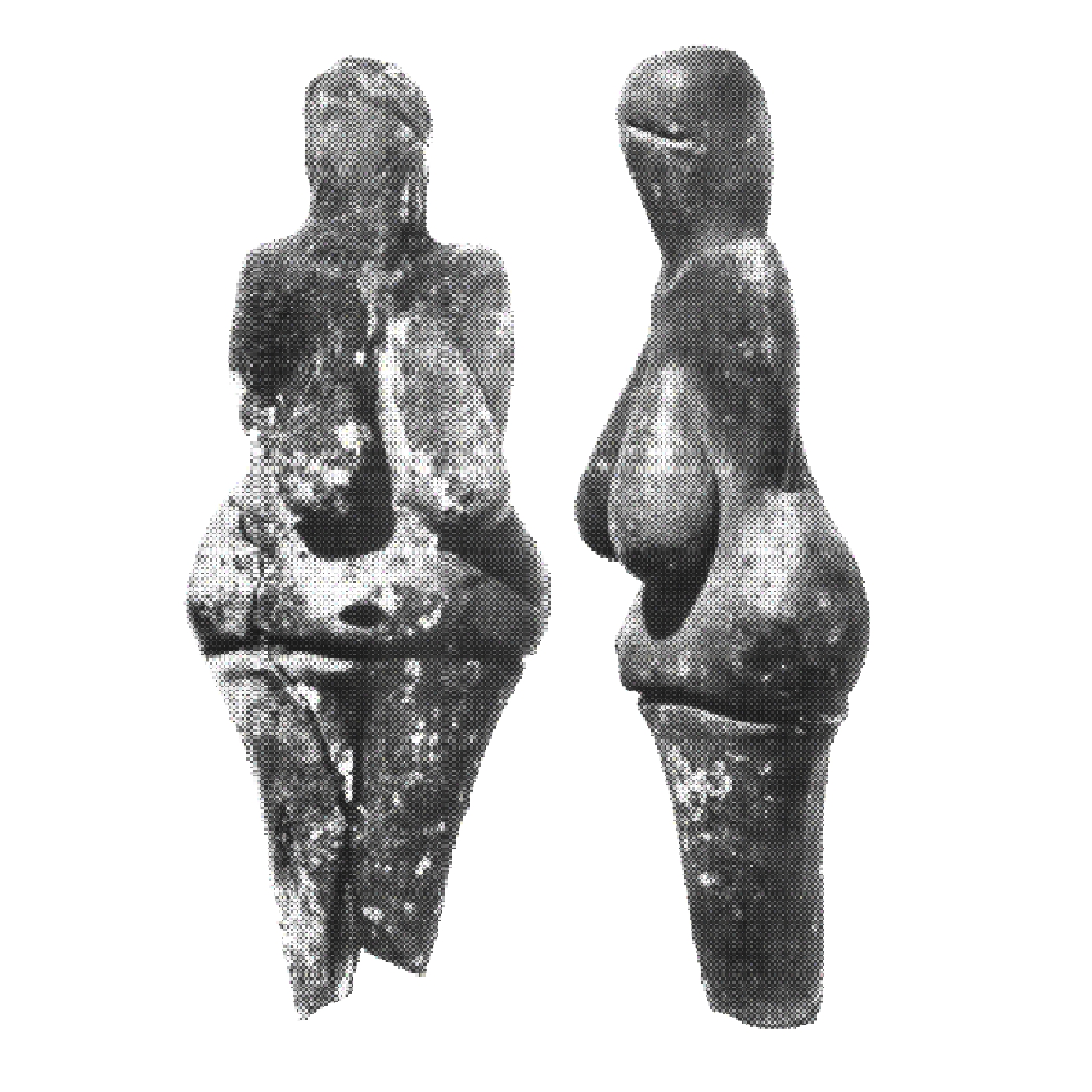
One of many ‘Venus’ statuettes. Represents the same ideas as the Woman of Willendorf.
(Edited image originally sourced from Karel Absolon, ‘Venus’ statuette, photograph, 1949, in “The Diluvial Anthropomorphic Statuettes and Drawings, Especially the So-Called Venus Statuettes, Discovered in Moravia: A Comparative Study,” Artibus Asiae 12, no. 3 (1949): 202. https://doi.org/10.2307/3248385.)
This distorted past is evident when we look at the assumptions of the ancient world, assumptions based on how women were represented. In 1949, according to those who dominated the narrative of the past, the Woman of Willendorf, alongside other ‘Venus’ statuettes, were considered “plastic pornography” (Absolon 208). This view of these statuettes is based on the contemporary beliefs and assumptions of women that many held during the time this paper was written, or even earlier, around the time that many of these statuettes were being discovered solely by male archaeologists. Before history began to consider the voices of others, history was interpreted predominantly by men, and the 1949 paper by Absolon is evidence of that. The ‘Venus’ statuettes have been interpreted as sex objects because of contemporary societal opinions, with their bodies only representing male concerns and interests (McCoid and McDermott 319). This continues today, and we see this in how narratives about women from the ancient world are interpreted.
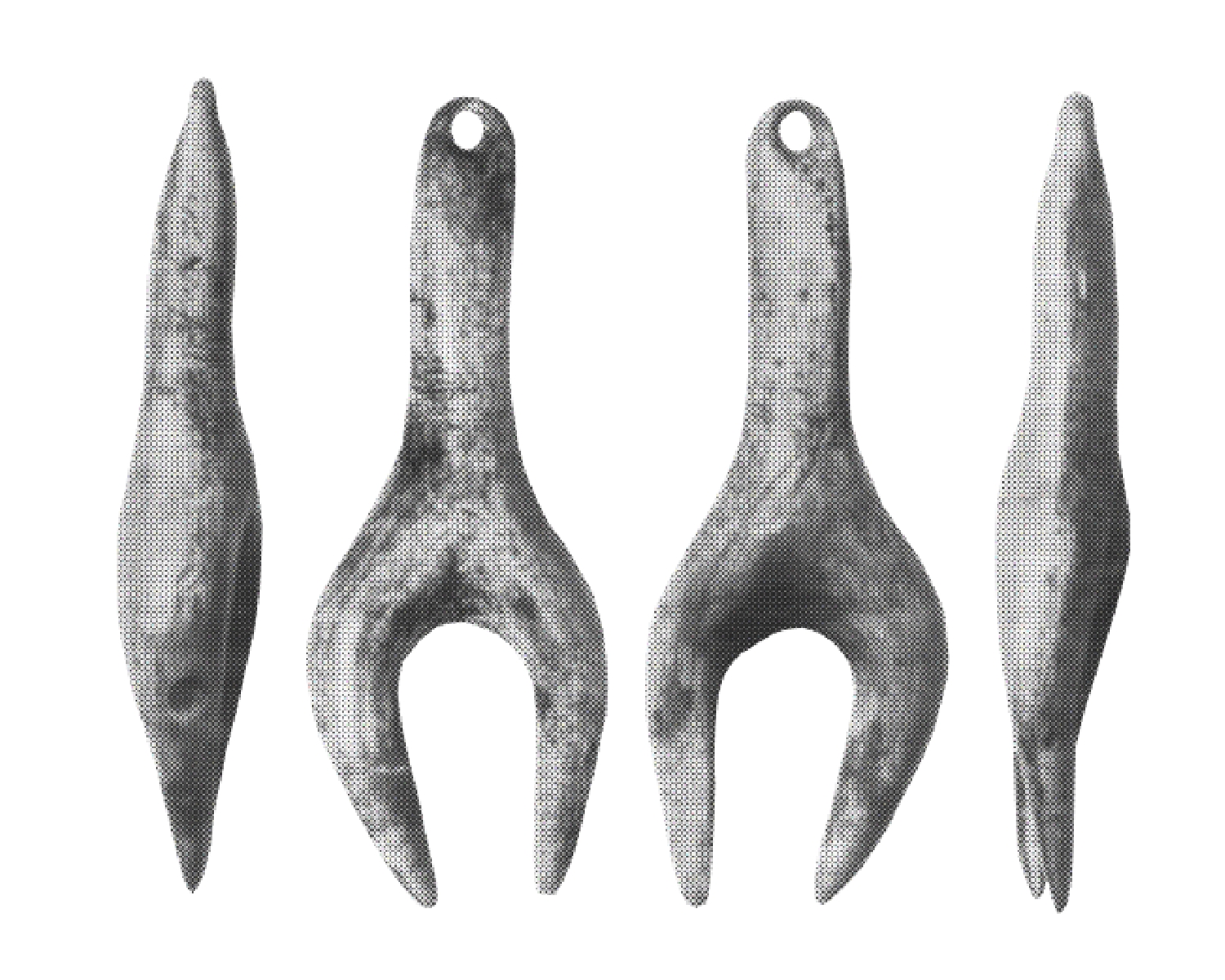
A much simpler version of the many ‘Venus’ statuettes. This simple representation of the female body was referred to as “plastic pornography” by Karel Absolon in 1949.
(Edited image originally sourced from Karel Absolon, ‘Venus’ statuette, photograph, 1949, in “The Diluvial Anthropomorphic Statuettes and Drawings, Especially the So-Called Venus Statuettes, Discovered in Moravia: A Comparative Study,” Artibus Asiae 12, no. 3 (1949): 208. https://doi.org/10.2307/3248385.)
The Woman of Willendorf, and what she represents, women of the Paleolithic period, are not alone in these inaccurate assumptions about women of the past. These statuettes represent women as a whole, but what of the representations of specific women, statues that represent specific, nameable women in history? Do these women, based on the representations of them, experience inaccurate narratives of themselves based on how they are seen in ancient art? In the case of ancient Egyptian Queen Hatshepsut, yes. Queen Hatshepsut, who reigned from 1479 to 1458 BCE, alongside many other female rulers in history, wielded great power (Tyldesley). Hatshepsut’s reign was one of peace, a focus on trade rather than war (Tyldesley). Within her mortuary temple at Deir El-Bahri, there are fresco scenes of her trading expedition to Punt, on the East African coast (Tyldesley). These scenes show Hatshepsut as a great leader, one who achieved greatness and the way in which Queen Hatshepsut chose to represent herself, to show her power, was through the use of statues. In these statues, Queen Hatshepsut chose to represent herself as a man; she appears as a king. She adorns kingly garb in her royal crown and false beard (Diamond 180). She holds herself in masculine poses and carries symbols reserved for male kings (Diamond 168). Within these statues, she holds herself as a man and dresses as one, depicting herself as a female king; in many others, she also presents herself physically as a man with a man’s chest and build (Hilliard and Wurtzel 25).
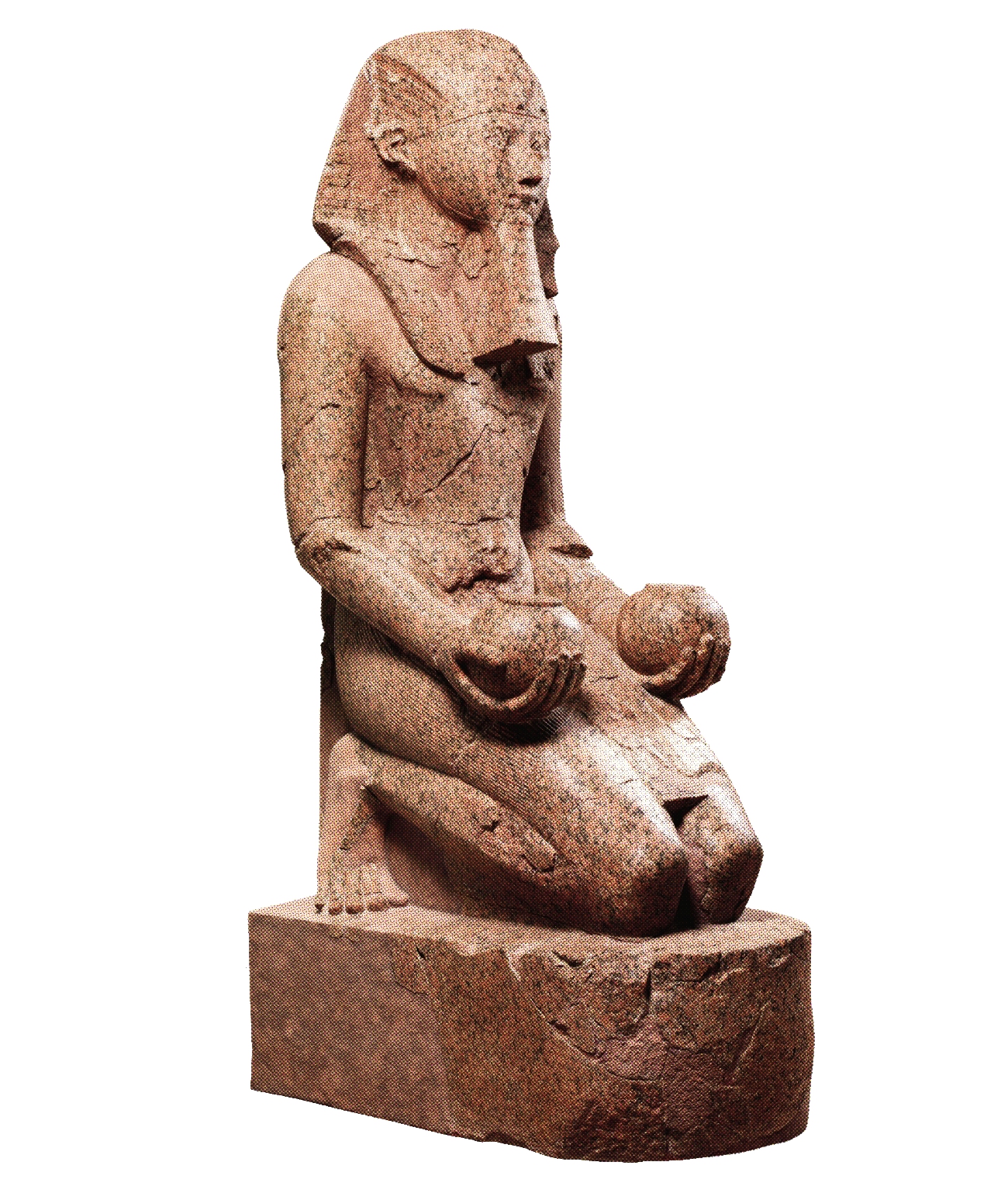
This kneeling full-body statue of Queen Hatshepsut from 1479–1458 BCE shows her represented with male symbols of leadership. Such as a false beard, the nemes-headcloth, and the shendyt-kilt. All regalia of an ideal Egyptian king. Hatshepsut is also represented with male musculature.
(Edited image originally sourced from Large Kneeling Statue of Hatshepsut, 1479–1458 BCE, The Metropolitan Museum of Art, https://www.metmuseum.org/art/collection/search/544449.)
Unfortunately, the way in which Hatshepsut chose to represent herself led to an inaccurate narrative of her past based on the contemporary assumptions around the time her mortuary temple and, subsequently, statues, were discovered. In the 1920s, as William Hayes and Herbert Winlock, two Metropolitan Museum of Art curators, began to excavate her temple, an inaccurate idea about her formed (Pobric). Unlike the Woman of Willendorf, Queen Hatshepsut did not stand out starkly against those who discovered her. She was similar to them in their male stature; despite this, the way in which this ancient era represented women led to an inaccurate narrative. In 1953, Hayes wrote that “it was not long, however, before this vain, ambitious, and unscrupulous woman showed herself in her true colours” (Hayes 82). Queen Hatshepsut was being described in these ways based on how she represented herself in art. She was seen to have usurped the throne from Thutmose III, her nephew-stepson. Hayes continues, “she contrived […] to have herself crowned king” (Hayes 82). She did crown herself king, but not in the vain, ambitious, and unscrupulous way Hayes had described her.
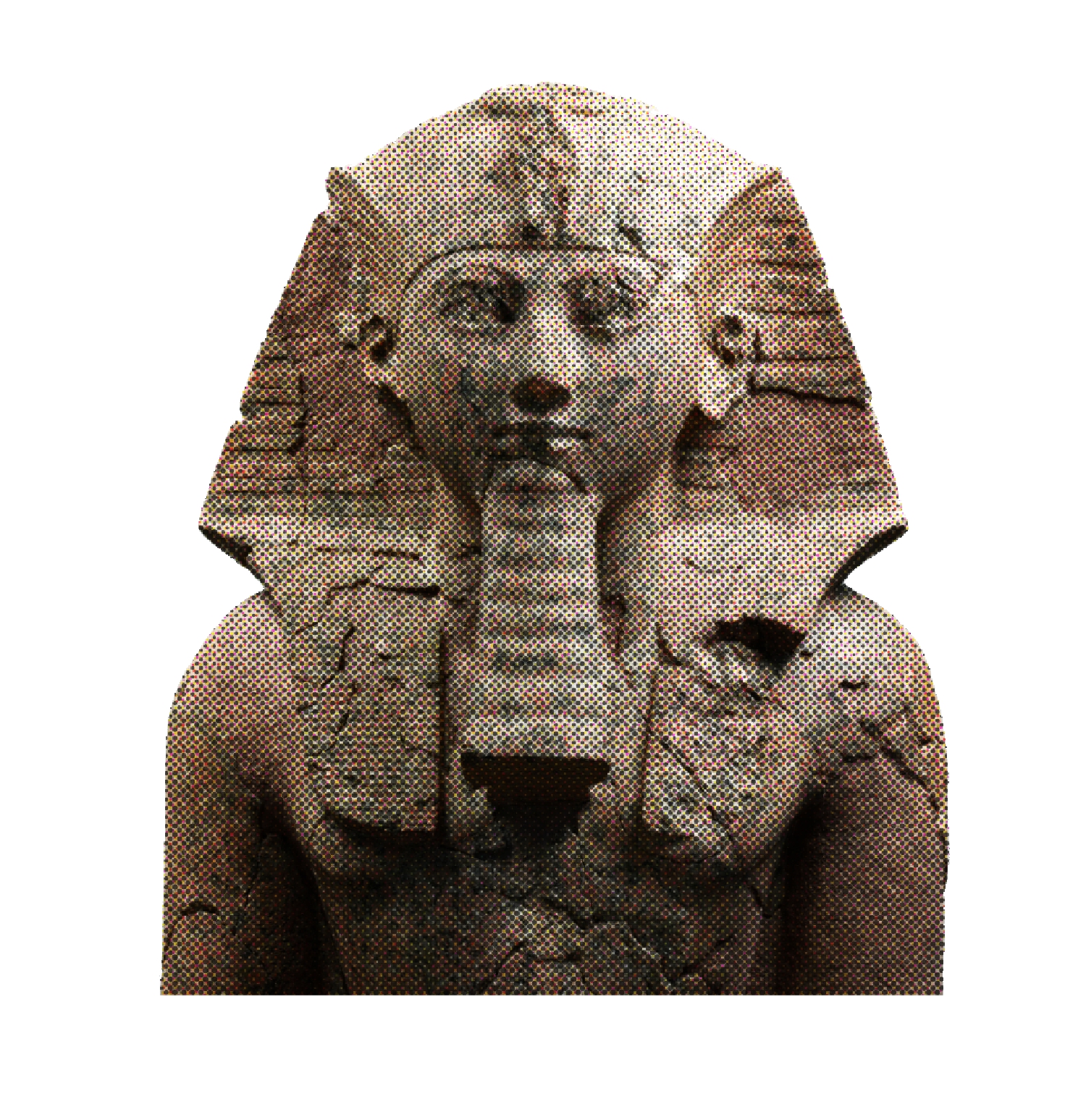
This close-up of a full-body statue of Queen Hatshepsut shows her wearing a false beard and nemes-headcloth. All regalia of an ideal Egyptian king.
(Edited image originally sourced from Large Kneeling Statue of Hatshepsut, 1479–1458 BCE, The Metropolitan Museum of Art, https://www.metmuseum.org/art/collection/search/544449.)
Hayes’ narrative is not accurate at all. She chose to represent herself the same way all pharaohs before her had, a pharaoh eluding power. Today, we know that this original narrative of her was not true, and we know this because we now consider other voices in history. Again, as Dr. Lucas explains, “History is history, but the story is always ever-changing because we as a society…[change]” (Lucas). As we understand today, as society has changed and in turn has reconsidered the past, Hatshepsut was not pretending to be a man to fool anyone or to steal the throne from Thutmose III; in fact, she ruled alongside her nephew-stepson, as co-rulers of Egypt (Roehrig et. al. 3). Rather, she was performing and showing leadership the same way pharaohs before her had. The way she represented herself clearly identified her as a ruler and made her recognisable to the people she ruled over. All leaders before her represented themselves with royal crowns, headdresses, and false beards, or symbols of gods, like how in one statue, Hatshepsut is dressed as the Egyptian god Osiris (Diamond 180). This way of representing leadership happened to be with exaggerated male musculature and symbols. She did not want to be a man, rather she wanted what masculinity could offer her, and this was a recognisable symbol of leadership (Diamond 170). Ancient Egyptian art followed a canon, and Queen Hatshepsut’s statues follow exactly that. The way in which leaders were represented were not accurate; rather, they represented an idea. In the case of Hatshepsut, her statues represented her as a powerful ruler. Although the Woman of Willendorf represents women as a whole rather than a specific person, and comes from the years between 28,000 and 25,000 BCE, both this palm-sized statuette and the statues of Queen Hatshepsut from the years she reigned, 1479 to 1458 BCE, have experienced vastly similar analysis based on the societal contexts around their discovery. This is something that women of the past have consistently faced when their history is analysed.
The study of history is constantly changing, and it is important that it continues to do so to break these inaccurate dominant narratives that have held weight about women for so long. It would be unfair to state simply that women are often subject to inaccurate narratives because of how they have chosen to represent themselves, because this is not the case. Outside of the study of art history, in past interpretations of history, women have been assumed to be exclusively responsible for things like domestic work, it is assumed to be the ‘nature’ of women (Pollock 41). These assumptions feed into the role women are assumed to have when looking at ancient art. Ancient art fuels ideas we already had about the past; it does not create them. We as humans have constant biases that impact how we view the world, biases formed from our own personal lives that then go on to create assumptions. This is especially apparent in history, where sometimes interpretations of the past are needed when information is missing. History can be distorted or changed in some way depending on how historians look at the past based on the bias they hold in their own lives (Alvarado 613). Dr. Lucas explains once more that “… we [as historians] just have to be more aware of [our] biases” (Lucas). What we choose to select when going about interpreting the past inevitably represents our interests, our bias, even if we choose to present something as accurately as possible (Alvarado 613).
Despite a past dominant narrative about the inactive role ancient women played in their lives, recent research, which has interpreted history to be more focused on the lives of those who have failed to have adequate representation in history, shows that women held a lot of power in their lives. This power went beyond politically held power, like in the case of Hatshepsut, but also in the lives of regular women. Everyday women in ancient Egypt held a lot of power over their own lives and others. For example, historical evidence shows that ancient Egyptian women often took charge of their lives in both legal and financial settings. Women could own property and businesses (Hilliard and Wurtzel 25). Translations of Egyptian economic and legal documents show this, for example, one legal document that discusses a woman’s dispute over her inheritance, states “the Citizeness Isis complained against the Workman Khaemipet, the Workman Khaemwast, and the Workman Amon-nakht, saying: ‘Let be given to me the property of Panakht my husband.’ Inquiry was made with regard to the opinion of members of the court and they said: ‘The woman is right.’ So she was given the property of her husband” (“The Egyptian Economy and Non-royal Women”). The workmen the Citizeness Isis refers to were most likely her relatives attempting to take her husband’s inheritance from her. The court sided with her, and she became the sole owner of her husband’s property (“The Egyptian Economy and Non-royal Women”). Citizeness Isis held power over her own life and assets. Something not understood when looking at art such as the Woman of Willendorf.
As mentioned, art is not an accurate representation of the past. It is important that, as Schlossman and York explain, one is careful “not to confuse the artistic or aesthetic ideal with the physical ideal of the woman being represented” (Schlossman and York 348). Though sometimes, this inaccurate art often shows truth. Women have been historically marginalised and continue to be so today. Just like the Woman of Willendorf, the painting Grande Odalisque by Jean-Auguste-Dominique Ingres stands out starkly against who painted her. Like the Woman of Willendorf, her body is unrealistic in her elongated, uncomfortable and contorted pose. This painting is not ancient art, painted in 1814, but it does accurately show the way women were perceived during this time, unlike the ancient art discussed above. Her unrealistic body was not painted to portray the body of a woman with power, but rather one whose body, as Absolon may put it, is ‘plastic pornography.’ She is on display for the viewer. The whole purpose of her representation is to give “visual pleasure” (Weekes 35). What the Grande Odalisque shows is that it makes sense that even today, many people hold assumptions about women of the past based on how they have been represented in art. When we view art from the past today, that does show women who lacked power in their lives due to society, we might understand that all the art of women during the past represents this.
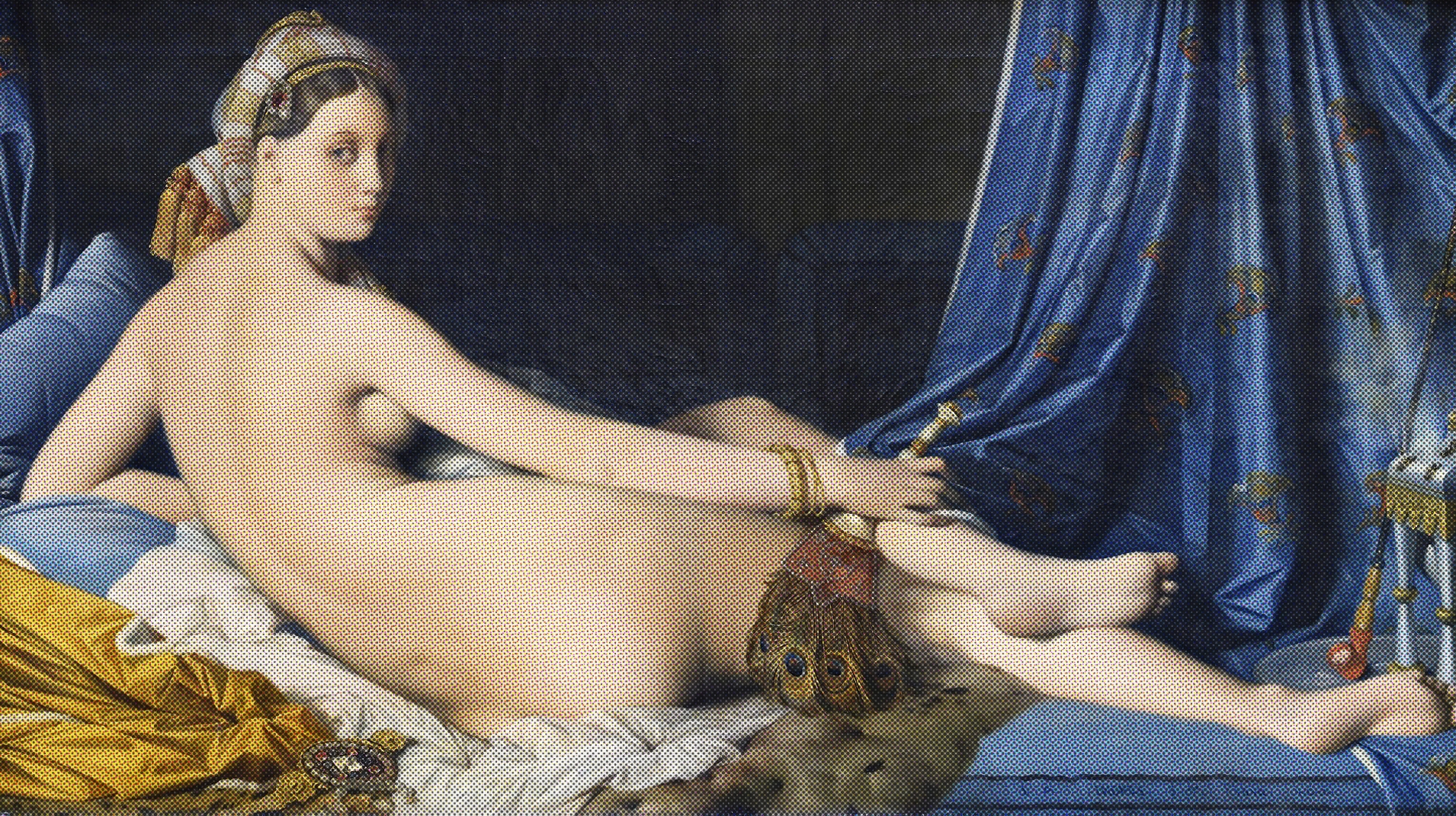
This is the painting Grande Odalisque by Jean-Auguste-Dominique Ingres. The female nude in this painting is painted with unrealistic, uncomfortable proportions. The figure is painted in this way to represent women in the male gaze, the way many women would have been viewed during the time of the painting’s creation in 1750.
(Edited image originally sourced from Jean-Auguste-Dominique Ingres, La Grande Odalisque, painting, Wikipedia, 1750, https://en.wikipedia.org/wiki/Grande_Odalisque#/media/File:La_grande_odalisque_-_Jean-Auguste_Dominique_Ingres_-_Mus%C3%A9e_du_Louvre_Peintures_RF_1158.jpg.)
Incorrect narratives have dominated an understanding of women in the past, that is, until other voices in history began to be examined. Today, we understand that ancient women from the Paleolithic period, as the Woman of Willendorf represents, were being represented in such a way to show the importance of women in the past. These statuettes were seen as fertility figures or even figures that represented gynecological information used by women in the past as a way to exhibit control over their lives. The many statues of Queen Hatshepsut did not represent her as a man because she was unable to rule as a woman, but rather show how all pharaohs were represented at the time. This is evident in the fact that ancient Egyptian women exhibited a lot of control in their everyday lives. Though still, even today, many of us have assumptions about the past, assumptions that harm the narrative of women in the past and even women today when we assume that women have always had an innate ‘nature’ about themselves. To combat these narratives more informed representation of the past is needed, a representation that is easily accessible to the public. This can be done with reconstructions of the past or representation in media, all things that have been informed by the better historical understanding of the past we have today. The year is 2026, and a small statuette of a woman is examined, and today she is understood the same way she was understood thousands of years ago.
Bibliography
Absolon, Karel. “The Diluvial Anthropomorphic Statuettes and Drawings, Especially the So-Called Venus Statuettes, Discovered in Moravia: A Comparative Study.” Artibus Asiae 12, no. 3 (1949): 201–20. https://doi.org/10.2307/3248385.
Alvarado, Carlos S. “Distortions of the Past.” Journal of Scientific Exploration 26, no. 3 (2012): 611-33. file:///C:/Users/User/Downloads/Distortions_of_the_Past%20(1).pdf
Diamond, Kelly‐Anne. “Hatshepsut: Transcending Gender in Ancient Egypt.” Gender & History 32, no. 1 (2020): 168–88. https://doi-org.ezproxy.capilanou.ca/10.1111/1468-0424.12462.
Hayes, William C. The Scepter of Egypt: A Background for the Study of the Egyptian Antiquities in The Metropolitan Museum of Art, vol. 2—The Hyksos Period and the New Kingdom (1675–1080 B.C.). (New York: The Metropolitan Museum of Art, 1990). 1-512. https://cdn.sanity.io/files/cctd4ker/production/d969a931b541edbb55bd3f7f1f62b357a6a4383c.pdf.
Hilliard, Kristina, and Kate Wurtzel. “Power and Gender in Ancient Egypt: The Case of Hatshepsut.” Art Education 62, no. 3 (2009): 25–31. http://www.jstor.org/stable/20694765.
Lucas, Nanci. Interview. Conducted by Freya Isham-Turner, 12 February 2026.
Marcovich, Miroslav. “From Ishtar to Aphrodite.” Journal of Aesthetic Education 30, no. 2 (1996): 43–59. https://doi.org/10.2307/3333191.
McCoid, Catherine Hodge, and Leroy D. McDermott. “Toward Decolonizing Gender: Female Vision in the Upper Paleolithic.” American Anthropologist 98, no. 2 (1996): 319–26. http://www.jstor.org/stable/682890.
McDermott, LeRoy. “Self-Representation in Upper Paleolithic Female Figurines.” Current Anthropology 37, no. 2 (1996): 227–75. http://www.jstor.org/stable/2744349.
Mercadal, Trudy. “Venus of Willendorf.” EBSCO. 2023. https://www.ebsco.com/research-starters/anthropology/venus-willendorf.
Pobric, Pac. “Unearthing Hatshepsut, Egypt’s Most Powerful Female Pharaoh.” The Met. January 22, 2018. https://www.metmuseum.org/perspectives/hatshepsut-female-pharaoh-egypt#3.
Pollock, Griselda. “Women, Art and Ideology: Questions for Feminist Art Historians.” Woman’s Art Journal 4, no. 1 (1983): 39–47. https://doi.org/10.2307/1358100.
Roehrig, Catharine H., Renée Dreyfus and Cathleen A. Keller. Hatshepsut: From Queen to Pharaoh. (New York: The Metropolitan Museum of Art, 2005). 1-356. https://www.metmuseum.org/met-publications/hatshepsut-from-queen-to-pharaoh.
Schlossman, Betty L., and Hildreth J. York. “Women in Ancient Art.” Art Journal 35, no. 4 (1976): 345–51. https://doi.org/10.2307/776226.
Seshadri, Krishna G. “Obesity: A Venusian story of Paleolithic Proportions.” Indian Journal of Endocrinology and Metabolism (2012): 134-5. 10.4103/2230-8210.912por08.
“The Egyptian Economy and Non-royal Women: Their Status in Public Life.” Trans. William Ward. Diotima: Materials for the Study of Women and Gender in the Ancient World. Accessed 24 November 2025. https://web.archive.org/web/20120112133805/http://www.stoa.org/diotima/anthology/wardtexts.shtml.
Tyldesley, Joyce. “Hatshepsut.” Britannica. March 26, 2026. https://www.britannica.com/biography/Hatshepsut.
Weekes, Ann Owens. “Students’ Self-Image: Representations of Women in ‘High’ Art and Popular Culture.” Woman’s Art Journal 13, no. 2 (1992): 32-38. https://doi-org.ezproxy.capilanou.ca/10.2307/1358151.