


Amanda Eremie
Amanda Eremie earned her Bachelor of Arts in Psychology from Capilano University in fall 2025. Throughout her studies, she developed a deep passion for child development and the factors that shape a child’s emotional and social well-being. This interest led her to pursue hands-on experience supporting young members of her community, including mentoring elementary school girls, teaching Sunday school, and coaching gymnastics. These roles gave her a front-row view of how parenting and values influence children’s growth—experiences that led her down the path of exploring the relationship between faith and parenting.
Amanda plans to continue her academic journey with graduate studies in Counselling Psychology, with the goal of helping young people strengthen their mental health and create nurturing environments that foster positive life outcomes.
Throughout history, religious teachings have been frequently used as tools to reinforce personal and sometimes destructive agendas (Esposito, 2002). An example of this is the Transatlantic slave trade of the 16th century, during which European slave traders cited the Bible to rationalize enslaving Africans, claiming ”…they were descended from Ham’s son Canaan” (Ham, 2024). While Canaan is indeed a Biblical figure who was cursed, the Bible never specifies his race—yet this misinterpretation was used to legitimize centuries of oppression. This pattern of religious extremism (though not always as striking) has permeated every institution including the home. Growing up in a Christian household, one of the first Bible verses I was taught was ”respect your father and mother…so that all may go well with you, and you may live a long time in the land” (Ephesians 6:2-3, Good News Translation [GNT]). From my experience, verses like this are often isolated out of their original context and used to promote parenting styles that are contrary to the writer’s intention.
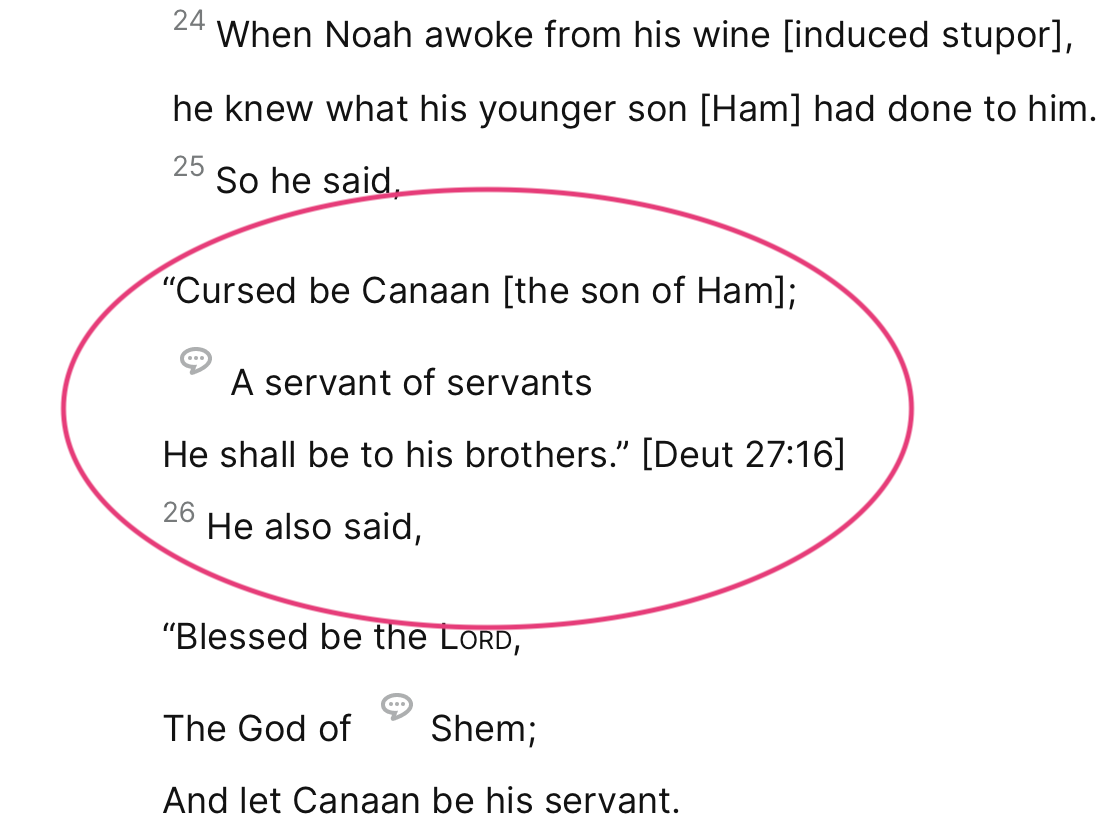
Genesis 9:24.
Understanding the different ways that parents choose to raise their children is a growing interest of mine that stemmed from my experience working with children from diverse religious and cultural backgrounds in the last few years. My roles as a sports coach, Sunday school teacher, and group mentor have led me to explore the prospect that religion is the bedrock upon which many different parenting practices rest.
Moving to Canada from Nigeria, one of my earliest observations was how the mere concept of religion is faced with strong opposition. At the time of my move, despite my own religious upbringing I was anti-religion myself and looked forward to living in an environment that aligned with that perspective. However, I quickly noticed a contradiction: despite the prevalence of anti-religion rhetoric, many of the value systems embraced by Canadian parents are, in fact, rooted in religious principles (specifically that of the Christian religion). One way in which Canada and Nigeria parallel in their approach to Christianity is that neither country has an unadulterated understanding of the religious values they claim to uphold (in Nigeria) or push back against (in Canada). With the current shift in the Western world away from religion (specifically Christianity) towards more secular views (Stolz et al., 2025), an important question surfaces: what if Christianity’s core values and teachings are the foundation upon which today’s widely accepted parenting styles have been built?
In today’s parenting conversations, the focus typically centres on managing challenging behaviours. Across social media and parenting forums, parents and caregivers are interested in knowing the best strategies for responding to defiance or emotional outbursts in ways that are both effective and compassionate. This change in thinking has led to the emergence of gentle parenting, a parenting style “that emphasizes understanding and empathy over punishment and strict control” (Biscontini, 2024). This movement has sparked debate, often polarizing parents: some strongly advocate for gentle parenting, while others dismiss it as overly permissive or impractical.
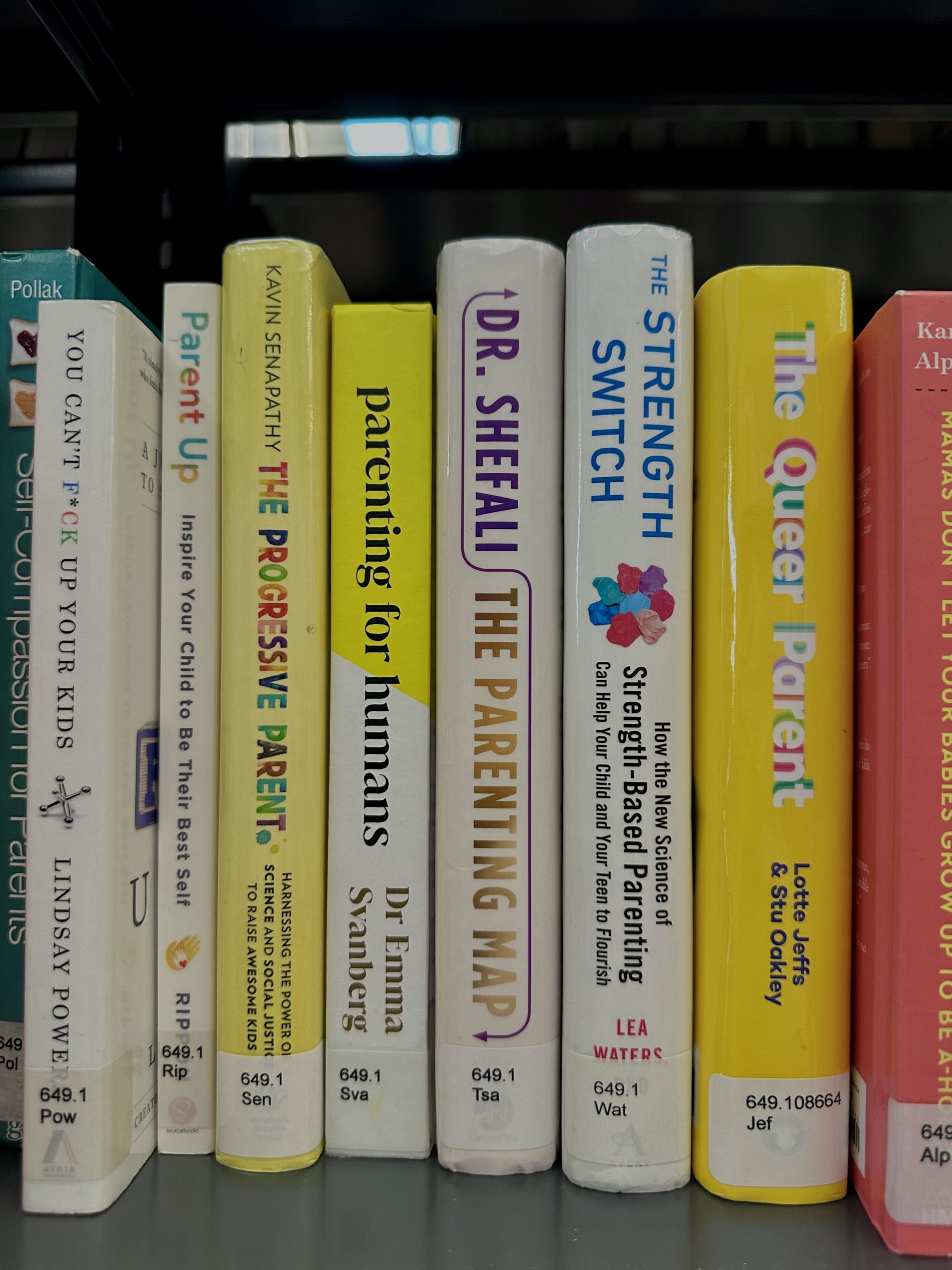
Books on parenting.
Historically however, the parenting landscape looked very different. The dominant model was largely authoritarian (Kappadakunnel, 2023). Within this model, children were expected to obey their parents unconditionally and their emotions were rarely acknowledged. Punishments served as a primary tool to enforce compliance (Coste, n.d.). This parenting style was first identified by American Clinical Psychologist, Diana Baumrind, who also identified two others: Permissive and Authoritative parenting (Coste, n.d.). It is important not to confuse authoritarian with authoritative parenting. Authoritative parents set clear expectations for their children but pair them with guidance and emotional support. This type of parenting leaves room for children to think independently and uses discipline to teach rather than control. On the other hand, authoritarian parenting is inflexible, relying on strict rules and unquestioned obedience while offering little to no emotional support for children (WebMD, 2025).
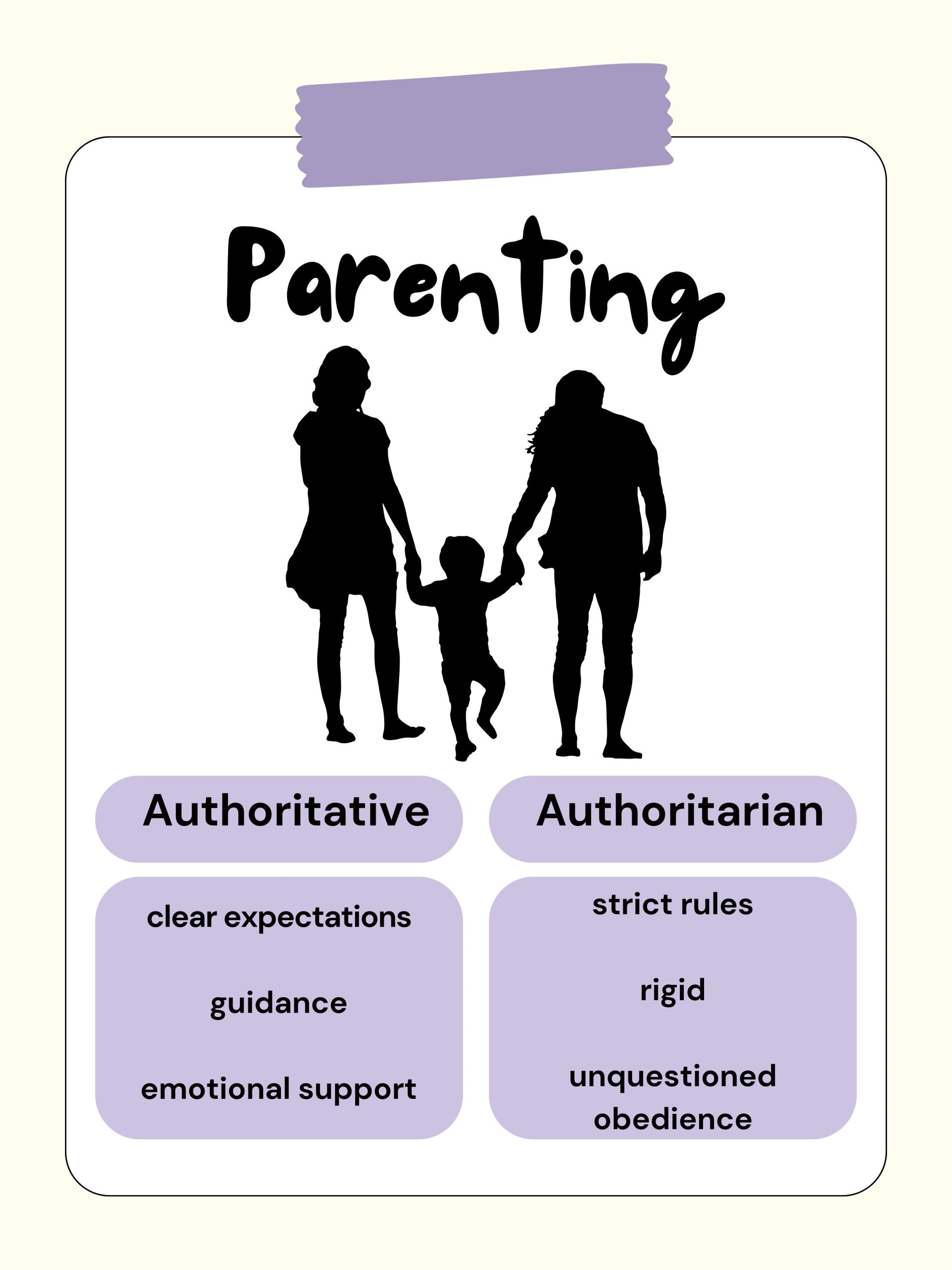
Comparative chart: Authoritarian is not equal to authoritative parenting.
The rejection of authoritarian parenting is frequently interpreted as a challenge to religious traditions — as though moving toward a more compassionate approach to raising children requires abandoning Christian beliefs. This assumption only holds if authoritarian parenting truly reflects Biblical teaching. However, when we look closely at the Bible, a very different picture emerges. The shift away from fear-based control is not a departure from Christianity; in many ways, it is a return to its core doctrines.
I wish to address the misconception that the association between authoritarian parenting and Christian values is rooted in a proper contextual understanding of Christian teachings, when in fact it stems from cultural misinterpretations that emphasize control over connection. Overtime, these distorted versions of Christian teachings have been treated as sacred mandates, leading many modern parents to reject “religious parenting” altogether — without realizing that what they are resisting is not authentic Christianity but a misrepresentation of it. Rather than being the foundation of a harsh discipline, the Christian faith — especially as expressed in the New Testament — emphasizes forgiveness, guidance, and most of all love. What modern parenting brands as “new,” Christianity has long encouraged, even if culture has not always followed suit.
In recent years, I have spent time studying the Christian religious texts — the very foundation upon which the faith is built—and that exploration has only strengthened my belief that the link between Christianity and authoritarian parenting is largely misunderstood. Some people argue that today’s more compassionate parenting approaches emerged only because society has moved away from religion, embracing a more “modern,” secular perspective. As Dhenin (2023) puts it, “Parents today are comfortable finding other ways to instill positive values in their kids without turning to religious institutions.” But what if this shift is not a rejection of Christianity at all? What if gentle parenting and religion are not mutually exclusive but the values championed in gentle parenting are, in fact, deeply rooted in the teachings of the New Testament? I would argue that many of the gentle parenting approaches we praise today actually reflect long-standing Biblical principles. So where do we see these values reflected in the Bible most clearly? A great place to start is the book of Proverbs.
In many ways, the book of Proverbs reads like a parent speaking to a child – offering guidance on finances, marriage, work, and everyday life. The writer’s tone in the book embodies a gentle admonition from a parent that is genuinely interested in every aspect of their child’s life. Many of the verses addressed to the writer’s son often begin with “my child” or “my son” which shows a level of intimacy between parent and child. The author of Proverbs writes a profound truth to parents in Proverbs 22:6 saying, “Teach children how they should live, and they will remember it all their life” (Proverbs 22:6, GNT). Another translation of the same verse says “direct your children onto the right path, and when they are older they will not leave it” (Proverbs 22:6, New Living Translation [NLT]). The use of the words “teach” and “direct” do not encourage the use of force as in authoritarian parenting but rather parents are encouraged to spend time communicating and living exemplary lifestyles that will make it easier for their children to emulate.
Authoritarian parenting on the other hand, by its definition, contradicts Biblical teachings on how children should be treated. In the book of Mark, Jesus is speaking to a crowd when some parents tried to bring their children closer to Him. His disciples attempt to stop them, but Jesus responds with a profound affirmation of children’s worth: “Whoever receives and welcomes one child such as this in my name receives me; and whoever receives me receives not only me, but him who sent me” (Mark 9:37, GNT). Within Christian theology, where the foundation of faith is to receive and accept Jesus, this comparison is deeply significant. If Jesus directly equates the act of welcoming a child with welcoming Himself—and by extension, welcoming God—then the value he places on children is unmistakable. Acceptance and care for children are not presented as optional acts but as essential expressions of the Christian faith.
Research has shown that this holistic Biblical teaching of accepting and welcoming children can positively influence children’s wellbeing. In a study conducted with families in China, Li and Guo (2023) found that quality time spent with parents and expressions of parental warmth are crucial for children’s emotional health. Their results revealed that “children demonstrated positive emotions when parents spent time with them and increasing that time was the key to improving children’s well-being” (Li & Guo, 2023). In this research, parental warmth was defined as a display of “love, approval, acceptance, and affection” (Li & Guo, 2023). These are principles that closely reflect the teachings of Jesus. Although this study was conducted in China, the implications extend far beyond a single cultural setting. Children everywhere need to feel safe and welcomed in the presence of their parents. In this way, a parenting approach rooted in connection not only aligns with long-standing Biblical values but is also supported by developmental science.

The effect of parent warmth.
This connection between spending time with children and their well-being is also reflected in an interview I conducted with a mother of three girls. Thinking back to the start of her parenting journey, she explained that, even when she had very little (financially), being present and emotionally invested in her children’s lives was always a priority. She described those early years, living in a one-bedroom apartment, as beautifully simple: “I put all of my heart and soul into it, I was willing to put in late nights, early mornings, sleep deprived…and that was what we were there for, to parent” (Anonymous, personal communication, November 2025). She emphasized that what truly mattered was beyond what could be bought with money, but instead, the lasting, non-material things. “We didn’t think they needed fancy food or toys, or you know, to come into a mansion. They were just…surrounded by love and opportunity” (November 2025). Her memories highlight an essential truth, children thrive on quality time, and the feeling of being welcomed and valued in their family.
It is true that those closest to us have the ability to cause us the most hurt and that is especially true in a relationship between a parent and a child. Many children (including myself) have seen religion used as a tool for manipulation. However, the misuse of religious texts within families reflects a much wider problem: when religion is misunderstood or misapplied, people begin to judge the faith not by its teachings, but by its worst representations. In media and public discourse, it is common to see religion depicted in its extremes e.g., through terrorism, slavery, oppression, etc. I am not here to deny the many atrocities that have been committed in the name of so-called religion. They are horrible, and continue to negatively impact the lives of many even till this day.
But I invite you to consider this: many of these atrocities were committed not because of Christianity, but in contradiction to it—by individuals who wielded religious language without truly knowing the values of the religion they claimed to represent.
This pattern can be better understood through the concept of dominance in human beings. Defined as the ability “to assert control in dealing with others” (Dictionary, n.d.), dominance is a relational trait that emerges naturally in social species, including humans (Chen et al., 2022). Individuals with greater physicals strength or access to resources often have an advantage in acquiring and exercising dominance (Chen et al., 2022). In society, this desire for dominance has sometimes shaped how Biblical texts are interpreted, with certain verses read through a lens of dominance. Within the parent-child relationship, for example, parents naturally possess more physical strength and access to resources, which can make it tempting to apply dominance in ways that misalign with the original intent of the Bible. When Bible verses are lifted out of context and viewed through the wrong lens, the original intent becomes skewed.
One might ask, “What about the Bible verse that says ‘spare the rod, spoil the child’ which explicitly encourages spanking?” Interestingly, that exact phrase does not appear in the Christian Bible. It is a paraphrase of Proverbs 13:24, which in the New International Version reads: “Whoever spares the rod hates their children, but the one who loves their children is careful to discipline them”, and in the Good News Translation: “If you don’t punish your children, you don’t love them. If you do love them, you will correct them”. The overarching theme of these verses—and the Bible as a whole—is love, of which discipline is included, but only as a form of guidance, never to the extent of abuse.
Still, there remains a difference between what is written in the Bible and how people choose to live it out. Meaning shifts quickly when the texts are filtered through personal experience and cultural norms. Despite the clear Biblical affirmations of children’s inherent worth, many Christians throughout history (knowingly or unknowingly) adopt parenting approaches that reflect an imbalance or misapplication of the Bible. Instead of centering the compassionate and invitational heart of Christ’s teachings, some parents lean heavily on isolated verses about obedience or discipline, using them to justify excessive strictness and unquestioned authority.
“Respect your father and mother…so that all may go well with you, and you may live a long time in the land” (Ephesians 6:2-3, GNT). When this verse is isolated from its broader context, it has often been used by Christian authoritarian parents as a mandate for absolute obedience.

Ephesians 6:2-3 quote.
However, what often goes unnoticed is the very next instruction in the passage that offers essential balance: “Parents, do not treat your children in such a way as to make them angry. Instead, raise them with Christian discipline and instruction” (Ephesians 6:4, GNT). This shows the Bible’s balanced perspective to parenting and how selective use of Biblical text, often distorts the broader Biblical narrative. As a result, what is intended to be a nurturing model of parenting has been warped into a rigid structure that does not reflect the loving nature of Biblical Christianity. There is a real need to re-examine how Christian teachings are interpreted and lived out in the family so that — wherever it is applied — parenting reflects the fullness of Biblical teachings, not just fragments that feel convenient.
Ultimately, the tension between faith and parenting is not about whether religion belongs in family life, but about how its teachings are interpreted and lived out. Gentle-parenting principles like empathy, and understanding are not modern inventions — they are woven throughout Christian teachings and tradition. This suggests that religion itself is not the problem; rather, the harm arises when its messages are weaponized, or stripped of context. For many families, Christian values continue to offer a moral foundation, even those outside the faith see this potential: one Sikh parent shared that they chose a religious school not for its doctrine, but because “they instill values” that nurture kindness and respect (Parent interviewed, personal communication, November 2025). When interpreted with accuracy, religion can serve as a guide toward raising children who feel seen, and valued. Maybe the most meaningful parenting shift lies in returning to love — the very foundation Christianity has taught all along.
References
Biscontini, T. (2024). Gentle parenting. Salem Press Encyclopedia.
Chen Zeng, T., Cheng, J. T., & Henrich, J. (2022). Dominance in humans. Philosophical transactions of the Royal Society of London. Series B, Biological sciences, 377(1845), 20200451. https://doi.org/10.1098/rstb.2020.0451
Coste, Birgitte (n.d.). The Essence of the Strict Authoritarian Parenting Style and the Long Term Effects. Positive-Parenting-Ally.com. https://www.positive-parenting-ally.com/authoritarian-parenting.html
Dhenin, M. (2023a, April 9). Millennial parents are raising their kids without religion and that’s totally OK. Parents. https://www.parents.com/parenting/better-parenting/style/millennial-parents-are-raising-their-kids-without-religion-and-thats-totally-ok/
Dictionary.com. (n.d.). Dominance definition & meaning. Dictionary.com. https://www.dictionary.com/browse/dominance
Ham, Paul. (2024, March 12). The “curse of ham”: How people of faith used a story in Genesis to justify slavery. The Conversation. https://theconversation.com/the-curse-of-ham-how-people-of-faith-used-a-story-in-genesis-to-justify-slavery-225212#:~:text=The%20making%20of%20a%20%27slave%20race%27&text=For%20almost%20500%20years%2C%20priests,the%20trans%2DAtlantic%20slave%20trade.
John, E. L. (n.d.). Jihad: Holy or unholy war? John L. Esposito. https://www.unaoc.org/repository/8412Jihad, Holy or Unholy War, J. Esposito.pdf
Kappadakunnel, B. (2023, October 17). Parenting styles and their evolution: Old, new, recent studies and recommendations. Conscious Mommy Community. https://www.consciousmommy.com/post/parenting-styles-and-their-evolution
Li, D., & Guo, X. (2023, April 2). The effect of the time parents spend with children on children’s well-being. Frontiers. https://www.frontiersin.org/journals/psychology/articles/10.3389/fpsyg.2023.1096128/full
Shroff, A. (Ed.). (n.d.). What is Authoritarian Parenting?. WebMD. https://www.webmd.com/parenting/authoritarian-parenting-what-is-it
Stolz, J., de Graaf, N. D., Hackett, C., & Antonietti, J.-P. (2025, August 19). The three stages of religious decline around the world. Nature News. https://www.nature.com/articles/s41467-025-62452-z
The Holy Bible: Good News Translation. (2025). YouVersion (1976). https://www.bible.com/bible/111/EPH.6.LSV?parallel=68
The Holy Bible: New International Version. (2025). YouVersion (1973). https://www.bible.com/bible/111/PRO.13.NIV?parallel=68
The Holy Bible, New Living Translation. (2025). YouVersion (2015). https://www.bible.com/bible/116/PRO.22.NLT?parallel=68