


Ben Kelly
Ben Kelly (he/him) is a student in the faculty of psychology at Capilano University. Upon the completion of his undergraduate degree in the summer of 2026, Ben plans to pursue his master’s degree in the field of clinical counselling. A proud and community-minded individual, Ben has spent the past five years working in a variety of social service jobs. At the outset of the COVID 19 pandemic, he began a volunteer commitment at the Vancouver Crisis Center, amassing over 150 hours of phone support for individuals experiencing suicidal ideation and emotional trauma. Currently, Ben works on Vancouver’s Downtown Eastside doing frontline support work in homeless sheltering and supportive housing. Before embarking on a career change and returning to school Ben worked as a professional musician, transversing North American and Europe with various punk, folk and ndie bands. He can still be found most weekends playing around the city across a variety of music settings. He remains an avid home cook, lover of reading, and a long-suffering fan of the Vancouver Canucks. Ben is currently a resident of North Vancouver and enjoys taking advantage of the abundance of nature that the city has to offer. In addition to finishing his degree, he hopes to become a dog owner in the not-too-distant future.
Y2K
January 1st, 2000. The new millennium has arrived. Lost in the shuffle of excitement over a new century and fears of catastrophic computer failures was something unique to Vancouver. A decade and a half earlier, with the city set to welcome the world for Expo 86, Vancouver dipped its toe in the water to curb cigarette smoking indoors. While the link to cancer had been known by doctors and scientists since the 1950s, primitive Surgeon General warnings did not begin appearing on cigarette packages in the United Sates until over a decade later and nearly fifty years later in Canada. In February 1986, Vancouver announced its intention to rid office buildings and most public places of indoor cigarette smoke. By the dawn of the 1990s, smoking sections in restaurants seemed destined for permanence and while individual business could dictate smoking policies, places like shopping malls, individual apartment units, and the BC ferries represented a type of grey area. Casinos, nightclubs, and bars-all entertainment establishments were entirely fair game for cigarette smokers throughout the 1990s. For the first time in the city’s history, January 1st, 2000, represented the day that all indoor public spaces- including bars, restaurants and nightclubs were free of cigarette smoke. While New Years celebrations were carried on, those wishing to smoke had to go outside.
The legislative, political, and social forces that encompassed cigarette smoking from an activity occurring unchecked in every public place to the gradual eradication is one of the largest social changes of the past fifty years. While a victory for public health, local arts and culture in Vancouver was funded at unpresented levels under tobacco. With the rise of smokeless tobacco and vaping, consumption is again rising. This is both a threat to public health and the right to clean air legislation in Vancouver achieved via the prohibition of cigarette smoking.
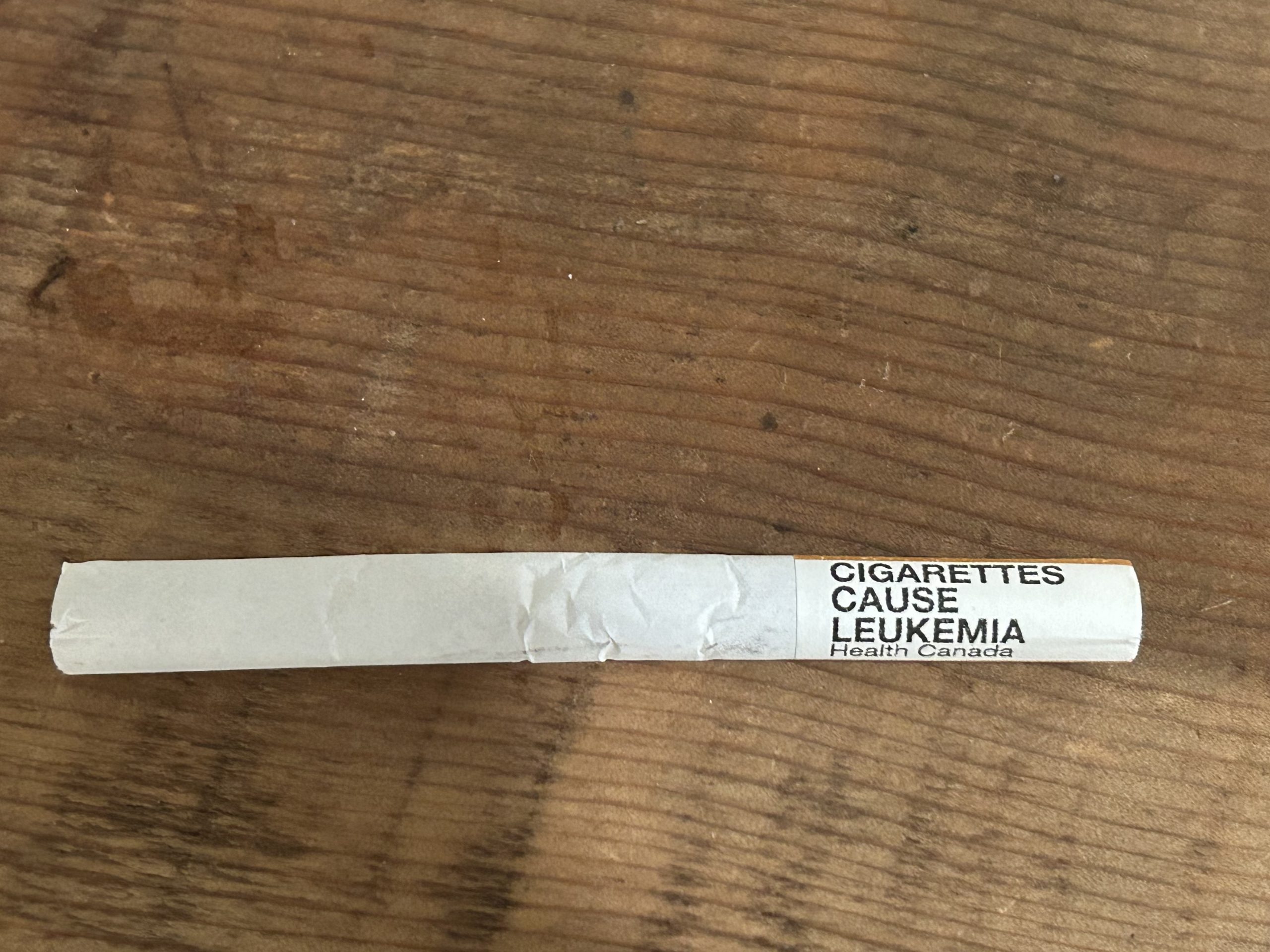
A product of Canada’s new plane packaging laws. An individual cigarette complete with a modern mandated written warning on the dangers of smoking. While it’s difficult to make out, the wording reads “Poison in every puff.” Canada is the first country to have individual written warnings on all cigarettes.
Gastown, Beer Parlors, and War: 1880 – 1920
In trying to capture the ubiquity and scope of smoking’s descent into public life, some background is in order. The transition of Vancouver from a Pacific Northwest outpost to a burgeoning city of business, higher education, and culture overlapped with the cigarette becoming the quintennial consumer product of the 20th century. Sexy and modern, it made your grandfathers wooden pipe look so last century. Seminal Vancouver, like any growing city, was an industry town. In 1886, the first transcontinental train arrived at the western terminus in Port Mody. “Soon after, the terminus was moved further west to the small False Creek lumber community of Granville, known locally as Gastown” (Legislative Assembly of British Columbia, n.d.). Canadian Pacific Rail staff and the numerous off shoot industries necessitated by the rail infrastructure needed somewhere to go after a long day of work. Saloons and beer parlours began to spring up over early Vancouver neighborhoods in East Hastings and Gastown full of men with money in their pockets looking to drink, gamble, and carouse.
This relative “boom” period free of regulation was interrupted by two things early in the 20th century, war and prohibition. As young Canadians headed overseas to fight in Europe at the outbreak of World War 1, the cigarette became a primary resource of comfort and respite from the atrocities of war. World War 1 veteran Arthur Halestrap recalls “[seeing] people utterly confused” yet upon having, “the first drag as it was called you could see the relief on their faces” (Hedgeco et al., 1999). However, influenced by forces in the temperance movement, Canada introduced prohibition in 1917 making all sales of alcohol illegal. While it did not remove vices from society, it merely brought them underground and behind closed doors. When prohibition was repealed three years later, thousands of soldiers resuming family and business duties, were now accustomed to the pleasure and convenience of the modern pre-packaged cigarette.
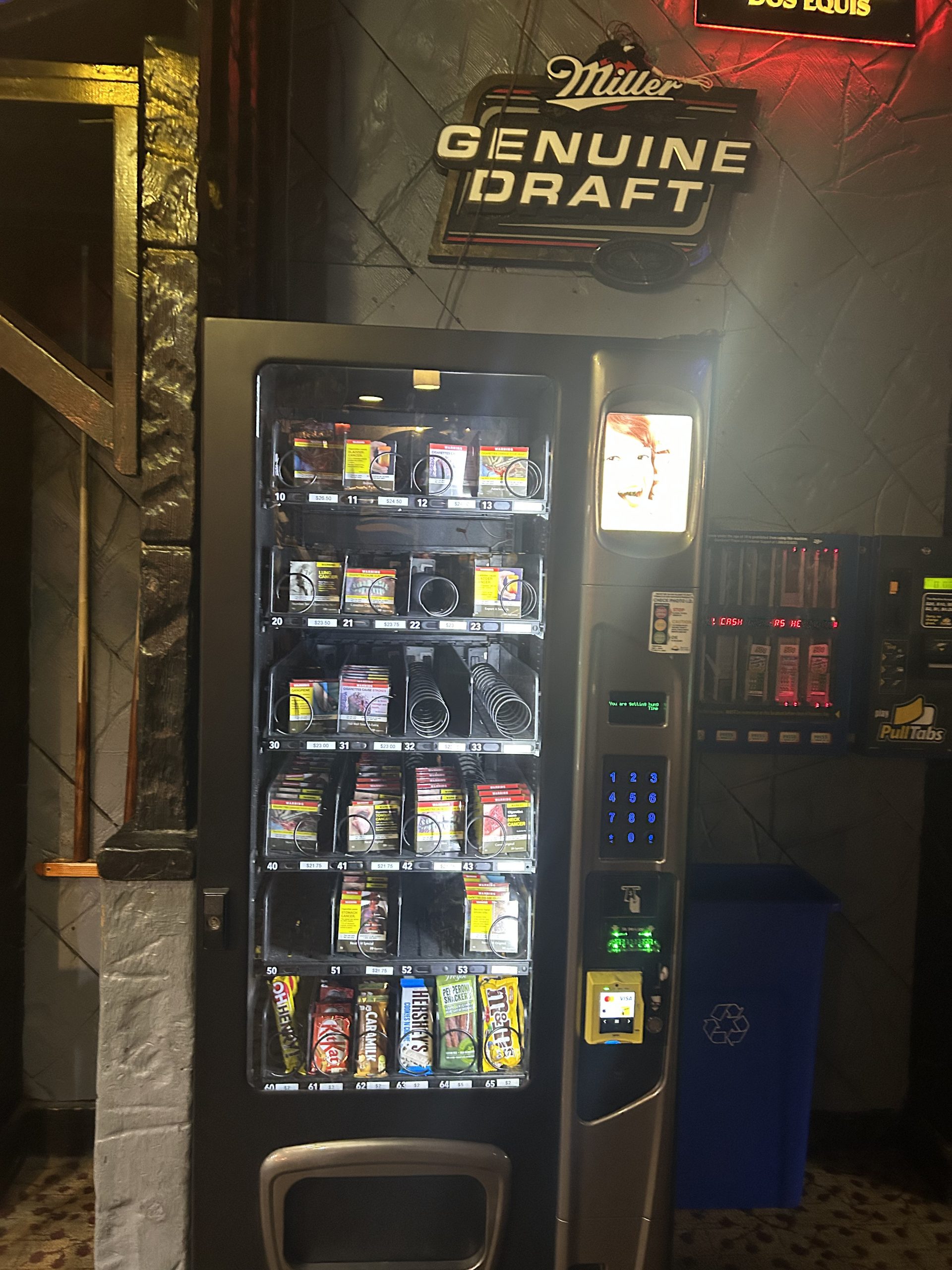
While a cigarette vending machine used to be a common sight in bars, diners, and nightclubs, today it is a relic of the past. This one, sporing plan packaging is still in existence at famed Vancouver drinking establishment at the Ivanhoe Pub on Main Street. The mostly brick building dates to the first decade of the 20th operating as a series of boarding rooms and hotels before eventually becoming a pub sometime later in the 20th century.
I Like Culture but Only When Its Free: How Tobacco Companies Made Vancouver More Fun and We Didn’t Think About It.
While smoking on an airplane or a hospital is comedic, even diabolical to most liberal eyes of today, it highlights how as an activity smoking was viewed in society. In the 1950s, doctors confidently promoted Camal cigarettes on radio and in print. James Bond smoked cigarettes. By the 1970s and into the 1980s, it remained a social and trendy habit of most musicians and celebrities. The sheer amount of arts and culture funding that was dropped into the city on the backs of corporate tobacco sponsership was a resolute benefit of the era. This is a different and entirely separate argument toward the absolute good that banning and mitigating cigarette consumption indoors has achieved under public health outcomes; two things can be true. As a case study, the Vancouver Jazz Festival serves to illustrate this point.
At the time of its inception in 1986, the Vancouver edition of the jazz festival was part of a growing network of events across the country promoting jazz, blues and ragtime music from Vancouver to Ottawa. “The du Maurier Internation Jazz Festival” got its name from du Maurier cigarettes, one of the two largest producers of cigarettes in Canada besides Players. Somewhat ironically, du Maurier would also provide title sponsership for sports. Both women’s professional golf and tennis in Vancouver, with the former dubbed the du Maurier Classic taking place just outside of Vancouver in Port Coquitlam, in 1991 (United Press International, 1991).
Vancouver’s relationship with tobacco-funded culture and sports would prolificate into the 1980s and 1990s. As a kid in the 1990s, I recall a rectangular sign advertising Players that hung above the electronic video screen at the Pacific Coliseum, home to the Vancouver Canucks from their inception in 1975 to 1995. An even larger Player sign greeted visitors to the “Rink on Renfrew” as it was affectionately known as they entered the main parking area. A common sight in old photographs of sporting events and live concerts from this era is a yellowish hue accompanying the image. While it is often mistaken for ageing negatives used in film photography, it is in fact the accumulated cigarette haze of the fifteen or sixteen thousand patrons that could comfortably fit into midcentury-built stadiums like the Pacific Coliseum.
Born in 1968, Vancouver resident and former smoker Kacey recounts that cigarette brand Benson and Hedges, provided the title sponsorship of the Symphony of Fire, (today known as the Celebration of Light) when he moved from Ontario to Vancouver in 1993 “ It was very regal sounding, that’s why I remember their name.” He further recalled that, “the Molson Indy… there was something to do with Players” (personal communication, October 29,2025). While he was correct, it was short lived.
The End of Cigarette Sponsorships
Effective October 1st, 2003, a federally mandated legislation, bill C-42 made it illegal for tobacco companies to provide sponsorship to “artistic, cultural or sporting events or facilities” (Parliamentary Research Branch, 1998). Players had a history with the Indy in Vancouver since its inception in 1989 and car racing in general, sponsoring individual teams across various leagues and race series across Canada. Known as the Players- Molson Indy, Players was soon forced to end their affiliation due to the impending ban. Imperial Tobacco, parent company of Players CEO Bon Baxton had this to say when the bill was passed in 1998 with a grandfather clause to give tobacco companies and municipalities time to locate new funding sources and sponsorship avenues.
“Tobacco is a legal product, and companies should be able to advertise a legal product, I guess the government doesn’t see it that way. These companies have supported motorsports and done a lot of good things, but people like to focus on the negative things. They don’t pay attention to the jobs and opportunities that have been created” (Autosport, 2003).
Nostalgia is a funny thing. Humans often opine about how things used to be better, and change is hard. When pressed though, we are unable to articulate why something used to be the way it was compared to its present form. When arts and culture organizations were scrambling to source new funding in light of the 2003 deadline, city officials were questioning the overall utility of bringing such events to Vancouver, regardless of how much money the city raked in. One city counsellor quipped, “if the [comapnies wanted] to help the community, [they] should get out of the business” (CBC, 2000a).
While it is understandable that an elected official is concerned with public health, a look at the numbers shows just how much revenue was brough in. Between 1981 and 2003 du Maurier Arts Ltd, the arts and culture funding wing of Imperial tobacco Canada contributed over $60 million to arts organizations across the country, including Vancouver (Coastal Jazz, 2024), including $600,000 annually for the Vancouver Jazz Festival into the early 2000s (CBC, 2000b). By the final year of du Maurier as a title sponsor in 2003, Vancouver received a million dollars a year from the corporation (CBC, 2001). Du Maurier would also chip in to fund renovations of the historic Stanly Theater on Grandville Street, originally opening as the “Stanley Theatre du Maurier Stage,” in the 1990s. At the time of this writing, the Vancouver International Jazz Festival has no title sponsor. Although the former Benson and Hedges “Symphony of Fire” has had non-tobacco corporate backing since 2000, citing rising production costs and budget shortfalls, the festival’s immediate cancellation has just been announced.
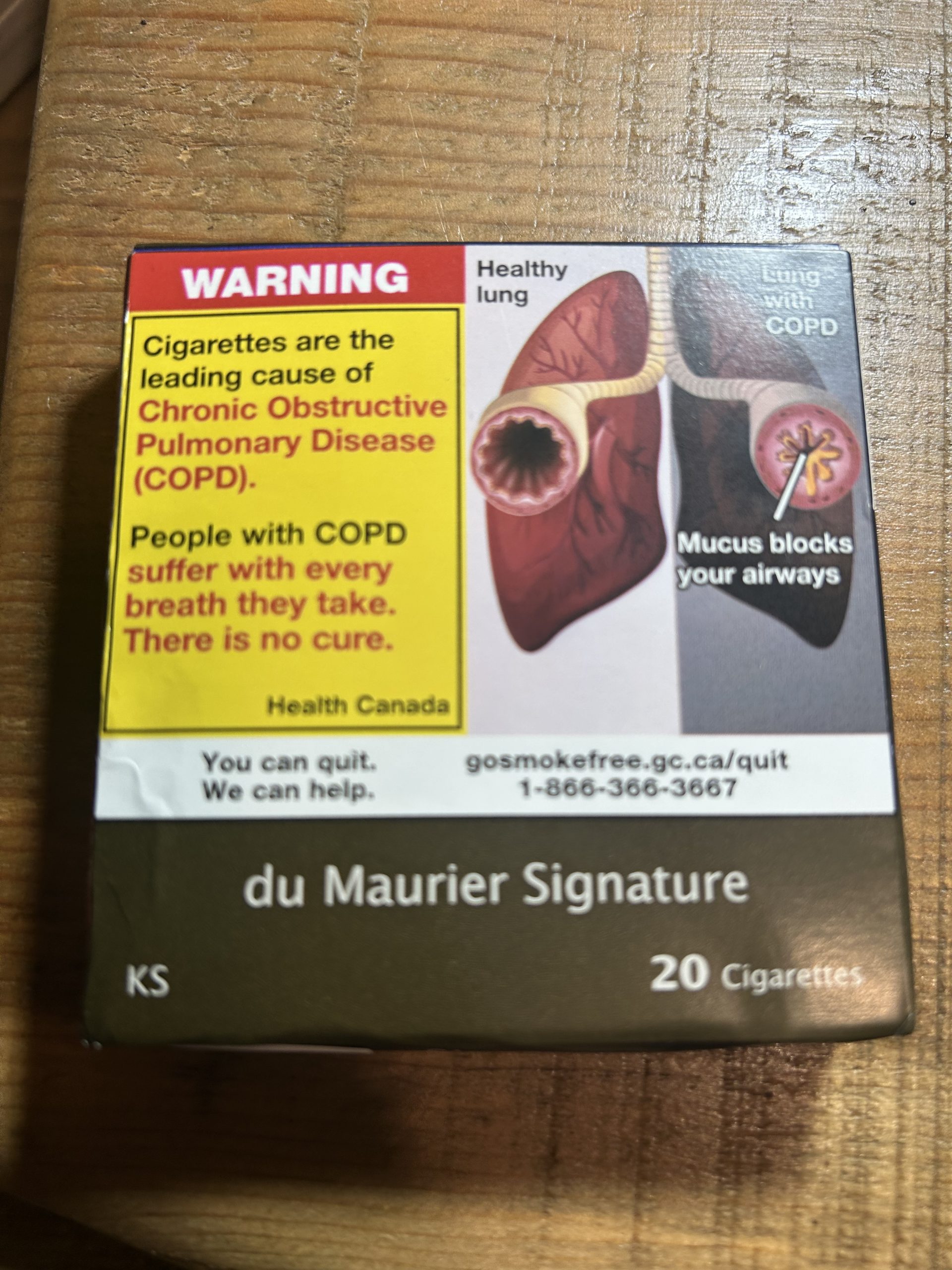
A modern-day plane packing box of du Maurier Signature cigarettes. Far removed from their bright red glory days and association with Jazz and culture, this package shows a large picture of healthy lungs and one with Chronic Obstructive Pulmonary Disease (COPD for shot). Note how small the du Maurier brand font is compared to everything else on the package. Incidentally, a pack will run you $24 dollars in 2025.
Bans
To fully grasp how accepted cigarette smoking was everywhere until the 1980s, one does not have to look further than to the arguments levied by those critical of those trying to ban it..
By December of 1986 smoking indoors in Vancouver began to resemble what it looks like today; smoke free office budlings, elevators, sports arenas, and most public buildings at large. However, while the idea of a smoking “section” indoors is arcane today, it was seen as a way to satisfy both smokers and non-smokers. At Vancouver’s Langara College, then principal, JJ Denholm, in charge of enforcing the new regulations at the college, noted in 1986 that in a school of six thousand students, “one zealot in a thousand is still six of them.” For this reason, he concluded that smoking would not be policed in the school’s cafeteria (Zeidler, 2016).
Yet, an unlikely opponent of the 1986 ban began to emerge in the form of the federal government. It claimed that Vancouver had no jurisdiction to regulate federal office buildings and crown corporations within the city walls. By 1989, the argument would be irrelevant as all federal office budlings across the country went smoke free outside of designated indoor smoking areas. Another sector claiming Vancouver had no control over its operations was bars and restaurants. By 1996, talks began to remove cigarette smoking from all restaurants and bars citing worker safety; the entertainment sector pushed back. In a Vancouver Sun article dating from March of 1998, a downtown location of The Keg restaurant chain continued to raise the ire of city officials by ignoring new smoking laws on grounds of lost revenue. According to the article, owners of the restaurant risked a $1000 dollar fine per day and possible arrest for repeated noncompliance (Sarti, 1998). About one third of the restaurant’s 300-person capacity still catered to smokers.
The double standard of workplaces subjecting workers to smoke while objecting to rules on other grounds is not captured better than the plight of Vancouver hospitals. Nurse Tania Gosnach, who began nursing in 1993 recalls an indoor smoking room at St Vincents Hospital for doctors, patients and hospital staff to use, during the early years of her career (personal communication, November 25,2025).
After January 1st, 2000, the air in Vancouver’s bars and restaurants changed forever, and with that so too did overall acceptance and appetite for increased smoking restrictions. While Canada did not have compulsory warnings on packaging until 1989 (over twenty years after the US made it mandatory in 1966), as a nation we made up for lost time, becoming the first country to ban cigarette smoking on all domestic air travel in 1989 (CBC,1989. By 1994 Canada was among the first countries in the world to ban smoking on all international flights originating from Canadian airspace (Reuter, 1994).
As a city, Vancouver would continue to crack down. In 2008 a 10-foot smoke-free radius around all doorways and windows was implemented, stretching to nine meters or 30 feet (Government of British Columbia,2024). By 2012 smoking was prohibited in all Vancouver parks and greenways. Smoking at bus stops and playgrounds is now also banned. In 2020, Canada joined Australia, France and The United Kingdom in adopting “plane packaging” No. Loger would the regal red of du Maurier and the royal blue of Players be an element of the buying experience. All cigarette packages are mandated to show the same font color and size regardless of brand in small non-descript lettering. A large picture of rotting teeth, an undersized sickly baby, or a tracheostomy patient adorns the box, dwarfing the size of the brand. An even bigger written warning appears on every box declaring “THIS IS WHAT DYING OF CANCER LOOKS LIKE”, among other catchy slogans. In addition, every legal individual cigarette manufactured sold or exported into Canada is required to contain text declaring “CIGARETTES CAUSE IMPOTANCE” or “POISON IN EVERY PUFF.”
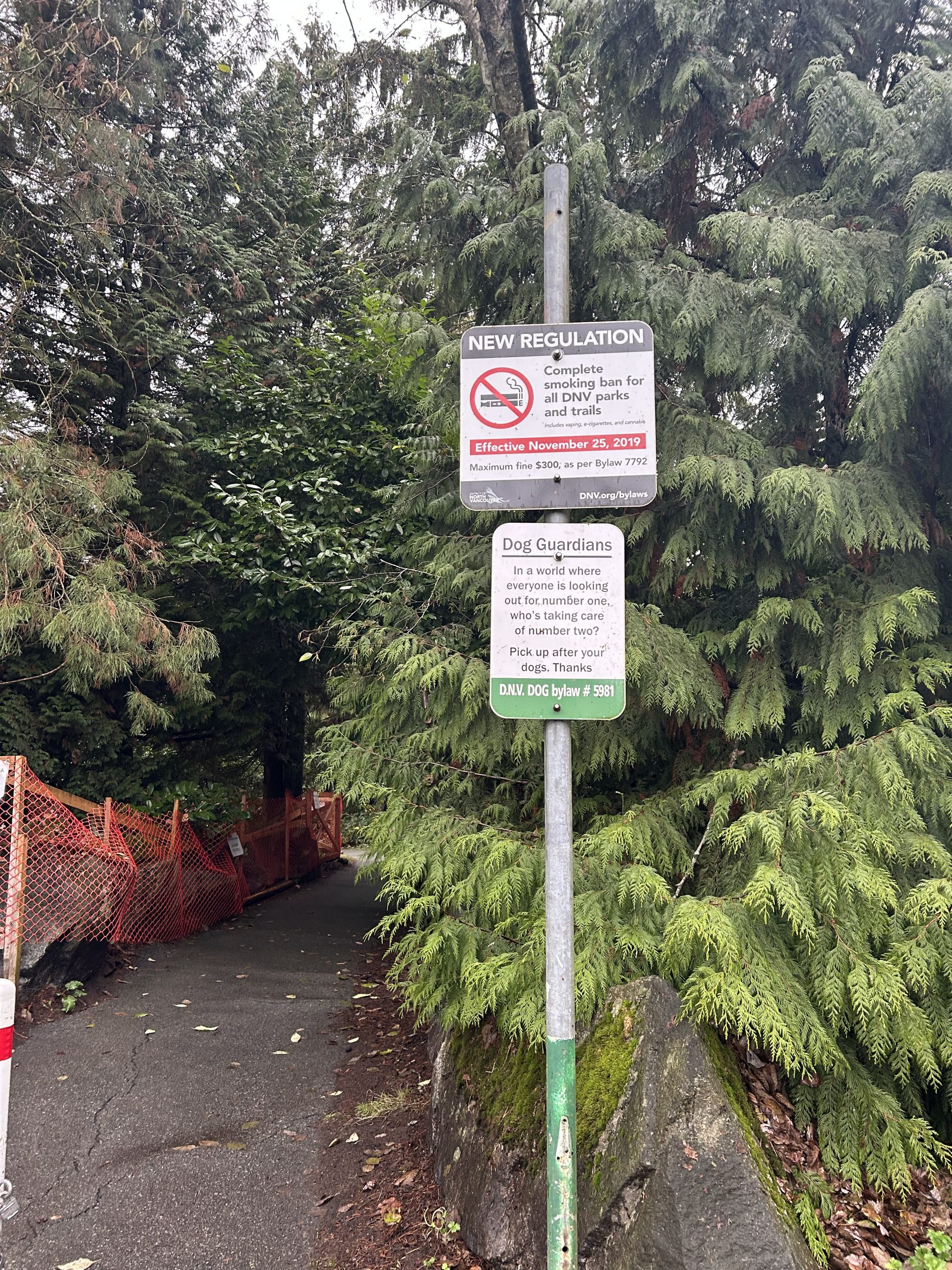
Near a public walkway in North Vancouver, a sign warns you that as of 2019, cigarettes and vaping are now illegal in all parks and trails within the city. In accordance with bylaw 7792 anyone found to be breaking the rules can be subject to a $300 fine.
Colours and Memories
A further element that underscores the sheer grip tobacco had on society is the visceral nature and speed with which former smokers can stillrecall brands and packaging, in some cases going back 75 years. Mother and pound “Nana” Shelly Michaluk remembers buying cigarettes for her dad at the age of seven. “Black Cat Cork” she recalls emphatically. “In a green box” (personal communication, November 14,2025). Born in 1943, a smoker herself beginning at 13 when a pack cost 43 cents; she quit for good in the early 90s, recalling her brand of choice as Craven A Menthol, oddly also in a green pack (personal communication, November 14, 2025).
For Kacey, brand loyalty also remained in his memory, recalling his dad’s brand as Peter Jackson and himself preferring Players (Personal communication, October 29, 2025). Hearing former smokers talk and remembering names and packaging colours from decades past to me, underscores one of the, if not, the primary objective of the plane packing movement; youth. While one could write an entire paper alone on how tobacco companies specifically targeted and then lied about marketing to youth, stopping any association to tangible and memorable packing elements, such as colours, mascots, and logos seems like an absolute best practice to insure young people never take up the habit in the first place.
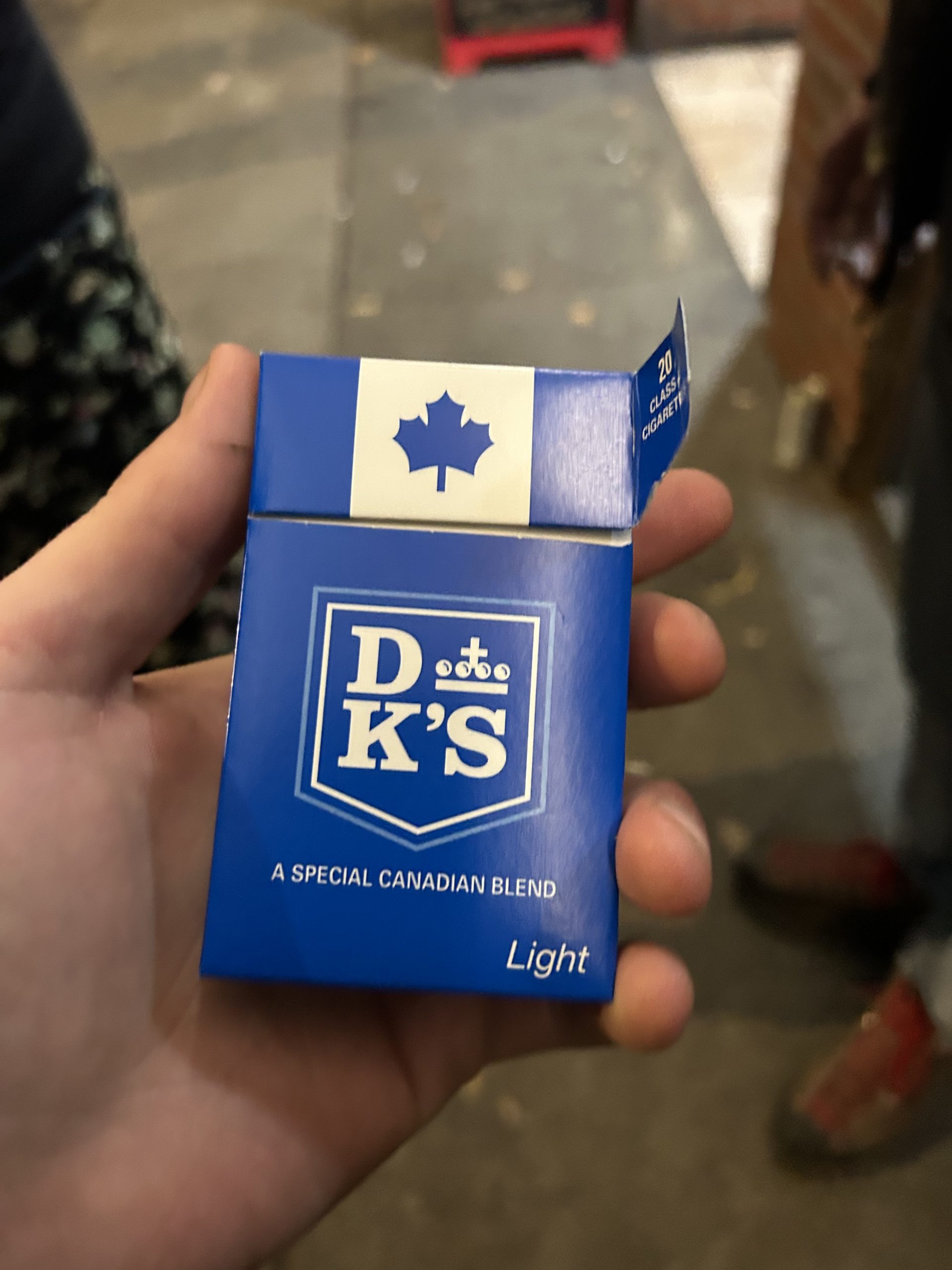
While a blue cigarette to most Canadians is associated with Player’s brand, thanks to plane packing, those days are over. Why might you ask does this package not have any warning labels or graphic photos of tracheas? Answer: it’s counterfeit! These and other brands make up an important service on the downtown Eastside of Vancouver. Going for about $5 a pack, they offer a way sellers to make a modest income while providing cigarettes to the local community at a decent price.
The More Things Change, The More They Stay the Same
In 1986, Vancouver made an intentional choice to begin removing cigarette consumption from most of public life. While there are few detractors today who would argue against such a decision, the city could not predict the future. Vaping has largely replaced cigarettes, particularly among younger demographics. It is hard not to see an irony however between the ease of vaping and the now relegated place of the cigarette smoker in most contemporary western cities At Capilano University, while one is technically not allowed to vape outside of two designated areas, well removed from the main area of campus, nobody does this. With how easy it is to vape, it is done in hallways, bathrooms and communal areas; replicating a similar pattern of ubiquitous consumption and acceptance enjoyed by cigarette smokers until the mid 1980s. While a far cry from the smoke pit at high schools and universities of former smokers interviewed for this project, it is none the less again accepted for vaping to be done in the company of non-vapers without much thought a behavior not seen by cigarette smokers in decades in Vancouver.
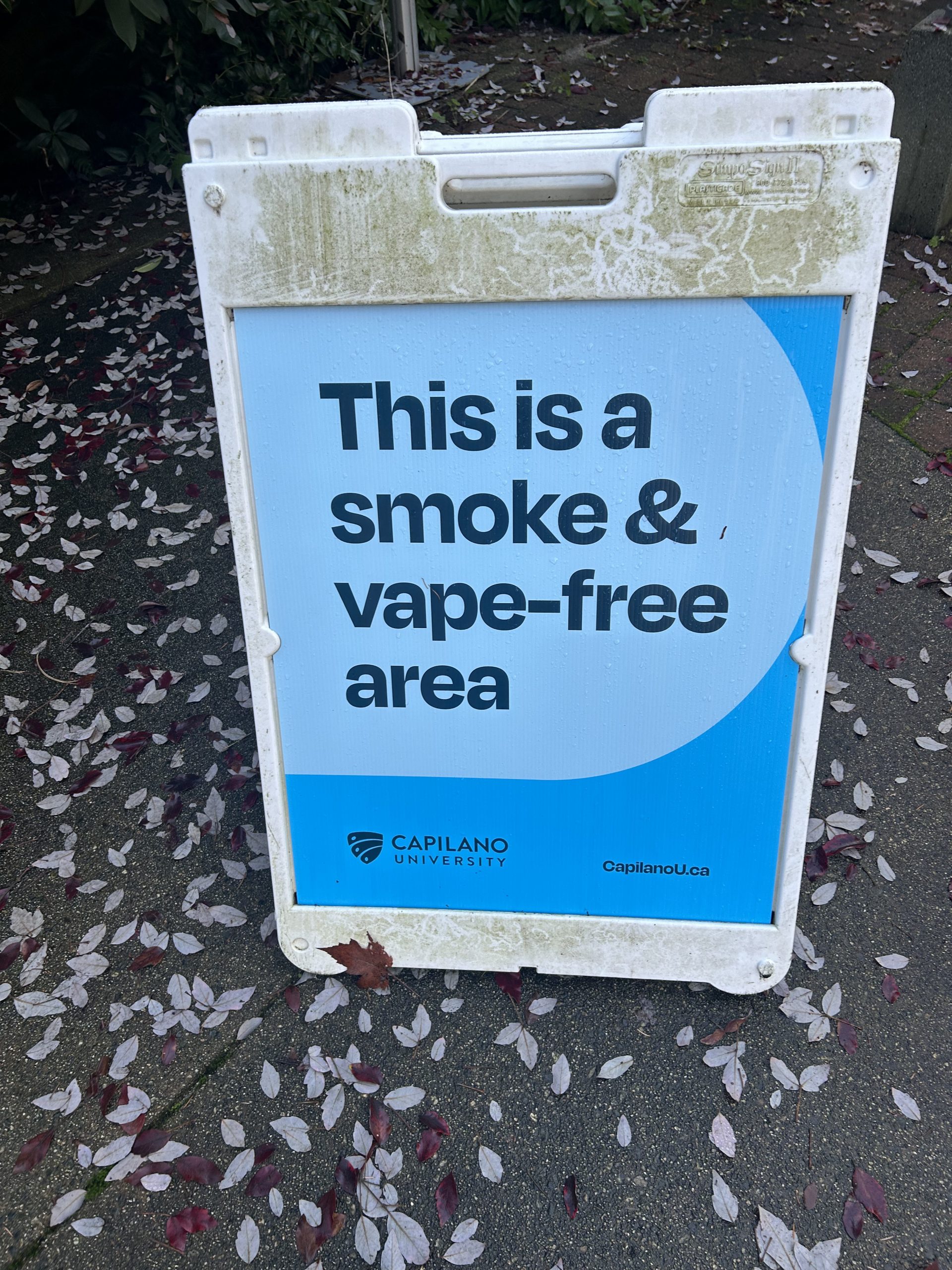
In case you did not know! A giant sandwich board sign informs folks at Capilano University that the whole campus is a smoke-free area. A far cry from the 1980s when it was pretty much the opposite; this sign sits in courtyard area kind of in the middle of the library and Birch.
Conversely, while it’s agreed upon that someone smoking a cigarette must do so only in the designated areas of campus, the only reason why vaping is not allowed openly at the University came on the backs of smokers and with that, massive amounts of money to Vancouver arts and culture. Yes, second-hand smoke is less of an issue with vaping but trading ash and yellow hue for clean air while replacing it with “watermelon,” or “blue raspberry” is a funny double standard. According to the literature, 29 percent of Canadian students aged 10-19 reported saying they tried vaping in 2021-2022 (Singh, et al. 2025).
What about other “modern” vices? Societally, we are not yet on the precipice of understanding what smartphones do to the developing brain. The duplicitous nature of social media companies to cover up the calculated and addictive nature of their products mimics the words and actions of tobacco lobbying in every decade. A second element of smartphones coincides with the more recent rise in sports betting, and onslaught of accompanying advertising. The concept of a large tobacco company sponsoring an ostensively free jazz festival feels primitive today, but it was public and social as much as it was an event for music lovers. Equipped with a phone and a propensity for addictive behavior, anyone can gamble in an instant. Anonymous and solitary, lives and families are destroyed in secret.
Ironically, the other title sponsor of the Vancouver Indy before its cancelation was Molson Brewing. Amongst the growing research pointing to the carcinogenic nature of alcohol, doctors and scientists are growing in support of warning labels to be mandated on all alcohol sold at retail. While unduly a good step, Canada, and the rest of the world at large are not close to restricting alcohol advertising on television and radio, let alone sponsorship of venues and events. The N.H.L and beer as a part of the Canadian cultural experience and source of revenue are as old as time and firmly in lock step today. Unduly we will look back with regret over the extent and speed that sectioned gambling has infiltrated society. While societal change is slow, public health is always a good index of what should happen.
References
Autosport. (2003). Tobacco laws force players out. https://www.autosport.com/general https:// news/tobacco-laws-force-players-out-5025375/5025375/
(1989, December17). Smoking banned on domestic flights in 1989. CBC. https://www.cbc.ca/player/play/video/1.3335098
(2000a, November 29). Symphony of Fire lose tobacco money. CBC. https://www.cbc.ca/news/canada/symphonies-of-fire-lose-tobacco-money-1.224462
(2000b, December 13). Jazz festival keeps tobacco sponsor. CBC. https://www.cbc.ca/news/canada/jazz-festival-keeps-tobacco-sponsor-1.207380
(2001, January 22). Du Maurier remains main sponsor of downtown Jazz Festival. CBC. https://www.cbc.ca/news/canada/du-maurier-remains-main-sponsor-of-downtown-jazz- festival-1.267847
Coastal Jazz. (2024). Jazz fest is a smash. https://www.coastaljazz.ca/jazz-fest-is-a-smash/
Hedgeco, N,Horocks,P, & Iwata,E,M. (Executive producers). 1999.Tobaco Wars. TLC
The Legislative Assembly Of British Columbia. (n.d.) 1886 The first transcontinental train arrives in vancouver. https://www.leg.bc.ca/learn/discover-your-legislature/1886-first-transcontinental-train-arrives-in-vancouver
Government of British Columbia. (2024). Tobacco and vapor free places. https://www2.gov.bc.ca/gov/content/health/keeping-bc-healthy-safe/tobacco- vapour/requirements-under-tobacco-vapour-product-control-act-regulation/tobacco-vapour-free-places
Parliamentary Research Branch. 1998. Federal legislation and regulatory action. https://publications.gc.ca/Pilot/LoPBdP/modules/prb98-8-tobacco/legislation.htm
Reuter. (1994, June 28). Canada smokeless on all flights . Washington Post. https://www.washingtonpost.com/archive/national/1994/06/29/canada-smokeless-on-all- flights/fde0a117-e8ea-43a7-a8bb-072f5a30aad5/
Sarti, Robert. (1998 March,11). City “Keg’ still smoking despite legal crackdown. https://www.facebook.com/photo/?fbd=2056899641507722&set=pcb.2224903267982767
Signh,S,Borkenhagen, D,Dimitropolous,G,& Arnold D, P. Investigating changes in vape use among Canadian youth fro 2014 to 2022. Canadian Journal of Public Health.
I: 10.17269/s41997-025-01119-0
United Press International Archives. (1991 Setepmner,15). Scranton wins du Maurier. https://www.upi.com/Archives/1991/09/15/Scranton-wins-du-Maurier/1090684907200/
Zeidler,M. (2016 December,4). 30 years ago smoking in public places was banned in Vancouver and smokers were outraged. CBC. https://www.cbc.ca/news/canada/british-columbia/smoking-bylaw-vancouver-history-1.3875548
References
Autosport. (2003). Tobacco laws force players out. https://www.autosport.com/general https:// news/tobacco-laws-force-players-out-5025375/5025375/
(1989, December17). Smoking banned on domestic flights in 1989. CBC. https://www.cbc.ca/player/play/video/1.3335098
(2000a, November 29). Symphony of Fire lose tobacco money. CBC. https://www.cbc.ca/news/canada/symphonies-of-fire-lose-tobacco-money-1.224462
(2000b, December 13). Jazz festival keeps tobacco sponsor. CBC. https://www.cbc.ca/news/canada/jazz-festival-keeps-tobacco-sponsor-1.207380
(2001, January 22). Du Maurier remains main sponsor of downtown Jazz Festival. CBC. https://www.cbc.ca/news/canada/du-maurier-remains-main-sponsor-of-downtown-jazz- festival-1.267847
Coastal Jazz. (2024). Jazz fest is a smash. https://www.coastaljazz.ca/jazz-fest-is-a-smash/
Hedgeco, N,Horocks,P, & Iwata,E,M. (Executive producers). 1999.Tobaco Wars. TLC
The Legislative Assembly Of British Columbia. (n.d.) 1886 The first transcontinental train rrives in vancouver. https://www.leg.bc.ca/learn/discover-your-legislature/1886-first- transcontinental-train-arrives-in-vancouver.
Government of British Columbia. (2024). Tobacco and vapor free places. https://www2.gov.bc.ca/gov/content/health/keeping-bc-healthy-safe/tobacco- vapour/requirements-under-tobacco-vapour-product-control-act-regulation/tobacco-vapour-free-places
Parliamentary Research Branch. 1998. Federal legislation and regulatory action. https://publications.gc.ca/Pilot/LoPBdP/modules/prb98-8-tobacco/legislation.htm
Reuter. (1994, June 28). Canada smokeless on all flights . Washington Post. https://www.washingtonpost.com/archive/national/1994/06/29/canada-smokeless-on-all- flights/fde0a117-e8ea-43a7-a8bb-072f5a30aad5/
Sarti, Robert. (1998 March,11). City “Keg’ still smoking despite legal crackdown. https://www.facebook.com/photo/?fbd=2056899641507722&set=pcb.2224903267982767
Signh,S,Borkenhagen, D,Dimitropolous,G,& Arnold D, P. Investigating changes in vape use among Canadian youth fro 2014 to 2022. Canadian Journal of Public Health.
I: 10.17269/s41997-025-01119-0
United Press International Archives. (1991 Setepmner,15). Scranton wins du Maurier.
My Right to Smoke Versus Your Right to Clean Air: Vancouver in the age of the Cigarette https://www.upi.com/Archives/1991/09/15/Scranton-wins-du-Maurier/1090684907200/
Zeidler,M. (2016 December,4). 30 years ago smoking in public places was banned in Vancouver and smokers were outraged. CBC. https://www.cbc.ca/news/canada/british-c olumbia/smoking-bylaw-vancouver-history-1.3875548