


Angellica Sabaratnam
Angellica Sabaratnam (she/her) has spent her entire life growing up in Vancouver. She is completing a Bachelor of Arts Degree in Psychology at Capilano University. Throughout her undergraduate degree, she was able to work and gain valuable experience as a pharmacy assistant. Angellica thrives on meaningful connections and building relationships with others. She hopes to continue her education by pursuing a master’s degree in clinical psychology. Her goals are centered on making a positive impact in her community.
Introduction
Have you ever exaggerated a bad experience with a pharmacist? Were the wait times too long for you? Before working in a community pharmacy, I was also unaware of the inner workings of a pharmacy. Why would it take upwards of thirty minutes to fill a couple of prescriptions? Pills were clearly marked for the person behind the counter to just give them to me. Why did it take so long? This is where the public and I are wrong. About 64.8% of the United States of adults aged 18 and older have taken prescription medication at some time during the past 12 months (Cohen & Mykyta, 2023). This figure does not account for one-time prescriptions filled. There are a multitude of steps being taken to ensure that your prescription is successfully filled. However, most of the public still acclaims pharmacists as “pill counters.” According to data provided by the B.C. Ministry of Health, community pharmacists dispensed 102.7 million prescriptions in the latest year. As a pharmacy assistant myself, I am a part of a smaller store, and we still fill around 100 prescriptions per day. This That is only a numerical number of the prescriptions that are filled, this does not account for previous or future days’ consultations, enquiries, and troubleshooting.
Pharmacists represent the third largest healthcare profession in Canada, after nurses and physicians, with 46,699 licensed to practice in 2022 (Frymire et al., 2024). Community pharmacists are accessible healthcare professionals with vast clinical skills. However, many patients continue to view their profession as “pill counters”. This disconnection may limit the pharmacist’s full range of skills in the community and the public’s use of available healthcare services. How do perceptions of community pharmacists differ between pharmacy professionals and patients? How may this affect the use of pharmacy services in the community? How would social media be a reliable source to bridge gaps in knowledge?
The change I am proposing is filling in the gaps of knowledge where the public undermines the efficiency and effectiveness of pharmacists’ clinical skills. This is important because, with the number of people struggling to find a family physician, pharmacists have stepped up in the roles of prescribing and counselling. This is an evolutionary approach; pharmacists have always been masters of medications and their interactions. As time has gone on, other services like prescribing minor ailments have been enforced, and a lot of the public is unaware of these expansions. To fill in the knowledge gaps that undermine a pharmacist’s clinical skills, and how community pharmacy has evolved. I propose an educational outlet to meet the masses of patients with the use of social media platforms.
Admission to pharmacy school requires a minimum of 60 undergraduate credits, and the program itself spans four years of clinical study. At the University of British Columbia, upon completion of pharmacy school, individuals will receive a doctorate. Pharmacy students can join the workforce as soon as they graduate; most do work as assistants first or during their education to gain experience.

Credits to Alexandra McPherson (November 11, 2025).
How a Pharmacist Fills and Checks a Prescription (British Columbia Practice Standards)
In British Columbia, pharmacists follow the HPA Bylaws Schedule F Part 1 when dispensing prescriptions, beginning with verifying patient identification by confirming the correct patient and receiving proper identification for unfamiliar individuals. They must then confirm allergy information at every dispensing, updating records as needed. A clinical check through PharmaNet (a database of prescriptions taken by patients that all pharmacies can view) is required to review the patient’s medication history, recent prescriptions, and potential drug interactions or duplications at other locations. The Necessary, Effective, Safe, Adherence (NESA) which is taught at the University of British Columbia. This guideline is used to determine if the therapy is necessary, effective, and safe for the patient. Pharmacists check issues such as incorrect dosing, interactions, contraindications, or insurance. After the clinical assessment, the pharmacist prepares the prescription by selecting the correct drug and strength, possibly compounding, and finally labeling and packaging the product. A final check ensures accuracy of the drug, strength, dosage form, quantity, labeling, and documentation. The technical procedure of counting pills can and is usually done by technicians or assistants. Pharmacists then have patient counselling unless refused by the patient. They explain the medication’s purpose, how to take it, expected effects, side effects, precautions, and when to seek help. Throughout the process, pharmacists document therapy problems, interventions, clarifications, counselling, and signoffs (PRP insights – prescription documentation 2023). These procedures are done for every prescription that has to be filled at the pharmacy.

This is a blurred photo of a prescription label. Each pharmacist dispensing must type out specific directions for the medications that have been written.
Historical Evolution
In interviews conducted with two community pharmacists, Donald Blyth and Gordon Luk, who have been in pharmacy practice for between 30 and 40 years, they said they have witnessed the profession transform dramatically. At the beginning of their careers, much of their work revolved around technical tasks: typing prescription labels, counting pills, and completing the final check. Over time, however, the focus has steadily shifted toward cognitive and clinical skills. Pharmacists now play a key role in patient counselling, prescriptions, and over-the-counter products, identifying and managing drug interactions, and ensuring optimal therapeutic outcomes.
More recently, their scope has expanded even further. Today, pharmacists assess and prescribe minor ailments, administer immunizations and other injections, adapt prescriptions for improved patient care, and even order lab tests. The profession and tasks they undertake have truly evolved, which is a reflection of their value within the healthcare system.
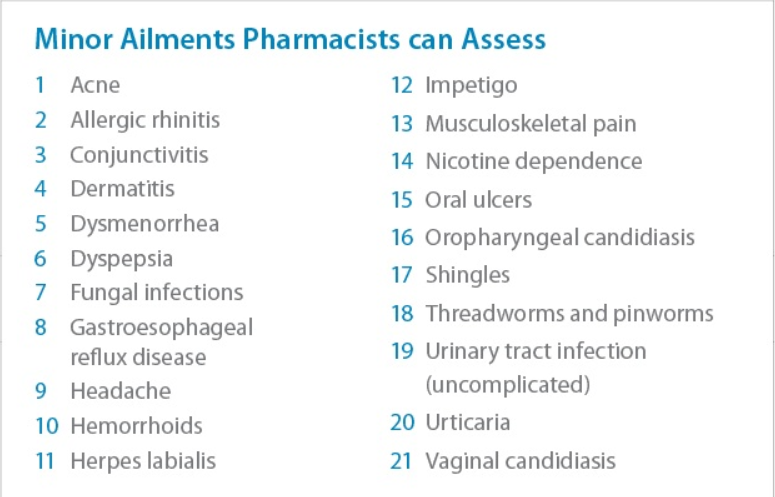
This is the list of 21 minor ailments your local BC pharmacist can prescribe for.
Clinical Responsibilities
Currently, pharmacists are able to prescribe for 21 minor ailments under a new program called Minor Ailments and Contraception Service (MACS), which was introduced in British Columbia (B.C) in June 2023. This program allows pharmacists to counsel and write some new prescriptions for B.C residents under their own license concerning health conditions that can be managed with low-prescribed treatment and/or self-care strategies (Frymire et al., 2024). This program allows community pharmacists to extend their skills and knowledge to patients in need. Between June 1, 2023, and May 31, 2025, pharmacists in B.C conducted over 963,800 MACS consultations. During this period, 590,590 patients received a MACS service. Over 4,500 pharmacists provided MACS, which is approximately 66% of licensed B.C pharmacists, or 73% of active community pharmacists. The most common MACS prescriptions are for contraception and urinary tract infections (Health, 2025). This program is a solution for B.C in response to the shortage of family physicians, as well as expanding pharmacists’ clinical role. Pharmacists also engage in daily injections for various reasons, trained in subcutaneous and intramuscular poke sites.
Other provinces have also enacted similar programs allowing pharmacists to extend their duties in prescribing, like Alberta. Most provinces in Canada have a similar variation of MACS. This program helps lighten the load of physicians catering to recurrent problems a patient may have, while not having an immediate appointment with a physician. Globally, other countries have not enacted a MACS program yet, aside from Australia. This program benefits physicians and patients, and it also increases the skill set of pharmacists. Under their license, pharmacists can adapt some long-term prescriptions to mitigate doctor appointments as well.
In rural areas, there has been an uproar for pharmacists to be given more duties regarding prescribing. Individuals feel more comfortable speaking with a pharmacist; they see them more often, and there is not a 10-15 minute window for them to describe their problems. A scholarly article examines the public’s wants in adding more services in pharmacies in rural communities in Australia. A lot of the services they want we already have here, but most individuals are not aware of them. Also, because this article is based in a rural area, more individuals have faith in pharmacy abilities and want to encourage more services. This may be attributed to local connectiveness. (Landes et al., 2023)
A plan of action where wait time frustrations occur, Pharmacies across B.C have established a text when ready program that mitigates calls, which take pharmacy staff away from other duties. This texting program also ensures the patient is notified as soon as their prescription is ready, cutting out idle waiting time in and around the pharmacy facility.

Contraceptive tablets that can be prescribed by pharmacists using MACS.
Credits to Alexandra McPherson (November 11, 2025).
Public Misperception and Professional Interviews
Pharmacists play a crucial role in reducing medication errors, identifying 30–70% of medication ordering errors. However, due to interruptions and distractions during dispensing, there have been known accounts of approximately 9.4% of these errors, with reported occurrences of every two to six minutes. In a study that reviewed existing knowledge on the impact of interruptions and distractions in pharmacy practice, it was found that external and internal interruptions varied from about five to twenty minutes per hour. (Ayanaw, Lim, Khera, Vu, Goordeen, & Malone, 2025). Pharmacists are pulled in many directions, whether answering questions, counselling medications, or recommending alternative over-the-counter products. Their profession is multifaceted.
This may be attributed to the public’s impatient behaviour. Pharmacists are pulled in many directions as a result of being the most accessible healthcare provider. Pharmacists are available in the community, there are no fees or cost to consult with one, and they work extended hours. Pharmacists are the middlemen between physicians and patients, which does come with challenges when they are sometimes at the mercy of a doctor’s office not answering or sending over a fax prescription, which in turn can aggravate patients, leading to hostile work environments. They are messengers and often bare the brunt of displaced anger simply because they are readily available. Pharmacists also handle insurance claims, which can create another host of problems related to billing. Seeing claim rejections can spiral patients. Behind the scenes, pharmacists work on interventions and counsel for special authority requests. The public rarely sees the back end of these procedures. They are quick to jump to anger and become volatile. Many pharmacists have expressed being verbally and physically abused on duty.
In response to the question, “Was there ever a moment or situation that led you to reevaluate pursuing this career?” 3 out of 4 Downtown Vancouver pharmacists indicated they had not reconsidered their profession. This outcome reinforces the perception that community pharmacists demonstrate a strong commitment despite the demanding nature of their work. They are committed to evolving pharmacy duties and engaging in community relationships. Pharmacists are ready and committed to helping the community with more expansion of their roles; a lesser burden will fall on our shortage of physicians.
When local pharmacists were also asked how they felt about their profession, many highlighted its rewards. They spoke about the value of patient counselling, ensuring medication safety, and being a trusted and accessible healthcare professional in the community. Many pharmacists noted that the role is meaningful because they can help patients and build strong rapport over time. They also explained how they are often the first point of contact before seeking their primary care provider. As one pharmacist explained, “it is rewarding when regular patients have so much trust in you that they only want to speak with you and always value your advice.” Pharmacists expressed pride in their work, appreciating the opportunity to apply their clinical training while also connecting with the public and supporting patient health.
Broader Healthcare Relevance and Action
In Canada, research in exploring the public’s views and experiences with extended pharmacy services is limited (Schindel, Hughes, Makhinova, & Daniels, 2022). In a national online survey commissioned by the Canadian Pharmacists Association to examine perceptions and attitudes towards pharmacists, most Canadians were aware of extended services such as the influenza vaccinations. However, there was less awareness of other services such as prescribing for minor ailments, smoking cessation, medication reviews, and administration of other vaccines. (Canadian Pharmacists Association, 2017)
Social media has popularized, exhibiting trends and viral videos/reels that inform a magnitude of viewers. A proposed solution in bridging the gap between the knowledge the public has with the clinical duties of the pharmacy is to educate. Pharmacists’ points of view have been commercialized, exhibiting new roles; however, the core of the practice still remains unknown. A lot of what is distributed is a one size fits all model endorsement of facilities. For example, although some pharmacists can prescribe now, they cannot prescribe every medication; consultations are needed to manage risks. Unknowingly, patients arrive at the pharmacy assuming their requests will be approved and filled immediately. This is where the commercialization of pharmacy duties has failed. Having individuals who are a part of the daily routines, like technicians, assistants, and even pharmacist educators, on social media platforms opens up possibilities of unknown information amongst the public. Creating social media accounts for individuals actually participating in the daily routines of the pharmacy would be a solution. A day in the life reel not only increases popularity for facilities but also educates the public of the behind-the-scenes procedures. Protection of privacy is a main concern; however, mock trials of fake patients can satisfy the same results, almost like a simulation.
Treating a pharmaceutical facility like a fast-food chain is problematic; interruptions have major repercussions. There are many moving parts in a community pharmacy that in unknown to the public, tools of social media may mitigate the discrepancy of public perception. Next time you are waiting for your prescriptions to be filled, be aware and give the pharmacy some grace; they are doing things behind the scenes that you will never know. The number of prescriptions being filled daily is only increasing. Having awareness of someone else’s career can save a lot of time and frustration when you find yourself waiting for what you believe to be too long.
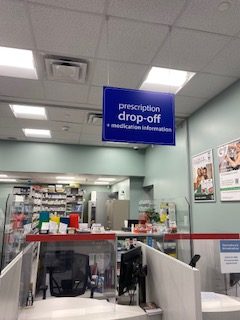
A local pharmacy; dropping off your prescription is the first step.
References
PRP insights – prescription documentation. College of Pharmacists of British Columbia. (2023, January 3). https://www.bcpharmacists.org/readlinks/prp-insights-prescription-documentation
Schindel, T. J., Hughes, C. A., Makhinova, T., & Daniels, J. S. (2022). Drawing out experience: Arts-informed qualitative research exploring public perceptions of community pharmacy services. Research in Social & Administrative Pharmacy, 18(1), 2200–2212. https://doi-org.ezproxy.capilanou.ca/10.1016/j.sapharm.2021.03.006
Ayanaw, M., Lim, A., Khera, H., Vu, T., Goordeen, D., & Malone, D. (2025). How do interruptions and distractions affect pharmacy practice? A scoping review of their impact and interventions in dispensing. Research in Social & Administrative Pharmacy, 21(9), 667–678. https://doi-org.ezproxy.capilanou.ca/10.1016/j.sapharm.2025.05.001
Landes, S. J., Smith, M. G., Lam, J. C., Watt, T. C., & Curran, G. M. (2023). Rural community pharmacists’ perceptions of implementing mental health interventions to reach underserved populations. Journal of Rural Mental Health, 47(2), 90–99. https://doi-org.ezproxy.capilanou.ca/10.1037/rmh0000220
Frymire, E., Tadrous, M., Premji, K., Glazier, R., Dolovich, L., Nguyen, P., Kiran, T., Roberts, L., & Green, M. (2024). The Top 5 Minor Ailments and Pharmacist Management in Ontario: Attachment and Primary Care. Annals of Family Medicine, 22(Suppl 1), 6613. https://doi.org/10.1370/afm.22.s1.6613
Health, M. of. (2025, September 2). Pharmacists prescribing for minor ailments and contraception – data. Province of British Columbia. https://www2.gov.bc.ca/gov/content/health/practitioner-professional-resources/pharmacare/initiatives/sop/monitoring-evaluation-ppmac