


Luiza Guimarães
Luiza G. Guimarães (she/her) is completing her Bachelor of Arts with a Major in Interdisciplinary Studies at Capilano University, where she has been guided toward a deeper understanding of her responsibilities as an ally and a settler on unceded lands. A Brazilian student recognized for her academic excellence, she has been named to the Dean’s List every semester. With a background in sustainability studies, Luiza is passionate about how community-building and creative practices work together to nurture reciprocal ways of being. Upon graduating in Spring 2026, she aims to carry what she has learned forward into work that is rooted in respect, attentive to land, and guided by intuitive creativity.
Humans have always made art. Long before the idea of markets, institutions, or “the artist” existed, creative practices such as weaving, carving, and painting were embedded in everyday life, as forms of communication, spiritual expressions, and even survival (Morris-Kay 158). Prehistoric rock art, for example, carried ritualistic meaning that marked memory and belief (Brittanica Editors), and Indigenous expressions demonstrate, since pre-colonial times, ancestral storytelling, ecological knowledge, and ways of being in relation (Gustlin). Totem poles, monuments carved by First Nations in the Pacific Northwest, represent kinship, relational obligations, and even records of lineages, holding significant socio-cultural importance (Huang). These works remind us that art was never separate from relating, be it to each other or to land, but rather, a symbolic way of honoring traditions, identities, and values.
Over time, however, particularly in Western contexts, the way people engaged with making changed as art became increasingly tied to institutions of power. During the Medieval and Renaissance periods, the Church and ruling elites commissioned artworks to reinforce spiritual authority and social hierarchy (Weinberg). With industrialization, some visual art was mobilized as propaganda, whilst those that challenged dominant ideologies were censored or banned with the goal of shaping public sentiment (Fürstenau). As capitalist systems expanded across the West, art became commodified, valued primarily as a finished product (Mambrol), something to gatekeep, collect, or even dispose of. What had once been a communal way of being, drastically narrowed into a market-driven system that prioritizes production, ownership and profit.
Yet in my own journey as a maker, and through conversations with artists today, it becomes clear that, even within this commodified landscape, people continue to insist on the deeper purpose of creativity as an innate and nurturing form of care. As Mathew Arthur, Canadian artist and instructor on Women’s and Gender Studies shared with me in a personal interview, “When you’re making, you’re paying attention — to yourself, to the material, to whatever is in front of you. That attention is a kind of care” (Arthur). Arthur’s insight reframes ‘making’ as a relational interaction with the materials and environments around us, becoming less about the finished product, and more about the process: the cultivation of presence, curiosity, non-judgement, and responsibility.
In this context, I believe that making should be valued not as a competitive pursuit, but as a way of living that sustains our capacity for care. Australian art theorist Jacqueline Millner writes, “In this imagining and creating safe affective spaces, artists have much to contribute, more so because maintaining a practice in neoliberal contexts means nurturing collectivities, sensitivities and resourcefulness – essential aspects of care” (Millner, “Care and Art”). Through attentive engagement, creative practices can reconnect us to ourselves, to one another, and to the more-than-human world. In a time marked by ecological crisis, social fragmentation, and political tension, making can become both a form of healing and an act of resistance, teaching us to listen, collaborate, and take responsibility for the worlds we inhabit.
With this article, I aim to explore what it might mean to return to making as a way of being. Through my own journey, scholarly voices, and the lived experiences of creatives who inspire me, I ask: what happens when we understand art as a practice that inherently cultivates care, connection, and empathy across all our relations?
My Personal Narrative
My relationship with art has never been linear. Growing up in Brazil, I rarely felt supported in creative spaces: art teachers tended to focus on more confident students, and at home, artistic practices weren’t seen as meaningful tools for emotional development. When I later attended a high school with no arts education, I began noticing how creativity is deprioritized within systems shaped by capitalist ideas of productivity and “proper” career preparation. For years, I followed the path expected of me, pursuing a marketing degree as it seemed like the most realistic choice.
Everything shifted in 2022, when I received a scholarship to study sustainability in Hawai‘i. The financial relief of this opportunity gave me the freedom to travel between O‘ahu and Maui, where I learned about Hawaiian Indigeneity, volunteered on local farms, and spent time in landscapes and communities structured around reciprocity. Being surrounded by fascinating landscapes, and witnessing how caring for the land the people shapes cultural practices, opened perspectives I had never encountered growing up in São Paulo.
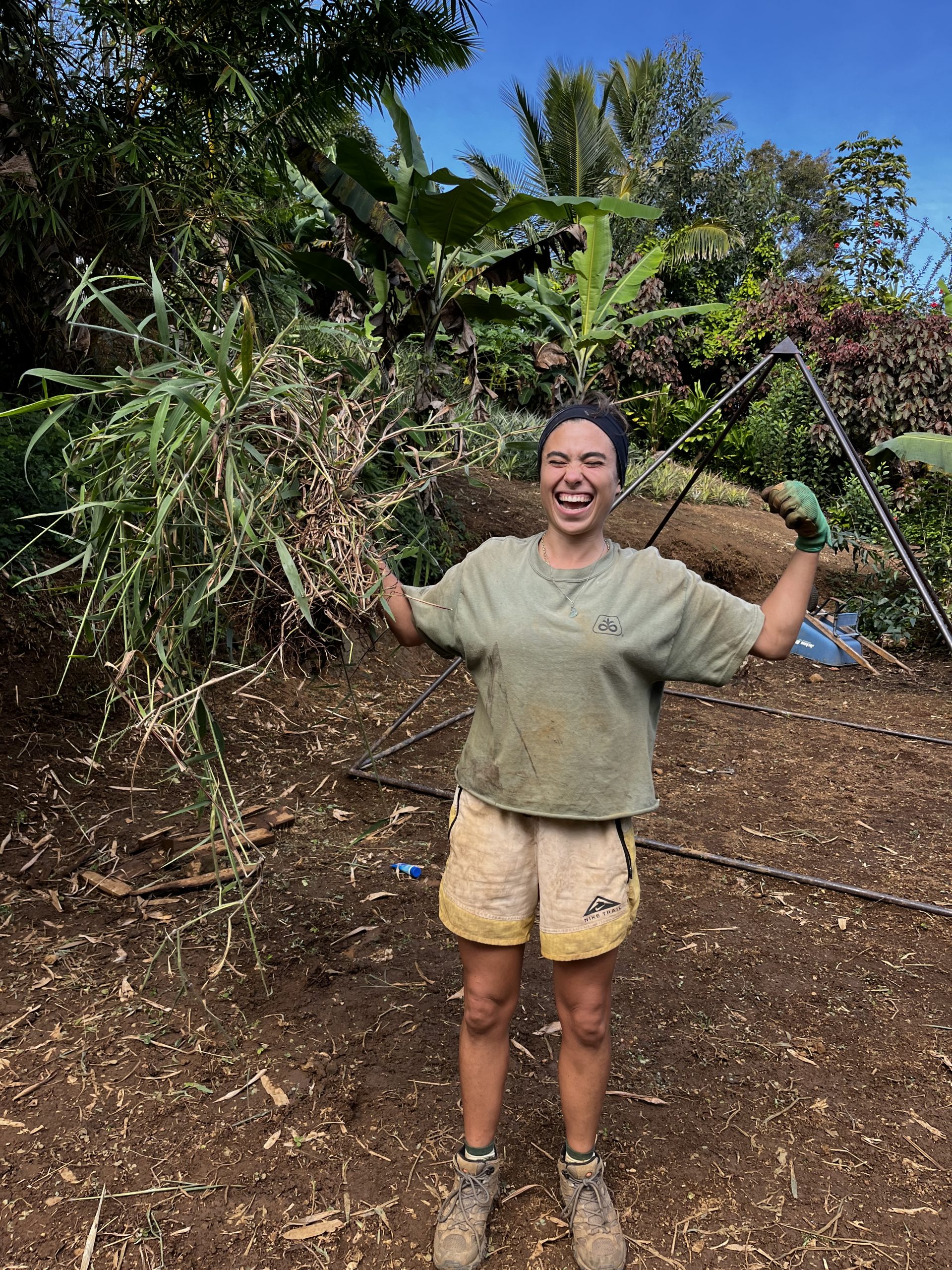
This is me weeding invasive plant species on a farm in Maui, Hawai’i.
During this time, I met activists, musicians, craftspeople, and community builders who centered art in their everyday lives. What struck me was that none of them approached creativity as “talent” or as a means to success. Instead, their making emerged from their attention to land, to materials, to each other. Whether carving political symbols, painting murals, or cooking for community events, their practices were inseparable from their ways of living. This orientation toward presence rather than productivity made me also want to create: not for any achievement, but simply for the pleasure of making and sharing.
As I allowed myself to explore creatively, I found that I was building a sacred space for myself, made of honesty and rawness. This openness eventually led me to pottery. From the first moment I touched clay, it felt instinctive, almost like a homecoming. When I returned to Brazil after a year abroad, pottery became a grounding anchor during a difficult transition. I joined local studios, worked alongside other makers, and found myself in spaces where experimentation was encouraged and failures were seen as part of the process.
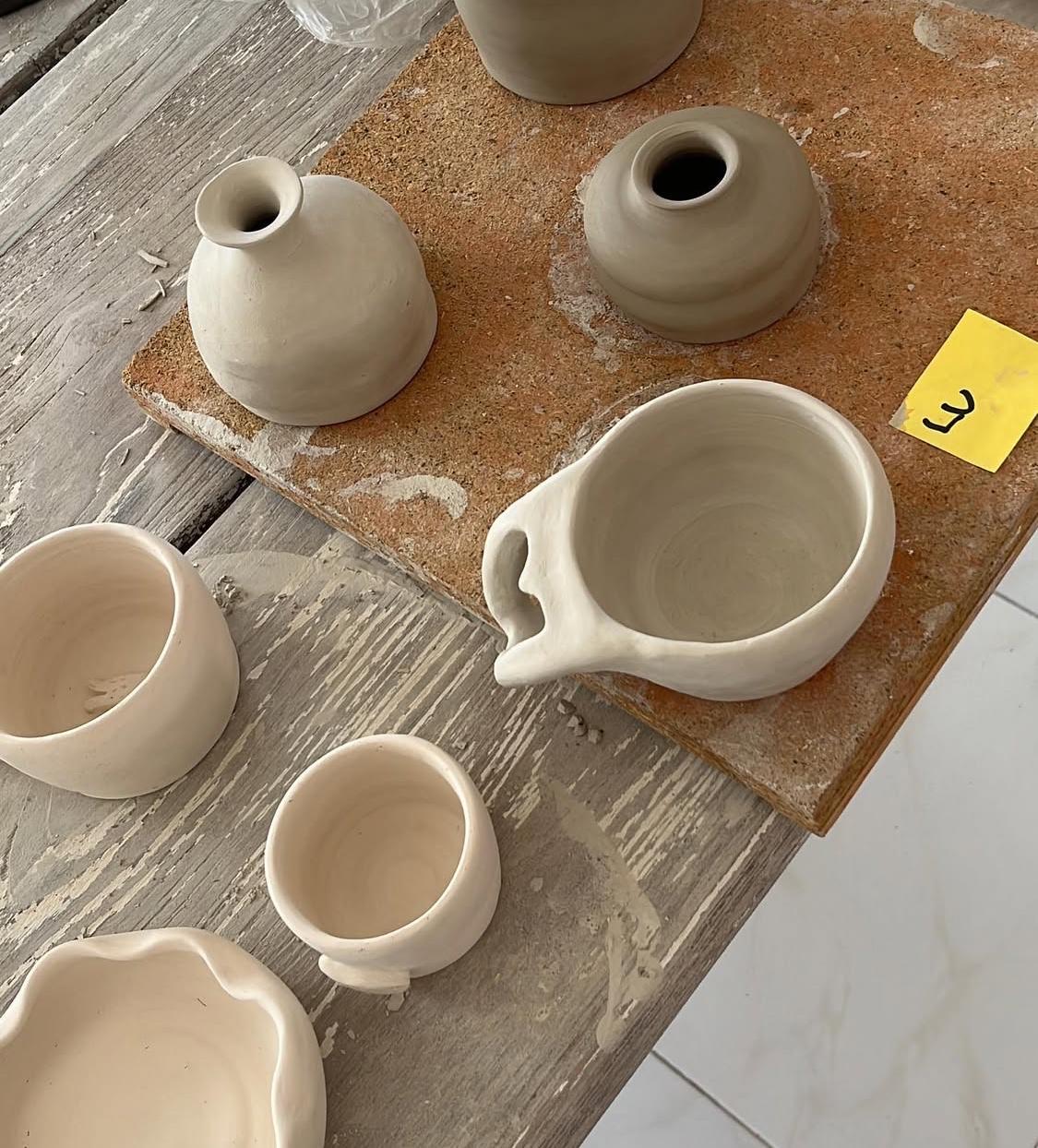
These are a few of the first ceramic pieces I made in a shared studio space in O’ahu, Hawai’i. I was inspired to experiment with shapes and ideas.
Working with clay allowed me to see it not as something to master, but as something to learn from. I noticed how the clay is alive and deserves care, just like me: it is responsive, generous, and attentive, holding memory, registering emotions, almost like a mirror. I realized that, in practicing letting the clay be what it wants, I find my best self being reflected in its surface. This reciprocity taught me that making is a way of practicing empathy, toward materials, toward myself, and toward the worlds I move through.
This understanding of making as relational later motivated me to seek out conversations with other creatives who center connection in their work. I wanted to understand how this orientation shaped their lives, communities, and their relationships to their environments. I also recognize that not everyone chooses this path: many artists work within commercial, corporate, or institutional systems, for many different reasons. Still, the individuals I spoke to, Júlia, Josh, and Érika, offer a unique lens on what becomes possible when making is understood not as production, but as relation: a way of caring for oneself, for community, and for the more-than-human world.
Artist, Júlia Godoy: Art and the self
In a heartfelt conversation, Júlia Godoy, Brazilian-American visual artist living in Mexico City, shared her journey with me. Her current practice revolves around natural pigments that she gathers and processes herself, transforming them into delicately layered canvases. Like me, she describes her journey as nonlinear: “It’s not as straightforward as getting a degree. The deeper I go into it, the more I realize it’s an internal journey.” She reminded me that creating under expectation, whether for a specific audience or ideal, tends to distance us from authenticity and the very reason we make art in the first place.
Júlia found that completing a Fine Arts degree, while it helped her develop skills and techniques she felt proud of, wasn’t enough to guide her through a more truthful practice. When the COVID-19 pandemic struck and she lost access to her studio, she turned to nature for guidance, “I’d find these bits of salmon brick and use them to draw in my sketchbook. That reminded me of my childhood, when I’d draw with stones on the sidewalk.” This return inspired her to abandon working on hyperrealistic paintings, which offered financial stability, but not so much fulfillment. Júlia finally decided to follow her intuition, into a simpler, but more raw style: “To this day, I still don’t know what I’m doing, and it’s wonderful. I figured that you’re on the right path when the path disappears.”
When I asked whether she feels connected with the materials she uses, she smiled, “For sure, making natural pigments is very meditative. I also believe that earth has its own sense of memory. Pigments settle into their own pattern, one I call blooming.” I sense this same reciprocity in clay. The memory of my fingertips remains imprinted in its body, and when I look back at my work, I can remember how I felt, and what the clay was asking of me. It becomes an archive of time, space, and process.
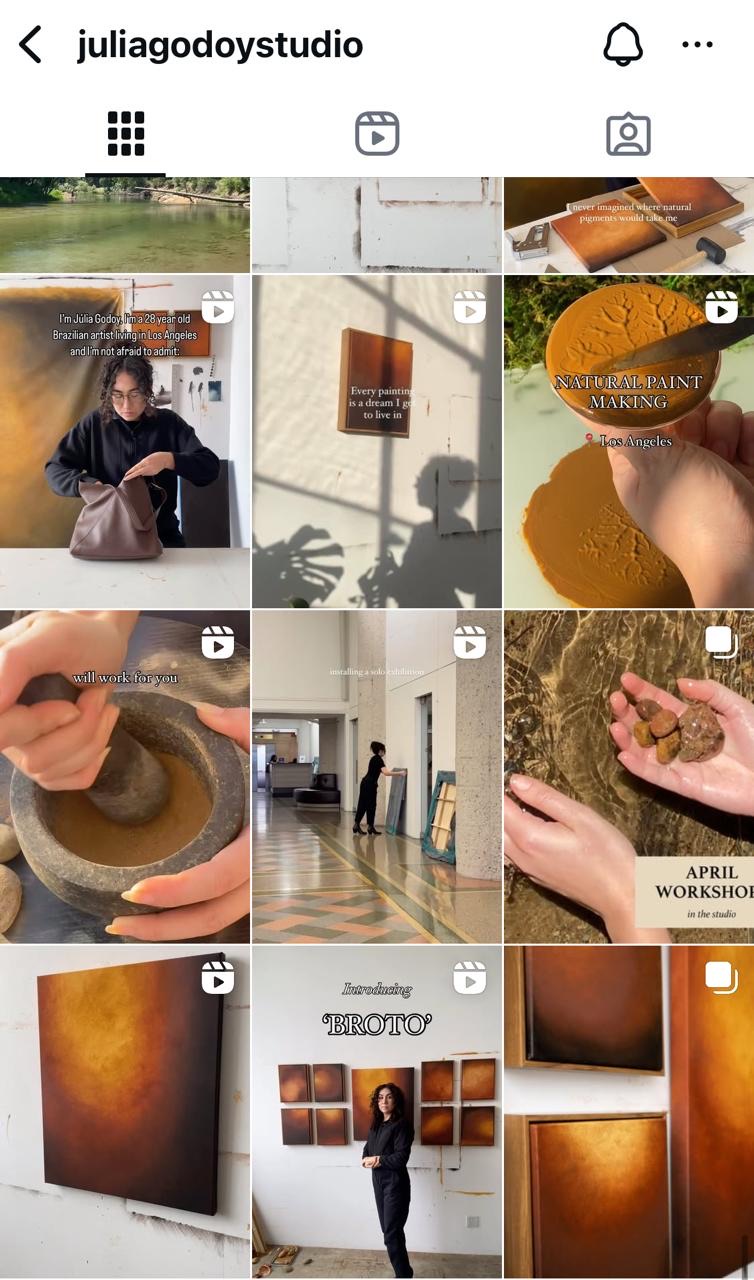
This is a screenshot taken from Júlia’s Instagram profile grid. It shows her collecting rocks, making the pigments, and even some of her paintings in the background. Her Instagram handle is @juliagodoystudio.
Godoy spoke of having to learn how to find peace when running out of a certain color. As she relies on nature for making her art, it’s not easy finding the same tone twice: “When a color’s done, the painting’s done. It wasn’t easy for me to learn how to be okay with this. Living simply is difficult; it forces you to be in the present moment.” I see this as a lesson in care: asking ourselves what can be done in times of uncertainty, and finding serenity in what we have right now. As British anthropologist Tim Ingold writes, “…the vitality of the work of art lies in its materials… it is never truly finished, except in the eyes of curators, and this is precisely how it remains alive” (Making: Anthropology, Archaeology, Art and Architecture,125). For both Godoy and Ingold, the value of art doesn’t exist in its final outcome, but in the unfolding relationship between maker and materials, reframing the piece as something dynamic and reciprocal.
Our conversation ended on a hopeful tone. Júlia invited me to think that what matters most is not what we make, but that we make. It doesn’t matter if a work is labeled as “beautiful”, because beauty is subjective. Authenticity is what resonates. “Creativity is the ultimate show of self-love,” she emphasized. Through practicing art, we gift ourselves the chance to meet who we truly are, to explore our limits, express our emotions, and practice acceptance with what we have and who we are becoming.
Creative Entrepreneur, Josh Kim: Art through community
When I met Josh Kim, Korean-Canadian owner of the East Café in Vancouver, I was fascinated by the community he built. Just by stepping into the space, you feel like you belong. Jazz in the background, art everywhere you look, and intention in each interaction, be it with other customers, or staff. I was curious as to what inspired him to create such a space, that not only offered tasty coffee and food, but brought people together in multiple art events throughout the week. I also wondered how, and when, did this up-close and personal relationship he has with creativity and artists came to be. He was excited to share his journey with me.
Josh saw potential when he first stepped into the café, even though the place was nearly abandoned, “Sales were at rock bottom, there was dust everywhere.” But that didn’t seem to stop him. He told me that, within only a few months, sales doubled, and tripled, and this inspired them to start the City Smiles program: a program that began with handing out sandwiches and drinks to people experiencing homelessness, but quickly blossomed into something much bigger. “It took off,” he said. “It became a book club, open mic, jazz night, craft club, writing club, story nights…” City Smiles became an ecosystem of care grounded in community and creativity, open to anyone and everyone seeking a place to belong.
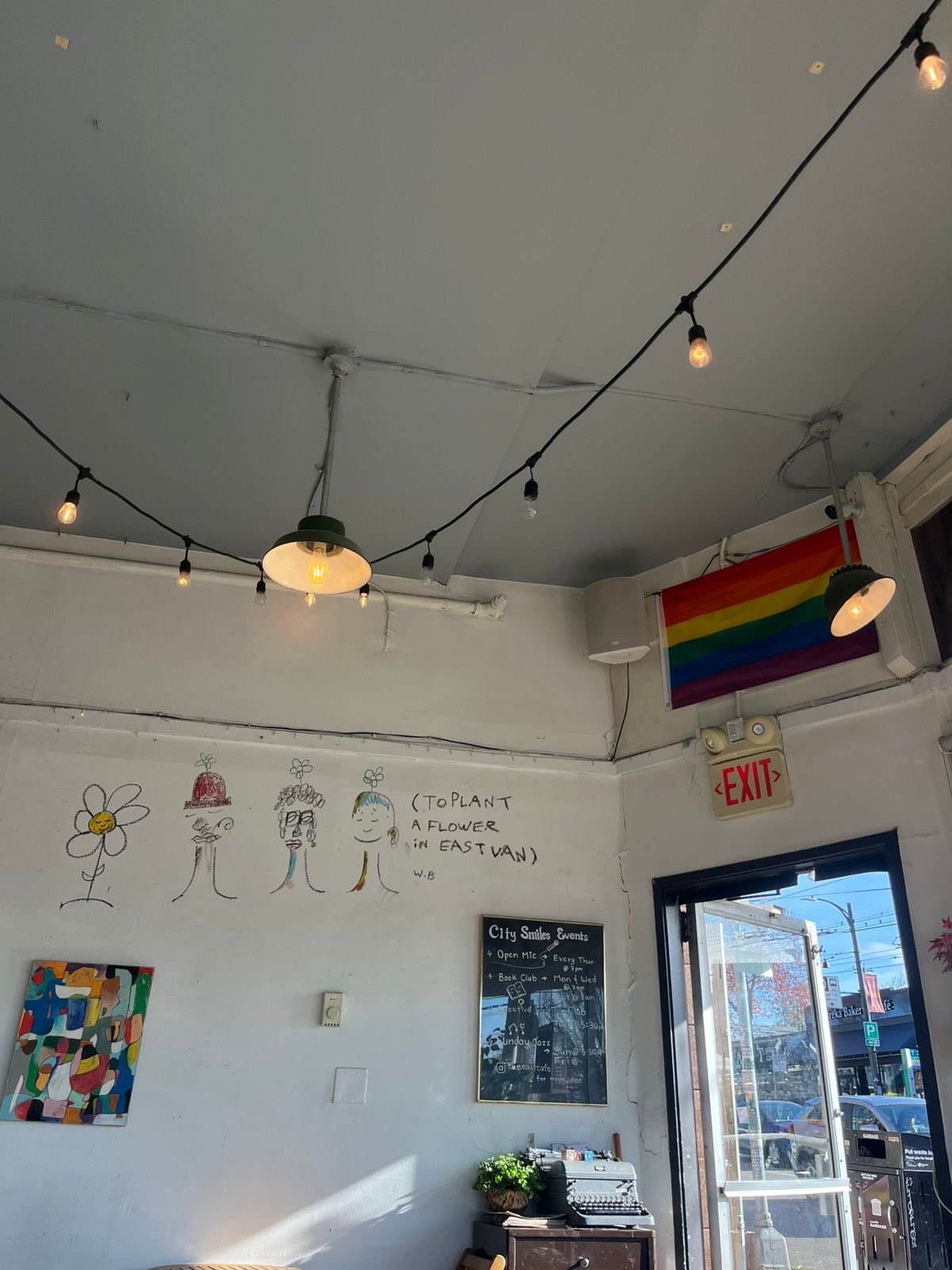
This is a picture I took from inside East Café. It shows a drawing on the wall, and a poster detailing City Smiles events. .
It’s remarkable to think that this transformation was led by someone who, not long ago, had been working as a biomedical engineer at UBC. “I’m a very sciency guy,” he told me. However, when COVID-19 forced his lab work online, the opportunity to realize his dream of opening a café finally arose, “I didn’t even know how to make coffee when I bought the café.” In a few months, he learned, on his own, how to fully be a barista behind the bar. “I didn’t know about my creative side, and I am still learning as I go. But I do believe that creativity isn’t something to be revealed. It’s always been there.” Josh told me that trusting his intuition and starting East Café wasn’t something he’d been planning on, nor was it a decision he had a lot of support for. However, looking back, he says that taking a chance and realizing his creative power was the best decision he’s ever made.
What Josh has built at East Café feels like a collaborative, ever-changing artwork made of people, stories, and shared time. He describes his role with humility: “We have nine hosts now, who come to me with ideas, and I don’t restrict them. It’s their space to feel safe and be in community.” What I really admire about Josh’s journey is the fact that he has fully embraced creative freedom, not only in his life or throughout the café, but in all the events. The trust he shares with the hosts is a reflection of what has been cultivated in the art nights: the joyous serendipity of attracting people who just want to be together and create together, including himself. Josh didn’t hesitate to tell me how this journey has changed him, “I’m a completely different person now, an extrovert! East Café brought back the happy child I used to be. It changed the way I look at the world, how I relate to and show love to my family and friends.”
Offering people a space where they feel welcome and seen is, for him, the heart of the work. “Why would you run a café if you’re not interested in connecting people? It was always about the people.” His resistance to treating the café as purely a business reveals an ethic of care that feels almost radical in a capitalist world. It shows how creativity, when shared collectively, becomes a practice of belonging: a way of tending to ourselves, to each other, and to the everyday spaces we inhabit. This resonates deeply with Australian art theorist Jacqueline Millner, when she reminds us that “…care ethics foregrounds relatedness, asking that we revolutionise the values that govern our societies – from valuing the accumulation of capital to valuing life: surely the only way to address the existential crises we currently face.” East Café is one small example of what that revolution can look like: a space built on generosity, creativity, and the courage to prioritize community over profit.
Artist, Érika Malzoni: Art and the more-than-human world
My third and final conversation was with Brazilian artist, and my dear friend, Érika Malzoni. If Júlia’s journey exemplified how making connects us inwardly, and Josh’s story amplified that by showing how creativity builds community, Érika invites the perspective of how art practices can connect us with the more-than-human world, be it with the land, materials, or even memory. Her practices fosters an ethical and ecological awareness that dissolves the boundary between creating and living, our stories and our surroundings. She demonstrates this interconnectedness by graciously giving a leading role to materials, places, or people, who are often sidelined or neglected.
When Érika defines art, she describes it as “an expression of an impression.” Impressions, she told me, are not only sensations we encounter outside ourselves, but also the marks life leaves within us: traumas, joys, stories carried over time. In the act of making, we can access this internal archive and express what cannot always be said in words. I find that her practice, much like my own, considers the thin, if not nonexistent, space where our inner world and the material world meet.
Érika also acknowledges another kind of art: the one demanded by the market. “As an artist, I’ve faced this conflict,” she said. “It’s a job. Hours and hours every day, everything accumulates in me… the relationships become part of the work.” This consideration reveals why returning to process and presence feels so vital. In contrast to a market that constantly demands of us so much energy and thought, Érika’s practice tends to restore a sense relation, reminding us that making is not just producing, but actively, intentionally participating in the creative process: one that is entangled with living.
When I asked whether she considers art as healing, Érika offered something that deeply resonated: “Practicing art helps you know your story. Every second you discover a new layer of yourself.” This self-discovery, I’ve learned, naturally extends outward. The curiosity sparked in getting to know oneself becomes a way of getting to know the world, empathetically, attentively, with care. As Tim Ingold reminds us, “You have to grow into things, and let them grow in you, so that they become a part of who you are” (16).
This connection becomes powerfully clear with her description of her 2023 exhibition “Somos Restos do que Fomos” (“We Are the Remains of What We Were”), which I was lucky to attend. The installation was built from suspended, woven, and tangled everyday materials, like bread, books, radios, dolls, pill bottles, that were thoughtfully gathered into vast reclaimed nets. “I wanted to show how everything is integrated,” she explained. “I connected fishing nets, soccer nets, nets from different places. It was as if I threw a net into the world and reorganized everything it brought back.” The result was a landscape of collected mementos that had moved through different lives, homes, and stories.
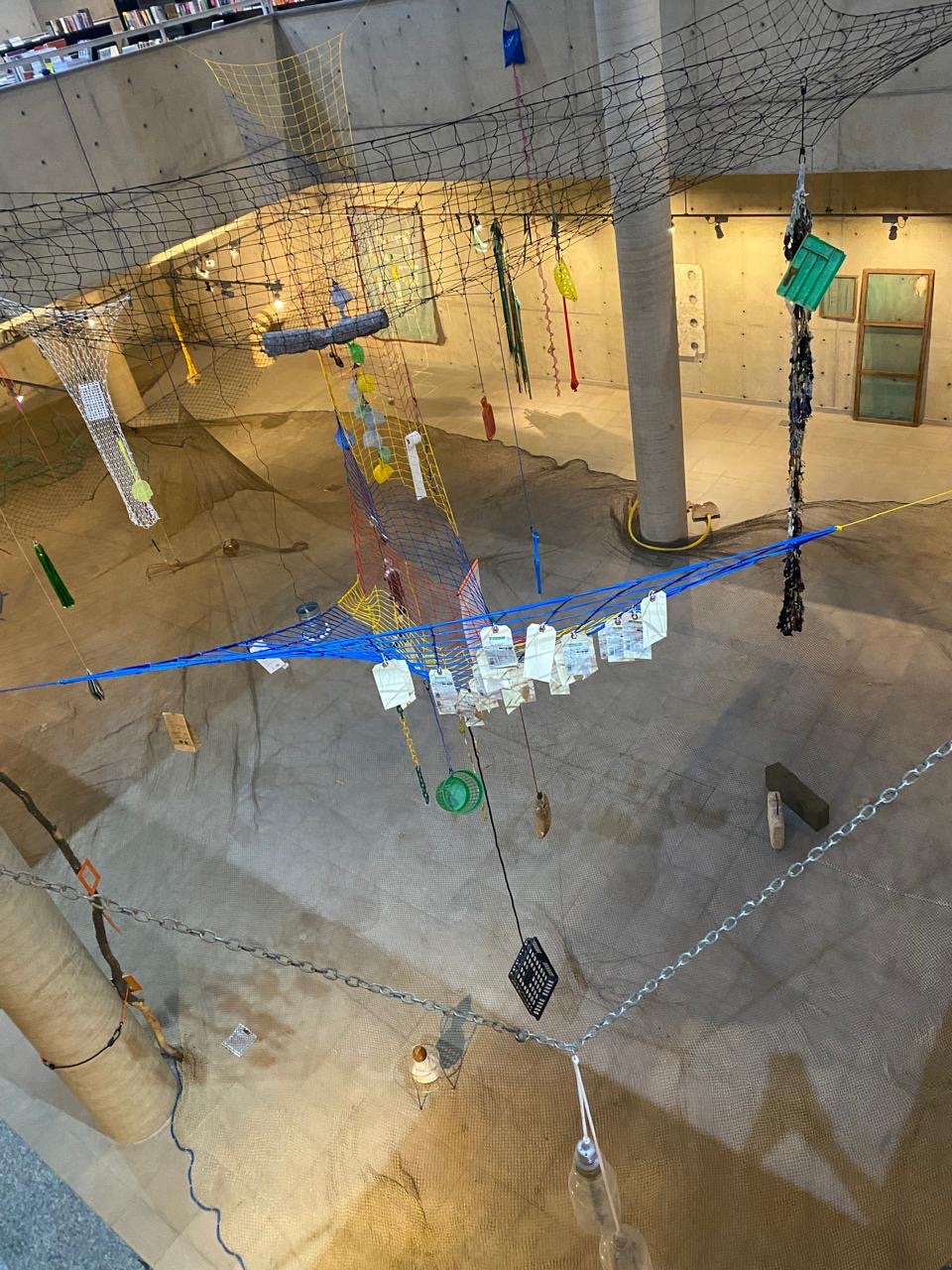
This is a bird’s-eye view of Érika’s exhibition “Somos Restos do que Fomos.” We can see the entangled nets and the objects hanging from them.
Érika’s relationship to materials is not a passive one, but one of collaboration. “I work with materiality that is very common,” she said. “Things people throw away. I give them a place, a leading role.” In her hands, what one perceives as “disposable” becomes a carrier of personal memories, and also of memories of ecosystems, labor, extraction, use, and waste. By reassembling them, she poses the questions: what makes certain materials worthy and others disposable? What does that say about the ways we relate to each other, to land, to the world? Her process is a lesson in ecological awareness that invites us to slow down and pay attention to what, and how, we touch, what we discard, and what we choose to gather.
In conclusion, reframing art as a relational practice rather than an institutional product is not simply an academic argument: it is an urgently necessary cultural shift. When art is reduced to a commodity, we not only risk losing our innate connection with creativity, but also a nurturing way of knowing ourselves, one another, and the world that sustains us. As artist Júlia Godoy beautifully reminds us, “Your job isn’t to decide if it’s good or bad or try choosing where it’ll end up. Your job is to make it, to put it out there, and everything else is none of your business, and that’s the beauty of it.” Her statement reminds us of how art is a process of living, making, releasing, trusting, and also a gesture of continual reciprocity. It’s not about possession or control. If we continue treating art as peripheral to life, we risk further deepening the social disconnection, and ecological indifference that already shapes much of contemporary society.
I personally haven’t found it possible to tend to my creative process without honoring the land and the people that make it possible. This feeling echoes one Indigenous teaching that has stayed with me. In “Embers,” Ojibway writer Richard Wagamese reflects on the phrase “all my relations,” writing: “It points to the truth that we are all related. Every person, rock, mineral, blade of grass, and creature. We live because everything else does” (36). This perspective brings to light the fact that my practice, as my existence, is relational. There is no isolated, hyper-individual self, the self conveniently invented by capitalist ideologies. There is only the process of becoming, in reciprocity, that dissolves the illusion of separation, reminding us of our entanglement with the world, and teaching us how to live within it with greater care.
Works Cited
Arthur, Mathew. Interview. Conducted by Luiza Guimarães, 22 Oct. 2025.
Britannica Editors. “Rock Art” Encyclopedia Britannica, 3 Oct. 2025, www.britannica.com/art/rock-art.
Fürstenau, Marcel. “How The Nazis Used Poster Art as Propaganda.” dw.com, 30 Nov.
2020, www.dw.com/en/how-the-nazis-used-poster-art-as-propaganda/a-55751640.
Godoy, Júlia. Interview. Conducted by Luiza Guimarães, 4 Nov. 2025.
“Herstory: A History of Women Artists (Gustlin).” Humanities LibreTexts, 22 July 2025, https://human.libretexts.org/Bookshelves/Art/Herstory%3A_A_History_of_Women_Artists_(Gustlin).
Huang, Alice. “Totem Poles.” Indigenous Foundations UBC, indigenousfoundations.arts.ubc.ca/totem_poles.
Ingold, Tim. Making: Anthropology, Archaeology, Art and Architecture. 2013, digitool.hbz-nrw.de:1801/webclient/DeliveryManager?pid=5079466&custom_att_2=sim ple_viewer.
Kim, Josh. Interview. Conducted by Luiza Guimarães, 3 Nov. 2025.
Malzoni, Érika. Interview. Conducted by Luiza Guimarães, 26 Oct. 2025.
Mambrol, Nasrullah. “Culture Industry.” Literary Theory and Criticism, 15 Apr. 2016, literariness.org/2016/04/15/culture-industry.
Millner, Jacqueline. “Care and Art.” AWARE Women Artists, 7 Sept. 2021, awarewomenartists.com/en/magazine/de-lart-et-du-care.
Millner, J. Care Ethics and Contemporary Art: Imagining and Practising Care. 1, La
Trobe, 23 Oct. 2024, https://doi.org/10.26181/27283218.v1.
Morriss‐Kay, Gillian M. “The Evolution of Human Artistic Creativity.” Journal of
Anatomy, vol. 216, no. 2, Nov. 2009, pp. 158–76. https://doi.org/10.1111/j.1469-7580.2009.01160.x.
Wagamese, Richard. Embers: One Ojibway’s Meditations. Douglas & McIntyre, 2016.
Weinberg, Elizabeth. “Religious Art in Medieval England: A Portrayal of Divine Kingship | Humanitas.” Humanitas, www.humanitasjournal.com/items/religious-art-in-medieval-england%3A-a-portrayal-ofdivine-kingship.