


Canon Okubo
Canon Okubo is completing her Bachelor of Arts with a Major in Psychology at Capilano University. Over the course of her studies, she has developed a strong interest in developmental and social psychology, as well as sociological theories that examine how individual experience is shaped by broader cultural and structural forces. Originally from Japan, she has spent the past eight years studying in Canada, an experience that has deepened her cross-cultural perspective and informed her academic work. She plans to build on these insights in her future professional pursuits, with the goal of contributing meaningfully to the communities she serves.
Introduction
Emily always knew that the community she was raised in did not operate like other families, although she did not initially see this as a bad thing. As a child, she sometimes wished for the “normal family” she saw on TV, with two parents and a house with a white picket fence, but overall, she was content. She grew up surrounded by other children she saw as siblings and caring adults who functioned like an extended family. Because the community offered experiences and opportunities her parents alone could not provide, she viewed it as a kind of unconventional school she happened to live in.
Everything changed when she turned eighteen. In a moment of honest self-reflection, she finally allowed herself to see the reality she had kept at the edge of her awareness: she had grown up in a cult, and she had been a child victim of abuse. She also came to the realization that accepting this did not invalidate the warm memories she carried from her upbringing. Instead, it clarified the reason why she had spent years reinterpreting harm as guidance and convincing herself that the leader’s actions held a higher purpose. To acknowledge that the moral authority at the center of her world had been a façade felt like admitting that every rule, value, and belief she had been raised on would lose its foundation.
Now, at twenty-three, Emily understands that this emotional conflict was not a personal failure but the result of destructive mind control. She also sees echoes of the same cultic tactics in places far beyond traditional cults: in political movements, influencer communities, wellness or self-help subcultures, and other online spaces, where people become deeply devoted to charismatic figures who promise belonging, purpose, or salvation. Seen through this lens, her story raises a broader and increasingly urgent question: why are so many people today finding themselves drawn into groups, movements, and communities that function with cult-like dynamics?

A photo of newspaper headlines about cults. This is what comes to mind for most people when they hear the word “cult.”
To answer this, the concept of a “cult” must be clearly defined since definitions vary widely even among experts. This article draws on the framework of Dr. Steven Hassan, an undue influence specialist with nearly fifty years of experience. He defines a cult as any group that uses destructive forms of mind control, meaning systematic control of behaviour, information, thoughts, and emotions to override personal autonomy and reshape identity [1]. With this definition, it becomes clearer to see how cultic influence can emerge in places that do not resemble isolated religious groups at all.
A growing body of research shows that contemporary social conditions make these dynamics far more common. Rising loneliness, weakened community bonds, and the dominance of extrinsic or “junk” values have created a deep sense of psychological disconnection. At the same time, digital platforms amplify insecurity and anger, reward constant self-presentation, and funnel users into algorithmic echo chambers that heighten emotional intensity and ideological rigidity. Sociologists and psychologists also document how hyper-individualism, materialism, and the erosion of meaningful relationships leave people searching for validation, guidance, and certainty in environments that often exploit these needs.
The purpose of this article is to examine how contemporary capitalism creates a perfect storm of alienation, amplified fear and insecurity, and existential confusion that intensifies the human need for belonging and meaning. In this emotional landscape, experiential nihilism becomes increasingly common, making individuals more susceptible to groups or figures that promise clarity, identity, and salvation. Through interdisciplinary research and interviews with survivors, this paper argues that the rise of cult-like systems in modern life is not a reflection of individual weakness but a symptom of broader cultural structures that leave people disconnected at a time when connection is most needed.
Capitalism: Foundational Theories
Capitalism is an economic and cultural system organized around private ownership, wage labour, competition, and the accumulation of profit, and it is deeply rooted in cultural values that privilege material wealth, self-reliance, and constant productivity [2]. These values not only shape economic life but also structure how people relate to themselves and one another.
Max Weber traced the origins of these values to the Protestant ethic, particularly Calvinism. Because Calvinists believed salvation was predetermined, they sought reassurance through worldly success. Hard work, discipline, and frugality became moral duties, and labour itself became a divine “calling.” Over time, this evolved into the spirit of capitalism, which treats wealth accumulation as a virtue in itself [3]. As Weber described, individuals become trapped in an “iron cage” of rationalized labour, where economic achievement becomes the primary measure of personal worth.
Karl Marx offered a more structural critique, arguing that capitalism is inherently exploitative because workers produce wealth but receive only a fraction of its value in wages, leading to four forms of alienation: from the product of labour, the labour process, other workers, and oneself [3]. Marx also described how false consciousness and cultural hegemony convince people to see competition, overwork, and consumption as natural or moral, even when these values do not serve their interests.
Sociologist Dr. Munsterman, PhD (oral communication, November 2025), strongly supports this theoretical foundation by emphasizing that capitalism is an alienating system by design. He explains that the system is built on the expectation that “you, as an individual, get rich,” and if you do not, you are framed as a failure rather than a product of structural inequality. Drawing from Weber, he notes that this model has operated the same way since its start, with individualism and capital accumulation always sold as the path to happiness. He also stresses that capitalism depends on extrinsic motivations and competitive hierarchies, arguing that “there’s no ethical consumption under capitalism because the system is set up to be a competition. One person has to fail for another to succeed.” He points to practices like conspicuous consumption, publicly displacing possessions/ consumptions as symbols of worth, as examples of how the system encourages constant comparison, insecurity, and the pursuit of status over community.
Émile Durkheim’s critique further shows how industrial capitalism produces anomie, a state of normlessness and meaning-loss that arises when traditional moral structures collapse faster than new ones can form [3]. One of the most significant of these collapsing structures is religion, which historically provided shared values, communal identity, and a clear sense of purpose. As societies secularize, this collective moral framework weakens, leaving individuals increasingly responsible for constructing meaning on their own.
Modern Capitalist Culture
Materialism and Junk Values
These sociological foundations appear vividly in late-stage capitalism, where materialism and hyper-individualism shape everyday life. Scholars note that people increasingly define themselves through consumption, self-branding, and external status [4], a pattern reflecting Weber’s “spirit of capitalism.” As a result, Western societies have shifted sharply toward extrinsic values like wealth, image, and achievement, while intrinsic motivations such as community, connection, and personal growth have steadily eroded under economic and cultural pressure.
According to psychologist Tim Kasser, capitalism conditions people to feel that “there’s never enough,” teaching them to link self-worth to money, image, and achievement. This creates chronic anxiety, as individuals primarily exist in other people’s reflections, leaving them dependent on external approval [5]. His decades of empirical research show that this value shift has serious consequences for mental health. Across multiple countries, age groups, and longitudinal studies, he found that people who prioritize extrinsic goals report higher levels of depression, anxiety, anger, and daily distress, while those oriented toward intrinsic goals experience greater life satisfaction, autonomy, and emotional stability. The conclusion is consistent and robust: the more individuals internalize materialistic “junk values,” the worse their psychological well-being becomes [5]. Kasser identifies four mechanisms behind this decline: materialism strains relationships, reduces opportunities for flow states, heightens self-monitoring and social comparison, and crowds out intrinsic needs for connection, meaning, and competence. As he observes, “we are being propagandized to live in a way that doesn’t meet our basic psychological needs, so we are left with a permanent, puzzling sense of dissatisfaction” [5, p.124].
This phenomenon is evident in interviews with cult survivors. According to A, who spent more than twenty years in a spiritual cult, the group appealed to her precisely because it seemed to offer an escape from the pressures of junk values and performative living that had defined her life. Before joining, she coped by distracting herself and conforming to cultural expectations: dating because others did, talking about marriage she did not want, following trends, and buying what everyone else bought. She admitted that it felt easier to live the “normal” life society prescribed than to figure out what she truly wanted, a pattern that mirrors Kasser’s findings on the psychological emptiness created by materialistic values. In this context, the cult’s message felt meaningful. Listening to the leader, she believed she might finally discover her authentic self and become the person she had always hoped to be. This promise of purpose also made the idea of leaving frightening, not because she lacked a home, but because returning meant slipping back into a predictable life shaped by others’ expectations rather than her own desires (oral communication, November 2025).
Hyper-individualism and Loneliness
Another defining feature of late-stage capitalism is the rise of hyper-individualism, which reveals that loneliness is not a personal failure but a structural outcome of an economic system that prioritizes profit over human connection. This dynamic is especially visible in modern work culture. Contemporary workplaces, shaped by Taylorism and its digital successor McDonaldization, break jobs into repetitive, tightly monitored tasks that erode autonomy, creativity, and any sense of shared purpose [2]. This is Marx’s alienation in practice: workers have little control over what they make, how they make it, or the pace of their labour. Hyper-individualistic work structures further pit workers against one another for jobs, hours, and wages, replacing cooperation with competition and preventing the development of class consciousness. As workers learn to see others not as colleagues but as obstacles or instruments for advancement, they remain isolated, overworked, and cut off from the relationships that could counteract their alienation [3].
Beyond the workplace, hyper-individualism is intensified by the erosion of “third places,” the everyday social spaces that once sustained community life. Research shows that cafés, parks, libraries, barbershops, and religious organizations are disappearing across the United States [7]. These spaces historically buffered loneliness by providing routine interaction, informal support, and a sense of belonging. As they vanish, people become more physically and emotionally isolated. Technological “efficiencies” such as self-checkouts and non-contact delivery deepen this trend by reducing daily human contact. According to Dr. Munsterman, PhD (oral communication, November 2025), these shifts are not organic changes but deliberate corporate decisions within capitalism, where technologies are adopted to minimize labour costs and maximize profits. The result is a society where communal life contracts, interpersonal contact declines, and individuals must navigate an increasingly isolating world alone.
These isolating work cultures and the disappearance of shared spaces do not merely reduce opportunities for casual interaction; they create a broader environment in which people feel fundamentally disconnected from one another. Social research shows steep declines in participation in communal activities: people now “bowl alone,” families eat together less, and the most common response to surveys about the number of close confidants has shifted from “three” to “none” [5]. According to psychological research, this is so harmful because humans are social creatures at a biological level, evolved to depend on connections for survival [8]. Our brains are wired so deeply for social bonding that loneliness functions like hunger or thirst: an evolved warning signal that our basic needs are not being met. fMRI studies show that after periods of isolation, the brain “craves” social contact in the same way it craves food after fasting [8]. Moreover, studies show that acute loneliness triggers stress responses equivalent to being physically attacked and often precedes depression [5]. As individuals become lonelier, they grow more anxious and hypervigilant, entering a “snowball effect” in which disconnection fuels further withdrawal [5].
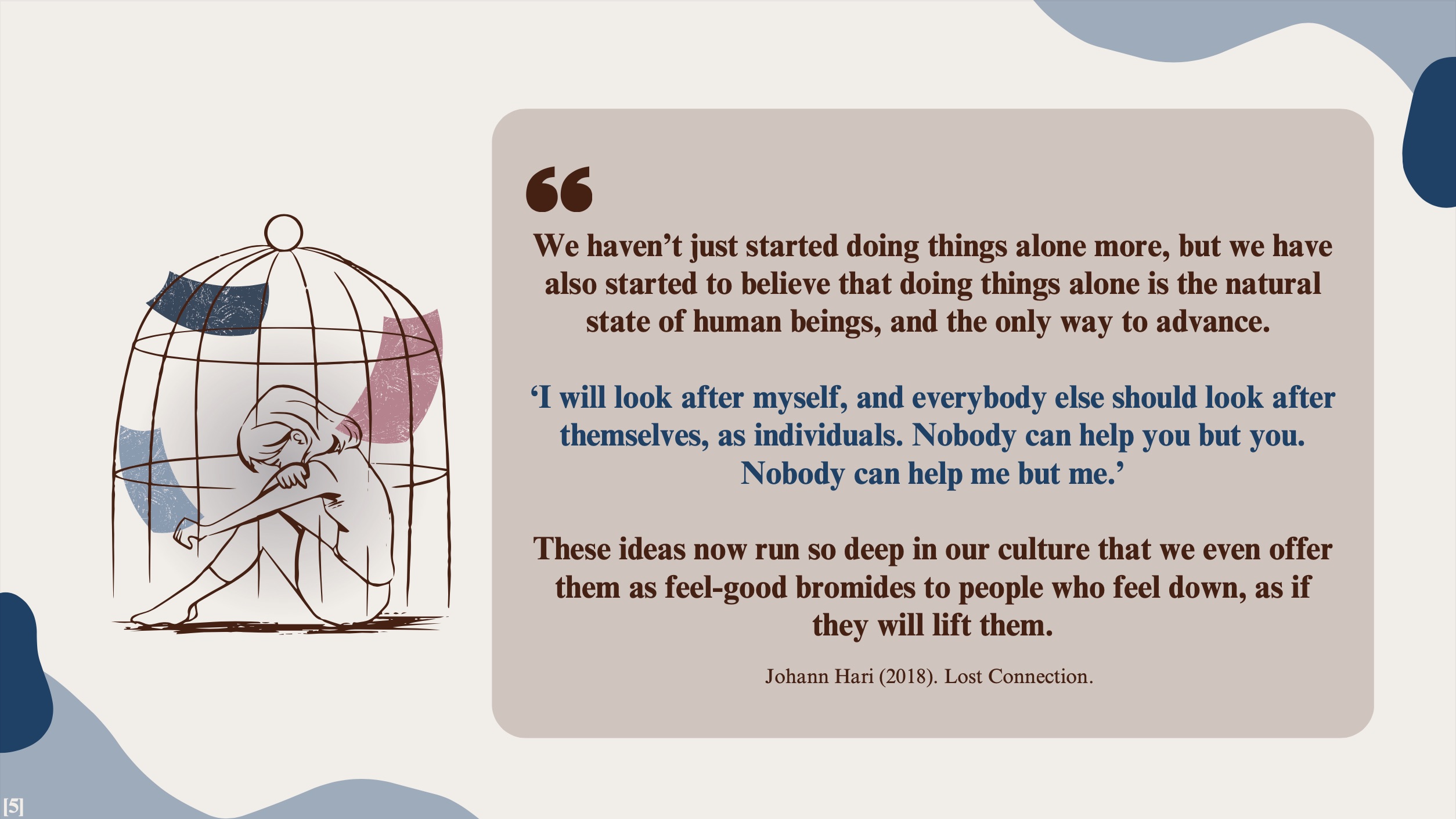
Quote from Johann Hari’s Lost Connections (2018), critiquing how deeply hyper-individualism has been woven into our culture and our sense of self [5].
The experiences of survivor D further illustrate how hyper-individualism and the erosion of communal support create openings for cult-like groups. Her mother joined during a period of grief and work-related stress, at a time when she lacked family, friends, or any meaningful social network to rely on. Feeling alone and emotionally unsupported, she was drawn to a community that explicitly valued connection, belonging, and collective care. According to her, the group provided the kind of shared childcare, communal meals, and multigenerational support that are increasingly absent in hyper-individualistic societies. Although the environment was harmful in many ways, she explains that collective parenting and the comfort of being surrounded by caring people were among the few positives of being raised in a cult. Her reflection that “parenting these days is very isolating” underscores how modern social structures leave families without the communal bonds humans are biologically and psychologically built to depend on (oral communication, November 2025).
Experiential Nihilism
The combined effects of hyper-individualistic work structures, collapsing community life, and the dominance of extrinsic “junk values” create the psychological conditions for what scholars call experiential nihilism. This refers not to a philosophical stance but to a lived sense of purposelessness, numbness, and hopelessness produced by social conditions that erode meaning. A national survey by the Harvard Graduate School of Education found that 58 percent of young adults reported having “little or no purpose” in the previous month, and half said their mental health was harmed by “not knowing what to do with my life” [9]. These experiences were strongly linked to anxiety and depression, showing how chronic disconnection from relationships, stable communities, and meaningful roles generates profound internal emptiness. Nearly half of respondents identified relationships as their primary source of meaning, highlighting how systemic social fragmentation directly undermines well-being [9].
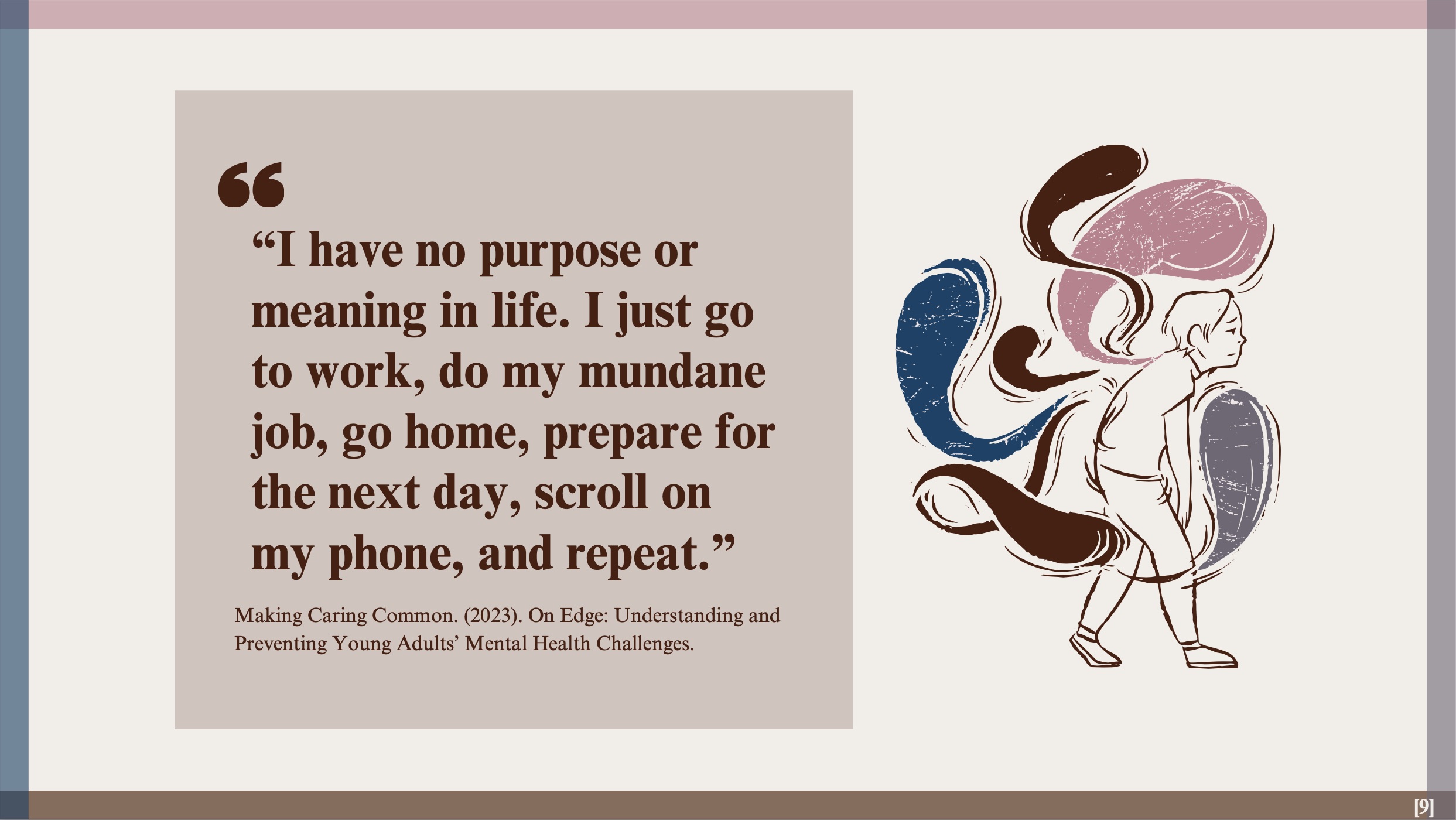
Quote from a young adult respondent in On Edge: Understanding and Preventing Young Adults’ Mental Health Challenges (Making Caring Common Project, 2023), a nationally representative survey by the Harvard Graduate School of Education [9].
Dr. Munsterman (PhD, oral communication, November 2025) argues that this emptiness drives people toward self-medication, noting that it makes sense why many turn to legal or illegal substances because “life is not exactly great for most of the population… It’s a patch because you can’t change the system.” This aligns with national data showing that one in five Canadians experience mental health or substance use issues annually [10], and those with mental illness are twice as likely to develop substance use disorders [11], illustrating how psychological strain and social disconnection feed broader public health crises.
Another manifestation of experiential nihilism is the rise of internet addiction and digital dissociation. Individuals increasingly turn to online immersion to numb or escape real-life disconnection, with research showing that compulsive engagement often reflects attempts to soothe underlying anxiety and isolation [5]. Psychotherapist Dr. Cash explains that people retreat into digital worlds because they lack the embodied, face-to-face connection humans evolutionarily require [5]. Excessive doomscrolling can erode identity clarity, emotional regulation, and self-awareness, producing a “digital dissociation” similar to trauma responses [12]. As Dr. Munsterman notes, technology becomes a “salvation” for those trapped in isolating environments, offering a temporary shield from meaninglessness but ultimately deepening it (PhD, oral communication, November 2025).
Psychological Mechanisms behind Cults
Vulnerability
The psychological vulnerabilities produced by modern disconnection make people more receptive to the promises cults are designed to offer. Dr. Hassan [13] emphasizes that people do not join cults voluntarily; they are recruited during moments of situational or emotional instability, such as grief, illness, breakups, job loss, or other disruptions that weaken usual defences. Clinical research similarly shows that susceptibility increases during periods of emotional strain, diminished support, or acute stress [14], conditions that late-stage capitalism amplifies through insecurity, isolation, and the erosion of stable community networks. Importantly, vulnerability is not limited to those with trauma or economic hardship. Harvard psychologist Burum notes that education and financial success offer no protection and that many cults deliberately recruit college students and prosperous professionals because they bring skills, resources, and legitimacy [15]. This reveals that susceptible individuals are not inherently weak but are seeking clarity, belonging, or emotional relief at moments when the broader society fails to provide them. Cult leaders exploit these openings by presenting themselves as sources of certainty and meaning.
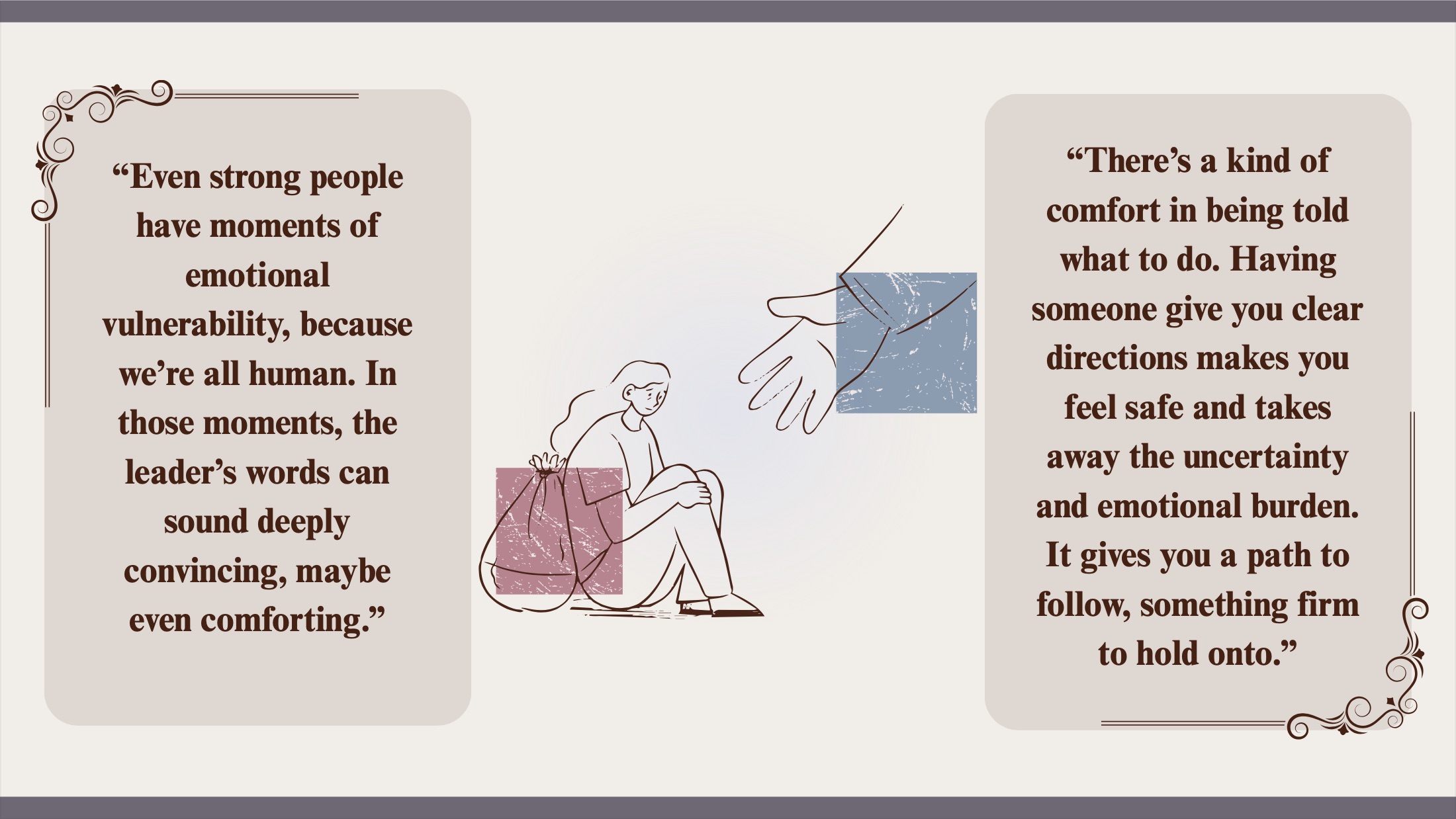
Quotes from interviews with two cult survivors. One spent over 30 years in a spiritual cult, and the other was a second-generation survivor who was born and raised in a cult until age 20. Together, their words highlight how vulnerability and the comfort of clear direction can make control feel reassuring (Oral Communication, 2025).
Survivor interviews reinforce this pattern. One survivor explained that adults in her group were often carrying unresolved emotional wounds, such as loneliness, pain, or a desire for guidance, which made the promise of community feel reassuring (oral communication, November 2025). Another noted that many who joined had stumbled in life or felt overwhelmed by decisions, and even intelligent and capable adults became susceptible when they experienced moments of emotional fragility (oral communication, November 2025). These accounts show that susceptibility arises not from personal weakness but from universal human needs that become especially acute in a hyper-individualistic society, creating openings that cults are structured to exploit.
The BITE Model of Mind Control
The effectiveness of cult recruitment becomes clearer when viewed through Hassan’s BITE Model of Mind Control, which explains how groups systematically manipulate Behaviour, Information, Thought, and Emotion to reshape a person’s identity [16]. These tactics operate gradually by controlling daily routines, regulating access to information, suppressing independent thinking, and using fear, guilt, or conditional affection to create emotional dependence. By limiting outside contact and fostering reliance on the group, cults create conditions in which a person’s former identity is slowly replaced by one organized entirely around the leader’s authority.
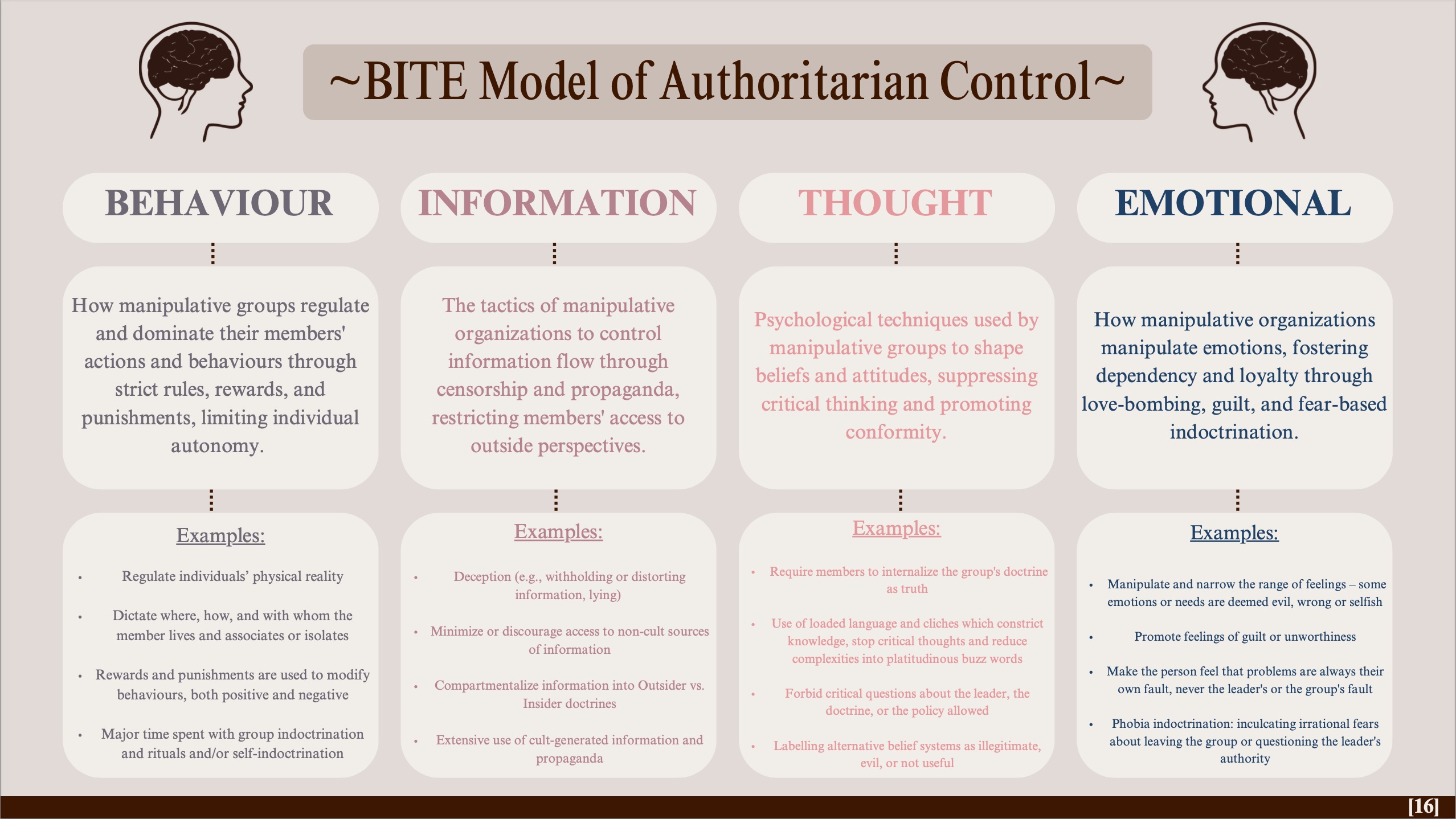
A visual model of the BITE Model of Authoritarian Control, outlining how cultic groups manipulate behaviour, information, thought, and emotion, with examples [16].
The story of B, who spent more than 30 years in a religious cult, illustrates how these mechanisms function in practice. His recruitment began not through overt coercion but through admiration. As a company CEO who was struggling, he was drawn to a charismatic organizer who seemed to embody the confidence he lacked. This admiration deepened into emotional dependence as the leader praised him, assigned him special roles, and framed participation as a pathway to personal growth. He described feeling liberated from rigid societal expectations about how a “man” or “president” should behave, which made him increasingly willing to surrender decision-making to the leader. The depth of this dependency became clear when the leader died. In his words, “it was like the ground disappeared beneath us,” and members were left disoriented and searching for the next figure to follow (oral communication, November 2025). His experience shows how behavioural and emotional control foster attachment strong enough to override autonomy and critical judgment.
These psychological mechanisms are not limited to religious cults but appear in political, commercial, and wellness-oriented settings. The experience of C (age 45), who was drawn into what appeared to be an ordinary self-help seminar, demonstrates how BITE-style influence operates even in seemingly benign environments. She encountered the group during a period of feeling “stuck” in work, relationships, and her sense of self, which heightened her openness. The leader’s charisma and apparent understanding of her struggles made her believe that “if I stay with this person, I can turn my life around.” Even when teachings were confusing, she assumed the fault lay in her own inexperience. Conformity pressures reinforced this dependence: she recalled participating in rituals she found strange simply because “everyone around you is doing something, so you follow.” Over time, the group became her primary source of identity and belonging, making the idea of leaving feel terrifying because, as she put it, “all my human connections, my values, everything was inside that group” (oral communication, November 2025). Her experience shows that different cults, regardless of appearance or ideology, rely on similar psychological mechanisms: charismatic authority, emotional dependence, conformity, and identity foreclosure, to draw people in and keep them attached.
Social Media as a Cult Pipeline
Social media makes cults more accessible than ever by transforming what once required physical isolation into personalized digital ecosystems delivered directly to users’ phones. Rather than needing a secluded compound, contemporary platforms digitize and scale the psychological mechanisms that have historically underpinned cultic control. Algorithmic feeds replicate these processes through behavioural reinforcement, curated information bubbles, and constant social pressure. As Lanier argues, platforms operate as behaviour-modification systems that manipulate emotions, reward conformity, and intensify tribal impulses, producing filter bubbles that mirror the closed informational worlds of traditional cults [17]. The result is a breakdown of shared reality, as users encounter only material that amplifies their fears or identities while opposing perspectives are reduced to caricatures that justify hostility and dehumanization.
Dr. Munsterman (PhD, oral communication, November 2025) emphasizes that this dynamic is not accidental but structurally embedded in capitalist platform design; algorithms “keep it manageable” by insulating users from content that contradicts the narrative being promoted. Within these echo chambers, online personalities and political figures function as digital charismatic leaders, attracting followers who feel lonely, disoriented, or desperate for certainty. As he explains, “somebody will come up on your phone and become your salvation,” offering the illusion of clarity, purpose, and belonging. These figures often redirect frustration and anger toward scapegoats such as immigrants, women, or other marginalized groups. During economic downturns, this becomes even more powerful because “people are desperate for a solution.”
When users are repeatedly fed emotionally charged messages, encouraged to attack dissenters, and shielded from alternative viewpoints, digital communities become fertile ground for political cults, conspiracy movements, and polarized micro-cultures. These online formations replicate the psychological conditions of traditional cults, but now operate with a reach, speed, and scale unprecedented in human history.
Conclusion
Returning to Emily’s story reveals how the emotional dynamics she experienced are echoed across many survivor accounts. Like others, she learned early to reinterpret abuse as devotion and to rely on adults who insisted that the leader’s authority could not be questioned. The confusion, guilt, and conflicted loyalty she carried into adolescence were not indicators of personal weakness, but the predictable result of an environment that normalized obedience and reframed harm as care. Her experience is not exceptional; it illustrates how readily mind control can take hold when people lack the language, support, and relational grounding needed to understand what is happening to them.
Placed within the broader analysis of this paper, the mechanisms that shaped Emily’s understanding mirror processes visible across contemporary society. Modern capitalist culture fragments communal life, elevates competition and self-presentation, and replaces shared structures of meaning with digital substitutes. These dynamics foster widespread loneliness and experiential nihilism, creating exactly the conditions that cults and cult-like systems are designed to exploit. One of the most striking patterns in survivor accounts is the extent to which many continue to cherish the community bonds they formed, even in harmful settings. This appreciation reveals what hyper-individualistic societies fail to provide and helps explain why collective belonging, even when distorted, can feel profoundly meaningful.
Recognizing these structural roots clarifies what is at stake. If the forces of disconnection, loneliness, and value erosion remain unaddressed, experiences like Emily’s will continue to emerge across political movements, online communities, wellness cultures, and commercial or spiritual subcultures that promise belonging while deepening dependence. Yet the analysis also points toward practical pathways forward. Rebuilding community infrastructures, promoting digital literacy and cleansing, reclaiming intrinsic values, and addressing loneliness as a public health issue are all supported by sociological, psychological, and media research.
Ultimately, the problem is not the vulnerability itself. It is a society that leaves people to face vulnerability alone. Cultic systems lose their power when individuals have access to genuine relationships and shared meaning. The most effective protection against exploitation is not increased individual resilience, but reconnection.
References
Hassan S. Combating cult mind control: the #1 best-selling guide to protection, rescue, and recovery from destructive cults. Newton, MA: Freedom Of Mind Press, 2018.
Rohlinger DA. New Media and Society [Internet]. NYU Press; 2019. Available from: https://www.jstor.org/stable/j.ctv12fw959
Conerly T, Holmes K, Tamang A. Introduction to Sociology 3e [Internet]. 3rd ed. OpenStax; 2021. Available from: https://openstax.org/details/books/introduction-sociology-3e
Noonan RJ. Extrinsic goals benefit capitalism but not well-being. Rethinking the economy’s goal for a healthier future. Health Promotion International [Internet]. 2024 Sep 25;39(5). Available from: https://doi.org/10.1093/heapro/daae090
Hari J. Lost connections: uncovering the real causes of depression– and the unexpected solutions. New York: Bloomsbury; 2018.
Raoul V, Bonner M. Advertising Shits in Your Head. PM Press; 2019.
Finlay J, Esposito M, Kim MH, Gomez-Lopez I, Clarke P. Closure of “Third Places”? Exploring Potential Consequences for Collective Health and Well-being. Health & Place [Internet]. 2019 Nov;60(102225). Available from: https://www.ncbi.nlm.nih.gov/pmc/articles/PMC6934089/
Braren S. The Evolution of Social Connection as a Basic Human Need [Internet]. Social Creatures. 2023. Available from: https://www.thesocialcreatures.org/thecreaturetimes/evolution-of-social-connection
Cashin A. Beyond Work, Scroll, and Repeat: Cultivating Meaning and Purpose in Gen Z [Internet]. Making Caring Common. 2024. Available from: https://mcc.gse.harvard.edu/whats-new/gen-z-meaning-purpose
Stephenson E. Mental disorders and access to mental health care [Internet]. Statistics Canada. 2023. Available from: https://www150.statcan.gc.ca/n1/pub/75-006-x/2023001/article/00011-eng.htm
Rush B, Urbanoski K, Bassani D, Castel S, Wild TC, Strike C, et al. Prevalence of Co-Occurring Substance Use and Other Mental Disorders in the Canadian Population. The Canadian Journal of Psychiatry. 2008 Dec;53(12):800–9.
Gerlach J. Breaking Free from Endless Scrolling [Internet]. Psychology Today. 2025 [cited 2025 Dec 1]. Available from: https://www.psychologytoday.com/ca/blog/beyond-mental-health/202510/breaking-free-from-endless-scrolling
Hassan S. Understanding Cults: The Basics | Psychology Today Canada [Internet]. www.psychologytoday.com. 2021. Available from: https://www.psychologytoday.com/ca/blog/freedom-mind/202106/understanding-cults-the-basics
Curtis JM. Factors related to susceptibility and recruitment by cults. Psychological Reports [Internet]. 1993;73(2):451–60. Available from: https://www.ncbi.nlm.nih.gov/pubmed/8234595
Pazzanese C. Think twice before saying “cult” [Internet]. Harvard Gazette. 2023. Available from: https://news.harvard.edu/gazette/story/2023/09/think-twice-before-saying-cult/
Hassan S, Gutheil TG, Shah MJ. Responding to Authoritarian Cults and Extreme Exploitations: a New Framework to Evaluate Undue Influence [Internet]. Psychiatric Times. 2022. Available from: https://www.psychiatrictimes.com/view/responding-to-authoritarian-cults-and-extreme-exploitations-a-new-framework-to-evaluate-undue-influence
Lanier J. Ten Arguments for Deleting Your Social Media Accounts Right Now. Random House UK; 2018.