


Kinneth Balucos
Kinneth Balucos is in his final year of the Bachelor of Arts in Interdisciplinary Studies at Capilano University. Kinneth began his academic journey by playing in the Canadian Junior Football League for the Langley Rams through his final year in 2023. Kinneth was born and raised in North Vancouver for 24 years. Has now taken these experiences into working as a full-time specialized support worker, working towards the advocacy of children and youth and aiding through cognitive challenges. He plans to enter the public service sector in the Lower Mainland.
What if Canadian football can grow in popularity, rather than changing Canada’s only professional league, the CFL, to resemble the rules and frameworks closer to those on the South side of the border? What if the CJFL and USports collaborated to schedule preseason games before the start of their respective leagues?
There is now an internal call not just for the Canadian football community but also for protecting our national sovereignty, which is an essential pillar for promoting the country’s identity through professional sports and entertainment. The Canadian Football League (CFL) is a part of Canada’s pop culture. With ongoing tensions between Canada and the US, the CFL rule changes for the 2026-2027 seasons do not support the trend of continuous copying from them. This unmistakable American system integration aims to increase the overall fan base, sacrificing the distinctive difference between Canada and the US. To ensure the game’s future, the entire landscape must prioritize collaboration over copying.

Stepping off the field after making a big defensive stop.
PERSONAL NARRATIVE
As a former football player who last played for the Langley Rams in 2023, under the Canadian Junior Football League (CJFL) in British Columbia, I was unexpectedly exposed to the enriching culture the game holds. My football career began in high school with the Cason Graham Eagles in North Vancouver. It was a foreign sport to me, and classmates honestly pressured me to join the team. However, that same decision changed the trajectory of my life, leading to the experiences I was soon to gain.
Under BC high school football (BCHSF) rules and regulations, all games are played under American (US) rules. This is a unique element to the conversation because British Columbia is the only province in Canada that does not play Canadian Football at the high school level. Making young athletes who come out of BC have more depth experience playing American rules. A historic reason I can provide for the province of BC playing within these structures was mentally noted during a football camp I attended (FOX40 Prospect Challenge). It was during the organization’s first year within the Lower Mainland. Providing a platform for all BCHSF athletes to practice together and play a live-recorded scrimmage in the end.
One of the defensive coaches was much older and had many years of coaching high school football in BC had a side conversation with a few teammates and me in practice about the province only playing American rules. The coach dates it back to the construction of the Canadian railway. It was noted that at the time, it was difficult for high school football teams to travel and play games because there were fewer teams in BC than in other provinces. This is why it shifted to competing against teams in the US: it was an easier commute, and more teams were available to play.
This also led the province to adopt American rules, which were followed by the construction of high school fields, as they are today. Now this is the most word-of-mouth source that makes the most sense, and a component of me playing under Canadian rules.
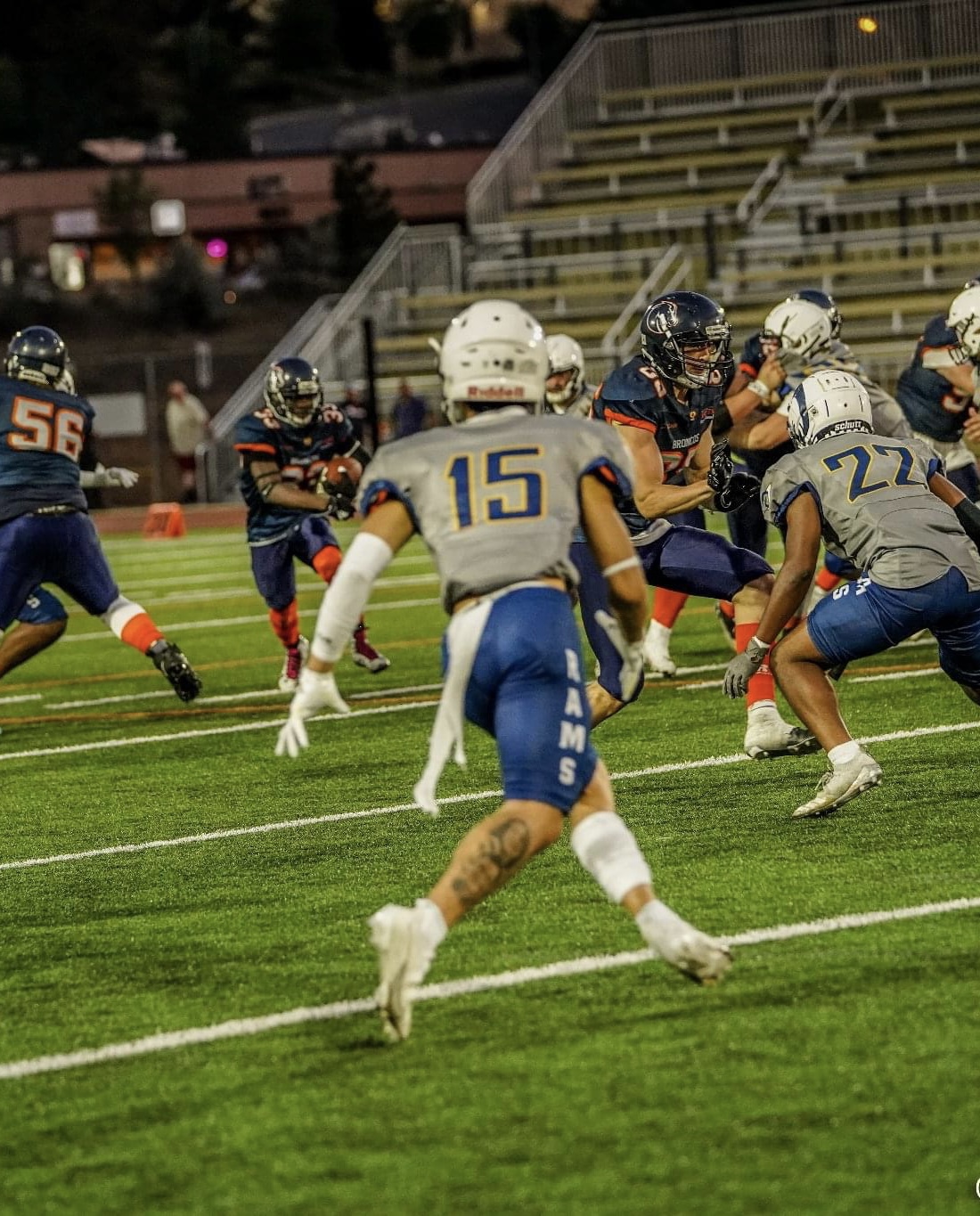
An action shot of me playing against the Kamloops Broncos in 2022.
In 2019, my senior year of high school, I was given the opportunity to play post-secondary football at Simon Fraser (SFU), then coached by Thomas Ford. Aligning well with my high school experience, as SFU was the only university in Canada that played by NCAA rules. At the same time, I was going to use key platforms that have supported my student-athlete development, including playing within BCHSF rules and using my experience travelling to the US to compete with American football teams in the off-season with Game Ready Elite 7on7 (Football Travel Team).
Unfortunately, this took a turn in the summer of 2019 during the lead-up to SFU football training camp, when I had to step away from this opportunity due to external factors. I was given another chance to play football a few weeks later for the Westshore Rebels in Langford, Victoria. This was the first real introduction to my football journey in Canadian Football. I had no prior experience with these rules or substantial practice in this type of game. There was a level of confidence and ego that I still brought to the table. It became a steep learning curve throughout the practices and games held across BC.
In short, my first year in the CJFL was an introduction to the Canadian game, where it was more than just different rules being played. It was a platform for this football community to continue enjoying the game’s long, historic heritage associated with Canada. I had only understood football through an American lens. After playing my first year in the CJFL, I decided to play for the Langley Rams, which was closer to home. While also continuing my academic studies at Capilano University.
The enjoyment I gained from the unaccustomed environment. Sparked an inner drive to work my craft as a Canadian football player, rather than trying to get back on the SFU route under NCAA rules. That decision led me to play four more years with the same team, wrapping up my senior year in 2023 and becoming the best defensive back that I could be.
My Canadian football journey is one among hundreds of stories that have shaped my love of this game, with some athletes playing by these rules long before I did. These new CFL rule changes pose a risk not only to the community’s passion but also to the distinctive identity of Canada’s only professional football team.
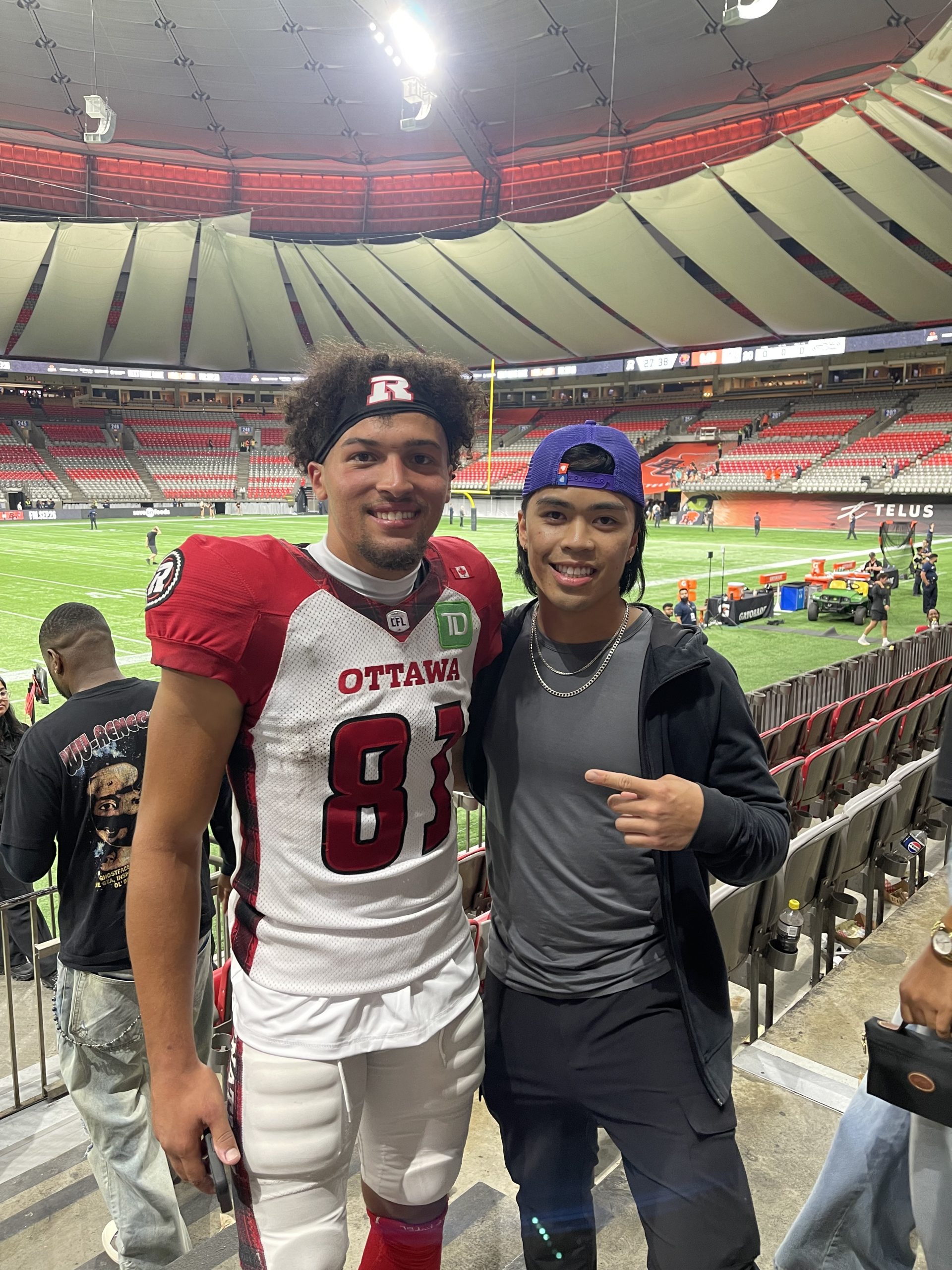
A photo with my former teammate/rival in high school, Keelan White after playing against the BC Lions in September 2025.
CANADIAN FOOTBALL
The recent CFL’s 112th Grey Cup had finally wrapped up last mid-November with the Saskatchewan Roughriders bringing home the cup. This is Canada’s version of the Super Bowl to wrap up the 2025 football season and possibly the last original display of it. Moving forward to the 2026-2027 seasons.
Prime Minister Mark Carney was in attendance for the game and made a statement after the last whistle, “The Grey Cup is uniquely Canadian through and through: 12 players, three downs, unlimited motion, and a field 65 yards wide; It’s our game, played our way – shaped by the values that define our nation: grit, teamwork, and perseverance” (Prime Minister of Canada, 2025). Canada’s Federal leader concisely outlined the key aspects of what embodies Canadian football. Still, it can be confusing for people with no interest in the sport. For the readers who are lost, I will peel back the layers to simplify the proposed CFL rule changes with a conceptual parallel.
There are two major soccer or “football” tournaments held in the summer every four years. One is the Copa América, and the other is the UEFA European Championship (Euro Cup), without stepping too deep into this world. Distinct differences between these tournaments are worth highlighting. In the Copa América tournament, it is known for an aggressive, physically intense style of play. In contrast to the UEFA European Championship, it is played more tactically and strategically. This boils down to differences in game philosophies, culture, and, some say, field sizes. Now, how do the new CFL rule changes connect to this breakdown? Imagine the CFL is the Euro Cup; we swap coaching and game approaches, and officiating from the Copa América. The European fan base and players would arguably not be in favour of these changes. Taking away the identity that encapsulates European football (soccer) and vice versa, to the Copa América.
Let’s take both professional leagues in Canada and the US, the Canadian Football League (CFL) and the National Football League (NFL), to explore these differences in depth. The first component is with the number of “downs” an offence has to play. These represent the number of attempts an offensive unit can make. To reach past ten yards before reaching a fresh set of “downs” to score a touchdown. In the CFL, teams are permitted only three downs. While in the NFL, teams are allowed four. This makes a massive difference in game philosophies: the CFL leans towards pass-heavy offences, while the NFL emphasizes the run game.
Secondly, the number of players “motioning” is significantly different. The CFL waggle allows multiple receivers on the offence. To run toward the line of scrimmage before the ball is snapped. Displaying forward and sideways movements, commonly at full speed. Generating faster route combinations to develop, increasing the difficulty to defend via CFL rules. The NFL does not contain a waggle rule; only one player may motion before the ball is snapped. Which cannot be a movement going towards the line of scrimmage. NFL receivers start their route running from a stationary position instead of a running start. This progression of play separates it into dynamic and controlled formations in offensive schemes for the CFL and NFL (Sportsnet Canadian Press, 2025). Thirdly, the field size can be comprehensively different from the four characteristics (3Down Staff, 2025):
- The CFL field runs 110 yards long, while the NFL field is 100 yards long.
- CFL fields are much wider at 65 yards than NFL fields, which are 53.3 yards wide.
- The end zones also show a difference: the CFL is 20 yards, while the NFL is 10.
- Position of the goalposts in the CFL is in the middle of the goal line, while the NFL has it in the back of the end zone.
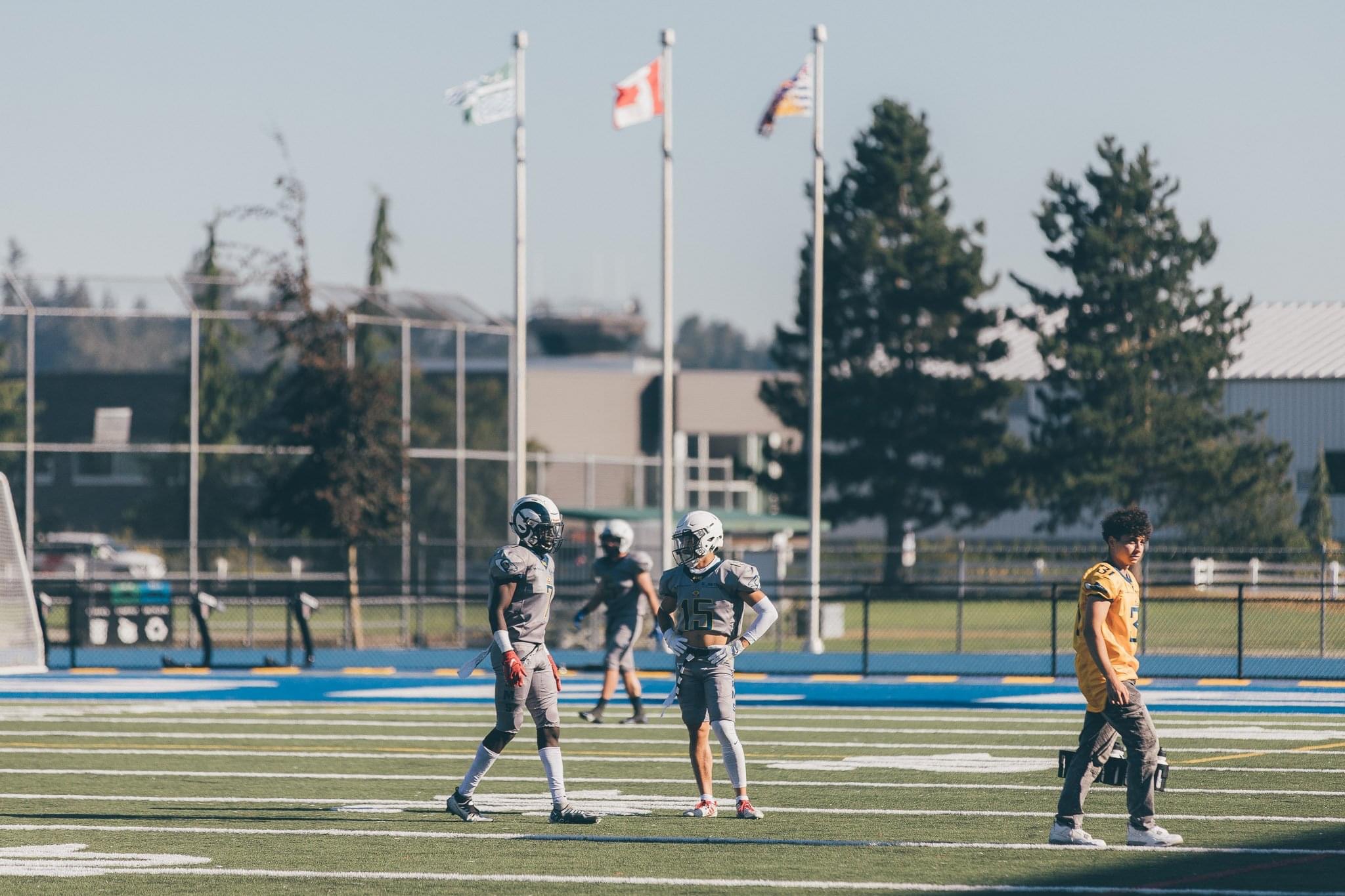
My partner in crime, taken during the middle of a time-out against the Okanagan Suns.
These three components highlight the main drivers of the significant differences between the Canadian and American game. Where the CFL is more notably a passing game in the more expansive field space with larger end zones, in contrast to the NFL, which is a much more physical game in the tighter field spaces, this also correlates with the need of teams wanting certain defensive players’ play styles, depending on the rules. The CFL favours more athletic, versatile athletes, while the NFL favours strong, specialized athletes. There are a few more regulatory differences. The most commonly known forms differentiate the type of game Canada and the US play.
Adopting these new CFL rule changes is playing closer to American rules, if not on the cusp of becoming them. There have been past attempts at international expansion with the US that evidently failed. The appeal of Canada’s complex rules did not impress its audience. Leading to significant strain in venue hosting, scheduling conflicts, stability, and identity pressures (Valentine, 2019). The desire to grow the Canadian game into external markets is closing our eyes to the opportunity to capitalize on current resources and more, and jeopardizing another attempt to replicate past mistakes in the US market (Valentine, 2021).

A quick photo with some young fans, before heading into the locker room.
GRASSROOT SECTORS
The game of Canadian football is in an all-around developmental state across the country, where it is considerably more of a niche sport here than in US markets (high school, university/college, and NFL)—showing a stronger sense of cultural pride than devotion to American football. This is something Canada lacks, and what the CFL is seeking through these rule changes: a framework to modernize the sport internally on a national scale, elevating its foundational landscape. Can aid in avoiding copying from outside systems and capitalize on internal collaboration across Canada.
One way forward is to merge grassroots areas of Canadian football for a unified approach. To understand why this matters, we need to examine the relationship between the CJFL and U SPORTS. These two amateur leagues, aside from high school, showcase the Canadian game before reaching the CFL. Despite that, they lack a strong partnership in community growth. Favouring progress in their respective leagues over a combined effort growing together. We see this in the US, where Division 1 schools schedule exhibition games or practices against Division 2 and lower-conference schools. To evaluate players lower on the depth chart and examine a team’s overall dynamic in the whole competition.
Rams defensive back coach in 2023, Baltej Dhanoya, explained the realistic chance of this joint approach: “I feel like a collaboration would be good in the sense of more so for the CJFL, not so much a U sport team – there is a jump, there is a change in physicality, size, and everything. I can speak from experience, going from Langley to the University of Calgary” (B. Dhanoya, personal communication, November 10, 2025). This presents a reality check for the differences in competition between the Canadian football leagues. It can be subjective as to how good a CJFL team could be at the start of the season. Coach Dhanoya later emphasized this notion, “If you look at this past season, we had the Okanagan Sun and the West Shore Rebels. They ran the whole league…Okanagan dominated the league. So the drop-off from competition… I feel like in the CJFL, it’s too up and down” (B. Dhanoya, personal communication, November 10, 2025).
While this may be constructive feedback on a proposal to preserve Canadian football, it does not address the imbalance in the sport’s production in the country, between the only two amateur leagues, with the CJFL being a limited pipeline of opportunity into developing players’ potential and the U Sports juggernaut platform of resources and university backing. The lopsided straddling for both leagues puts the CJFL at a substantial disadvantage when it comes to player and game development.
Still, with my prior experience and knowledge of playing in the CJFL. This gives junior players a chance to prove themselves at the next level. I could confidently vouch for the players taking this path in their football journey if they were allowed to compete against a U SPORT football team. Whether through a joint practice or an exhibition game. May the stronger athlete win.
Another way forward is to adopt Lacrosse’s community-building model. There has been a recent surge in popularity with the sport. The explosive foot traffic stemmed from grassroots approaches, through the transitional demand and the growing interest in turning Canada into a box lacrosse nation. At the same time, the US is predominantly a field lacrosse nation. The National Lacrosse League (NLL) is heavily invested in grassroots development, as its culture and large player pool were built on local club teams. During the summer, to fill in sporting vacancies at hockey arenas. Encapsulating this internal culture-shaping offers many opportunities to cultivate connections within this community. Players who make it into the NLL will have roots to the clubs they grew up in and personal experiences added on to it. There is also a common occurrence of current NLL players playing in these men’s lacrosse leagues in the off-season, strengthening the skill level among active professional lacrosse players and enhancing community enjoyment of the sport, on full display at their local rec centre or sport complex.
A similar blueprint can be created for Canadian football, adopting Lacrosse’s community-building model. Where current CFL players can join more local football flag leagues in the Canadian cities they play for. Coach Dhanoya was asked about this conceptual idea, due to a mutual friend we both share, named Bobby Kidd III, who plays in the NLL for the Saskatchewan Rush: “You see it happening…I feel like it is going to be something that’s going to take off soon…the Team Canada flag football team in the Olympics… It’s all ex-U sport athletes, ex-CFL guys, not many current CFL guys… that’s going to take off in the upcoming years” (B. Dhanoya, personal communication, November 10, 2025).
Even though this proposal poses injury risks to active CFL players, there is a sense of devotion to a Canadian platform. The lacrosse community presents a beautiful example of leveraging internal resources to their maximum potential. Football is a more physically demanding sport. As Coach Dhanoya puts it, “these guys want to protect their bag… so in the offseason, playing a rec football league in BC and getting hurt will be detrimental to their career…definitely see it being in a controlled environment and picking up more in the coming years” (B. Dhanoya, personal communication, November 10, 2025). An off-season for CFL players is taken more seriously in terms of training for the next season. Nonetheless, it remains an avenue to strengthen bonds in the Canadian football community. Modernizing frameworks on a national scale to elevate a shared passion.
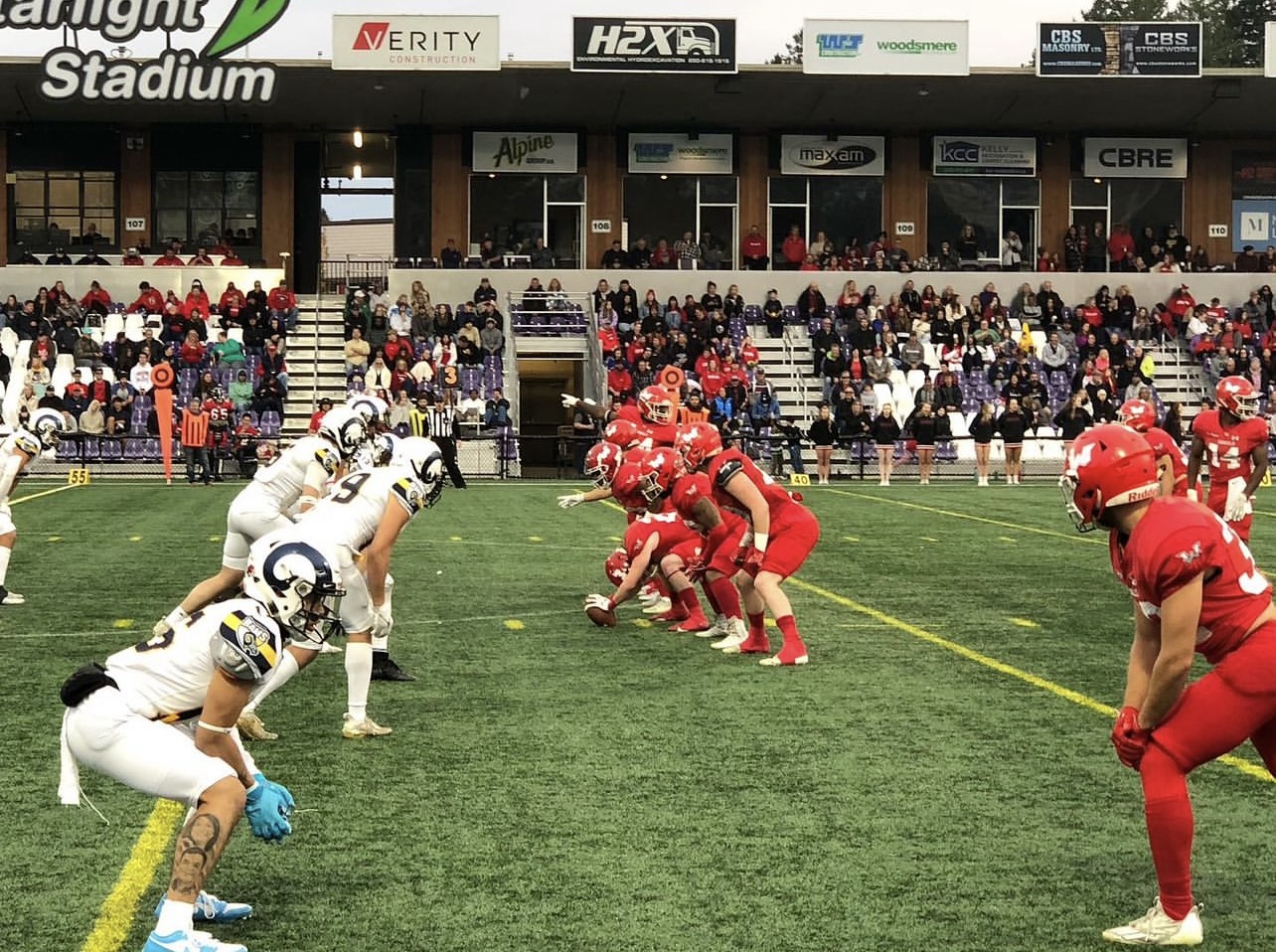
Playing my final game in the BCFC playoffs, against the team I first played for in the CJFL.
THE TRUE WAY FORWARD
The Canadian football community deserves to preserve the sport’s authentic rules and traditions. Even though the only pro football league Canada has to offer is now more geared toward an American style of play. There is now a call for unity within the Canadian football community and across the country around this state of innovation in the CFL. Grassroots sectors of the game are now the catalysts for preserving Canadian identity.
When players travel to opposing team stadiums, they witness each other’s different atmospheres.
When it’s a local town or school rivalry, let the whistles blow.
When the game is played North of that border, that is Canadian football.
We are currently in a position to reveal the proper foundation of pridefulness in our homeland. Reaching the next stage for this sport should not be achieved by copying US principles, but by accelerating the development of Canadian resources within the football community to enable united collaboration and drive true innovation in the game and its spirit.
RESEARCH / BIBLIOGRAPHY
3Down Staff. (2025, October 18). Poll shows 42 percent of fans wont watch as much CFL after new rule changes, majority oppose Americanization. 3DownNation. https://3downnation.com/2025/10/18/poll-shows-42-percent-of-fans-wont-watch-as-much-cfl-after-new-rule-changes-majkority-oppose-americanization/
Prime Minister of Canada. (2025, November 16). Statement by Prime Minister Mark Carney on the 112th Grey Cup. https://www.pm.gc.ca/en/news/statements/2025/11/16/statement-prime-minister-carney-112th-grey-cup
Sportsnet Canadian Press. (2025, September 23). CFL changes bring mixed reactions, some say it makes the game more American. Sportsnet. https://www.sportsnet.ca/cfl/article/cfl-changes-brings-mixed-reactions-some-say-it-makes-the-game-more-american/
Valentine, J. (2019). Cultural Nationalism, Anti-Americanism, and the Federal Defense of the Canadian Football League. American Review of Canadian Studies, 49(3), 376–393. https://doi-org.ezproxy.capilanou.ca/10.1080/02722011.2019.1660454
Valentine, J. (2021). The State and Canadian Cultural Nationalism: Protecting Canadian Football. International Journal of the History of Sport, 38(12), 1189–1209. https://doi-org.ezproxy.capilanou.ca/10.1080/09523367.2021.2003332