


Ziad Elbadry
Ziad Elbadry (he/him) is completing his Bachelor of Science degree at Capilano University and has consistently demonstrated academic excellence, being named to the Dean’s List on five occasions. His experience as a Research Assistant allowed him to deepen his understanding of scientific methods and contribute to university research initiatives. Born and raised in Egypt, Ziad is motivated by curiosity and a commitment to knowledge, and he plans to pursue further studies that will help him apply science to real-world challenges.
Introduction
The overwhelming solitude during the pandemic was enough to drive everyone insane. I think that’s why so many of us tried to stay “productive,” just to keep our minds distracted. I spent most of my day online, jumping between websites and videos, looking for anything that might give me a slight advantage in school or in my future career. Imagine this: a huge group of stressed, isolated people living through a moment when trust in science was shaky at best. We were the perfect market just waiting for the right person to exploit us. Maybe that’s why my ads were always for online courses from supposed experts I had never heard of. Among those ads, one stood out because of how much it promised: perfect memory, a fulfilling life, and unbelievable success. Bored and curious, I clicked on it. The video was about the Silva technique. From the first couple of minutes, it was very clear that this was just a meditation scam. All the signs were there: the paywall, the level system, and the belief that sitting down and breathing rhythmically can somehow bend the universe to your will. However, I still watched the whole thing, took notes, and even downloaded the video to review later, all because of the presenter’s appeal to science.
It doesn’t stop at one video. For example, in another video in the same playlist, the presenter says, “Jose Silva fine-tuned [manifestation and meditation] with science” (Mindvalley, 2020, 1:20). Then they go on to talk about accessing different levels of brainwaves that spur creativity, which is a real phenomenon. Specifically, the techniques aim to move the brain from the typical Beta state. associated with active, logical thought, into the Alpha and Theta states, frequencies associated with deep relaxation, intuition, creativity, and the subconscious mind. The way that speculative science is mixed with mysticism to make it sound genuine is one of the main selling points of these scams, allowing them to target a wider audience, as the greater the space for speculation, the greater the effect. So, what happens when you combine a field of science that seemingly breaks all rules, like quantum physics, and a concept like consciousness, which has been a topic of debate for a few thousand years at least? Surely, the effect will be endlessly magnified. Just scrolling on TikTok, you can find innumerable videos of people discussing these topics with no background information, because who is going to fact-check them anyway?
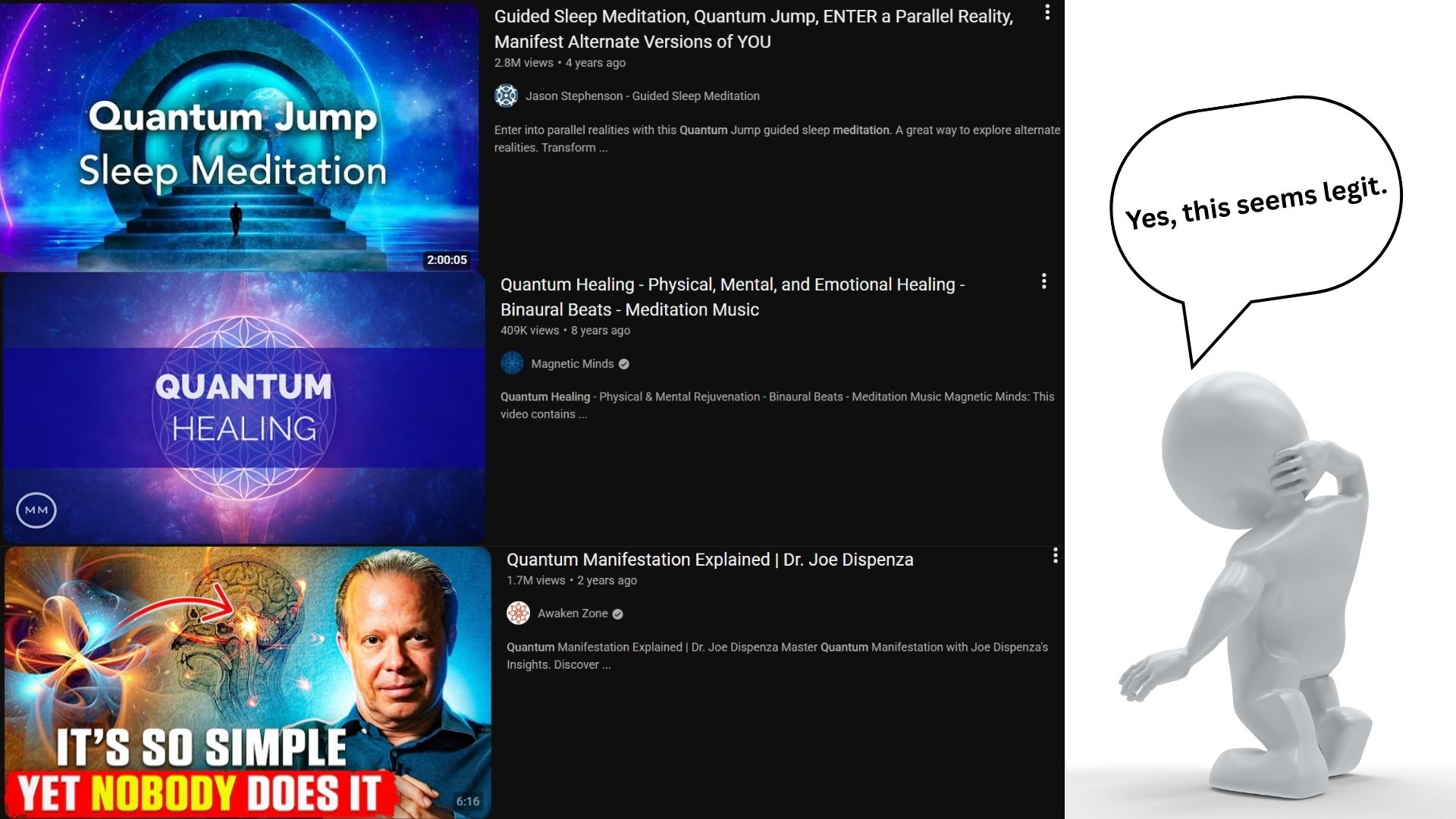
Quantum Mysticism: When scientific terminology is used to sell everything but science.
However, in this article I will argue that quantum physics can’t provide a model to explain consciousness in the way other traditional theories with evidence backing them can. This is because quantum physics is still an emerging field that is not understood completely, which pushes discussion around it in a philosophical direction and allows for the spread of misinformation. Although it is possible that quantum interactions occur within the brain at the level of electrons, there is currently no evidence establishing a causal link between such interactions and conscious experience.
Literature Review
Consciousness, the main concept being investigated, unfortunately lacks a fully agreed-upon definition, even after thousands of years of speculation and more than a century of rigorous scientific study. In a discussion with Dr. Michael Kiraly, a professor of biology at Capilano University, we agreed to define consciousness as a phenomenon that stems from self-awareness or a concept of self. This is not that different from other academic definitions. For example, the Stanford Encyclopedia of Philosophy defines it as “the feature that makes states count as experiences in a certain sense: to be a conscious state is to be an experience” (Siewert, 2025).
The mechanisms of how consciousness comes into being are still up for theorizing. The newest and most controversial theory is quantum consciousness. According to Alvarez et al. (2024), “quantum consciousness theory [proposed by Penrose and Hameroff] posits that quantum processes … might have a role in brain function.” To understand why quantum processes could be relevant to consciousness, it helps to first consider what quantum mechanics entails. To clarify this concept, I consulted Dr. Bruno Tomberli, a professor of physics at Capilano University. He explains the difference between quantum physics and classical physics to be that “Classical physics… is predictable, it’s deterministic… Quantum mechanics appears to be, to everyone’s shock, not deterministic” (B. Tomberli, personal communication, November 19, 2025). This ability is reflected in quantum systems’ ability to experience particle and wave properties, otherwise known as particle-wave duality. “A small object can behave as a particle or as a wave depending on the experiment… If I measure the wave-like properties of light, it behaves like a wave; if I measure its particle-like nature, it behaves like a particle” (B. Tomberli, personal communication, November 19, 2025).
This discussion will focus on two key concepts in quantum consciousness: the foundational framework of the Copenhagen Interpretation and the Heisenberg-von Neumann Cut, and the modern theory of orchestrated objective reduction (Orch OR). According to Dr. Tomberli, the Copenhagen interpretation maintains that the wave function provides a complete description of a quantum system. It is a mistake to describe the system as anything more or less than what is contained in its wave function, such as labeling it strictly as a particle or a wave. The act of measurement forces the system into a definite state, a process described as the collapse of the wave function (B. Tomberli, personal communication, November 19, 2025). A key issue in this framework is understanding what measurement means in quantum physics. Traditionally, people talk about the Heisenberg–von Neumann Cut, which is the imagined line separating the quantum system from the classical measuring device. The idea is that quantum rules apply on one side of the line, and everyday classical rules apply on the other. Modern discussions argue that this boundary isn’t just physical. It can also be seen as psycho-physical—meaning the role of the observer (mind, awareness, or consciousness) may influence when a fuzzy quantum possibility becomes a definite outcome. In other words, the “cut” marks the point where observation turns a range of probabilities into a single measured result (Narasimhan et al., 2019). We will discuss Orch OR later.
Since everything is made up of atomic and subatomic particles, there is a possibility that quantum phenomena play an important role in the brain. However, a newer theory does not necessarily mean it is better, since there are other theories, such as the Global Workspace Theory (GWT) and the Attention Schema Theory (AST), which have accumulated more evidence. In their article, Baars et al. (2021) outline GWT by arguing that brain architecture and unconscious brain activity allow pieces of information to come together to create an idea or a conscious experience that then gets broadcast to the rest of the brain for processing, creating consciousness. Graziano (2020), on the other hand, frames consciousness in his article as an illusion that is created by the brain’s attention schema (AST). In other words, the brain gains awareness of what it is paying attention to by creating a simpler model of reality. This creates the illusion of a conscious experience.
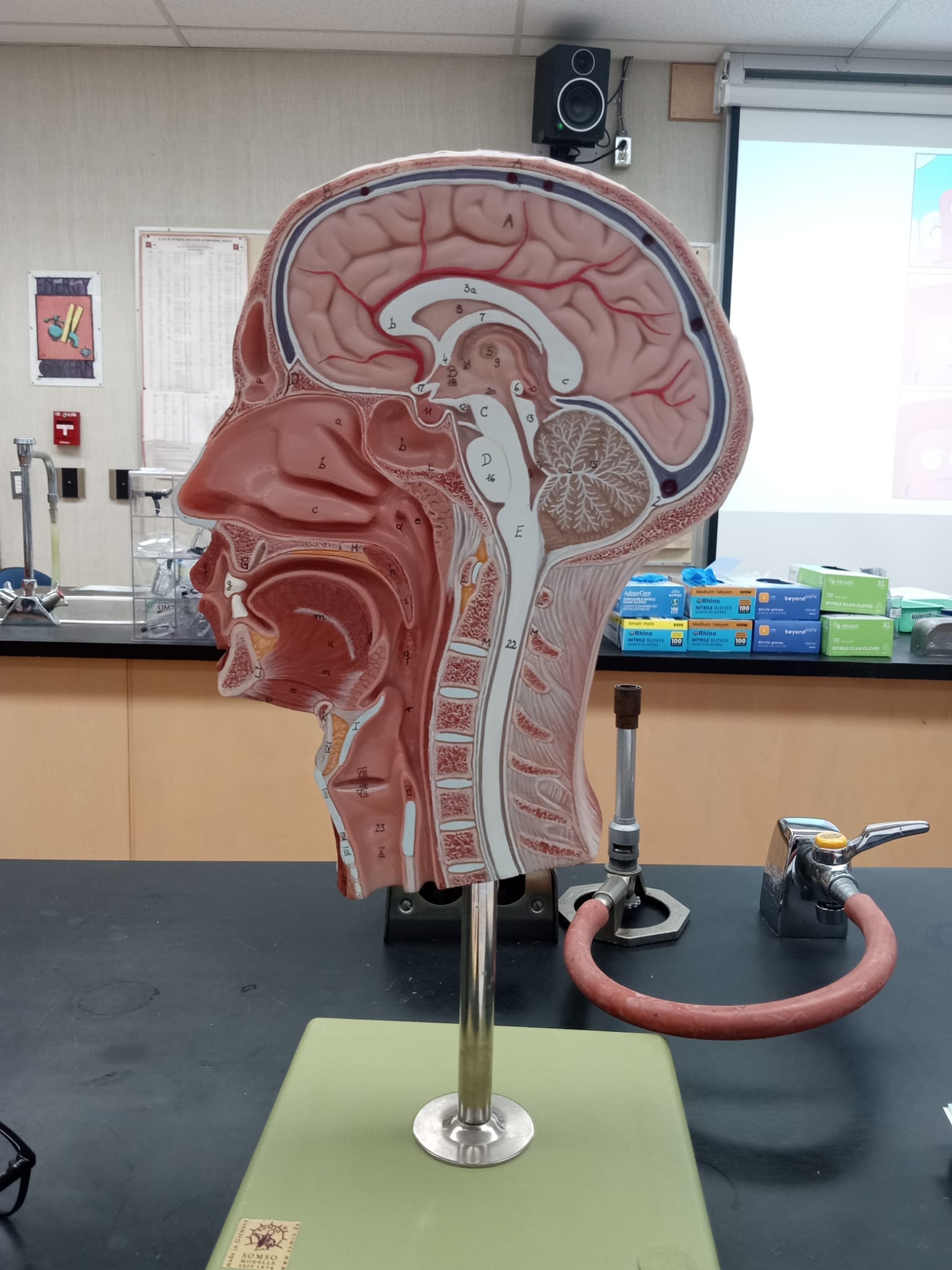
The complex architecture of the brain.
Claims
Claim 1: Could quantum phenomena in the brain give rise to consciousness?
If you like to check science news from time to time, you might have seen articles reporting on quantum phenomena discovered in organisms. For example, you may have come across the older claim that quantum mechanics can explain the high efficiency of photosynthesis or the newer one that it explains birds’ ability to navigate during migration (Engel et al., 2007; Zhang et al., 2015). One thing that I would like to stress is that the evidence is not conclusive for them either. Still, the most intriguing claim has yet to be mentioned: that quantum mechanics in the brain can explain consciousness, as proposed by Penrose and Hameroff’s Orch-OR theory. The Orch-OR theory argues that microtubules use quantum superpositions to store data like a quantum computer in the form of qubits, and that due to an objective collapse in the wave function (no observer necessary), conscious experience occurs (Hameroff, 2020).
In the case of the first two claims, although there is not enough evidence to fully prove them, it is still quite possible for quantum mechanics to be a contributing factor. This is because, in both plants and birds, the quantum phenomena would just be affecting proteins. However, the third claim is where things seem to get a bit messy, as quantum mechanics allegedly gives rise to consciousness. This is a significant shift because other traditional theories that try to explain consciousness have been successful within the range of classical physics. To make such a big claim, you would expect that there would be some basis for the theory to stand on, and yet Hameroff (2020) states, “Orch OR is the most complete, and most easily falsifiable theory of consciousness.”
It does not stop there. Since Orch OR proposes that microtubules act as quantum computers, this means it requires coherence between wave functions. Dr. Tomberli explained that coherence arises when two quantum wave functions are synchronized, with a well-defined phase relationship. This synchronization allows their wave-like properties to combine in ways that significantly influence the system’s behavior (B. Tomberli, personal communication, November 24, 2025). However, one major counterargument to quantum consciousness, famously put forward by Tegmark (2000), is that quantum coherence is a fragile state that can only be sustained and observed under the highly specific and controlled conditions of a physics laboratory. As Dr. Kiraly explained, “To measure quantum effects requires very controlled experiments, the brain not being one of them” (M. Kiraly, personal communication, October 22, 2025). This indicates that the brain’s biological environment lacks the stability needed for sustained quantum behavior. Furthermore, even if quantum states were to arise, they would decohere almost instantaneously due to the brain’s warm and noisy environment. Dr. Kiraly also noted that “quantum effects typically arise in femto- or attosecond timeframes, whereas cognition is in the millisecond timeframe” (M. Kiraly, personal communication, October 22, 2025). In other words, any quantum process would collapse far too quickly to play a meaningful role in neural activity. Finally, according to Baars and Edelman (2012), “We know of no evidence that neuronal microtubules have different quantum properties than other cells.”

The brain’s warm, biological environment lacks the stability needed for the sustained quantum coherence required by quantum consciousness theories.
Claim 2: If quantum phenomena are involved, what is their explanatory role in consciousness?
If I asked you, “Does the device you are using to read this physically exist?” you would confidently say “yes.” The question has a single, definite answer because the device has a specific, measurable location and state. It is here, on your desk or in your hand. Unfortunately, this is not the case for smaller objects such as electrons. Electrons can experience something called superposition, where they exist in a combination of multiple possible states at the same time. Once a measurement or interaction causes the wave function to collapse, however, the electron is forced to take on a definite value. This begs the question: if everything is made up of electrons and other subatomic particles, then is reality just a probability, and what does that mean for the brain or mind? In their article, Schwartz et al. (2005) argue that “the presumption … that all aspects of experience … are solely [due to] brain mechanisms” is unjustified and that “contemporary physics entails no such conclusion.” Schwartz et al.’s argument is that relying on deterministic activity in the brain robs us of the potential of focusing on how attention, for example, can affect the brain, resting their argument on the indeterministic nature of quantum theory.

Before observation, a quantum particle exists in superposition. The balanced coin is the classic analogy: neither definitely heads nor tails until the moment of measurement.
While this argument makes sense, there are some flaws. For example, there is no reason for the physics of quantum particles to be the same as for larger objects. The expectation for it to be that way is mere human bias, since our brains like to look for and establish patterns in everything. To test this, I would like you to touch grass during the day and turn your back to the sun. If the Earth freezes, then the sun disappeared because you were not observing it; if it does not, then the sun stayed there regardless of your observation. I am quite interested in your results.
Another flaw is that Schwartz et al. do not attempt to explain the source of attention. If attention or observation can, in fact, affect quantum particles, then the question of what attention is arises. To quote them, “conscious effort … [has] causal origins [that] may be untraceable in principle,” yet its influence “in the physical world can be explained on the basis of the laws of physics.” Personally, I find the use of the word “untraceable” to be very wishy-washy and uncharacteristic of rigorous science. All it does is make it seem like quantum physics is just an excuse to allow studying the effects of attention to be included in neuroscience.
Finally, traditional theories of consciousness like GWT and AST have been able to reach a similar conclusion on the effect of attention without the inclusion of quantum physics or judging attention to be untraceable. To illustrate, Romo and Rossi-Pool (2020) performed experiments on trained monkeys that showed an alignment between the models of GWT and AST. The experiments demonstrated how attention can influence whether sensory information is broadcast for global processing by other parts of the brain. However, they concluded that the specific brain circuit where this attention mechanism resides remains unknown.
Discussion
Neuroscience is a multidisciplinary field that integrates biology, psychology, and even philosophy. Nonetheless, it is still a branch of science, which is why its study must follow a specific methodology and rely on evidence to confirm hypotheses. The fact that consciousness is a very mysterious concept, however, gives it a deceiving allure that invites both experts, non-experts, and regular people just looking to make monetary gain.
The discussion of philosophy in neuroscience can be taken too far. I am referring to a paper by Ceylan et al. (2017), which uses the word ‘soul’ and tries to rationalize its existence using quantum physics and the Orch-OR theory. This, I hope, shows how speculation can feed off itself to create even more. To be clear, I am not trying to disprove the existence of the soul. My main issue is when science is used as a sacrificial pawn to give credibility to the metaphysical. I believe I share the same opinion as Dr. Kiraly when he says, “Science to me is a very pure, noble, special thing, and I do not like it when people pervert it or make up pseudoscience and psychobabble. … I feel like you are manipulating the masses when you claim that science explains something it does not” (M. Kiraly, personal communication, October 22, 2025).
If this can happen in academic papers, then you would imagine that the effect would be magnified in non-academic settings. In their article, Brang et al. (2025) investigate how physics teachers deal with quantum physics terminology in pseudoscience. Some notable, although minority, responses included acknowledging personal gaps in understanding and partial acceptance of pseudoscientific claims. I would like to stress the fact that these were physics teachers. This shows how convoluted some pseudoscientific claims can be, to the point where they can pass as credible information.
The internet can further amplify the effect of pseudoscience. Plencer (2014) argues that the internet inhibits critical thinking, as online behavior is often driven by emotions like anxiety and attachment rather than rational analysis, leading to the spread of conspiracy theories and pseudoscience. Bordignon (2023) gives more context by arguing that trust, not ignorance, is the deciding factor of whether a person gets misled. According to their logic, populist and pseudoscientific narratives provide a Manichean worldview (the pure people vs. the corrupt elite). In that framework, scientists are often portrayed as being in league with governments and pharmaceutical companies. This can reach a point where even exposure to scientific information can have a positive relationship with pseudoscientific beliefs.
This dynamic is powerfully illustrated during public health crises. Kbaier et al. (2024) observe that the fear and anxiety generated by the COVID-19 pandemic created a heightened need for certainty, which pseudoscience fulfills with absolute, simple answers. Their research confirms that this emotional state, combined with a pre-existing erosion of trust in scientific institutions, makes individuals more vulnerable to misinformation. This aligns with the view that it is not a lack of information, but a deep-seated distrust of the sources of official information that drives belief in pseudoscience. Consequently, simply rebutting false claims with facts is often ineffective, as addressing the underlying emotional needs and trust deficits is paramount.
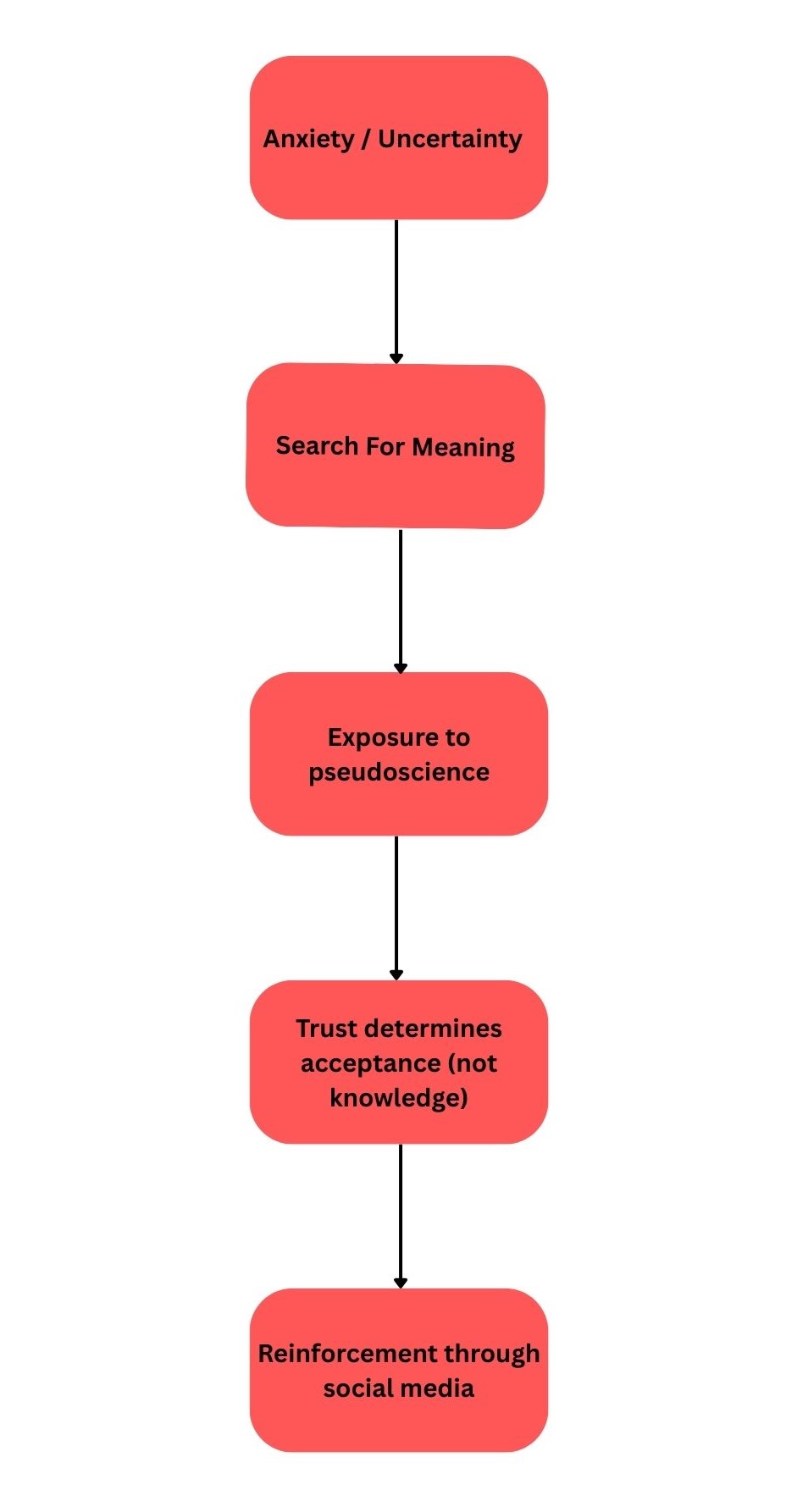
The spread of pseudoscience is often driven by emotions like anxiety and the need for certainty (especially during crises), not a lack of information.
Conclusion
Science is the process by which we understand and communicate the physical world. We require such a process because the human experience is inherently flawed in the sense that we cannot report things as they are, but only how we experience or think of them. The internet, for example, is a space that allows the constant, free sharing of thoughts without regulation, and that is why it plays a big role in the spread of misinformation. To put it into perspective, the science that was used to prove that the Earth is round is simple and even ancient, with the earliest discussion of a spherical Earth dating back to 400-500 BC, and yet there are still people who think the Earth is flat. In light of that, imagine the impact of quantum physics—a science that is not fully understood and deals with matter in terms of probability rather than simple existence and nonexistence—when wielded by those who are not experienced in the delicate language of science and have no interest in the communication of truth. I believe this article is a warning to not let our curiosity fly us too close to the sun, only for us to burn and fall.
References
Alvarez, P. H., Gerhards, L., Solov’yov, I. A., & de Oliveira, M. C. (2024). Quantum phenomena in biological systems. Frontiers in Quantum Science and Technology, 3. https://doi.org/10.3389/frqst.2024.1466906
Baars, B. J., & Edelman, D. B. (2012). Consciousness, biology and quantum hypotheses. Physics of Life Reviews, 9(3), 285–294. https://doi.org/10.1016/j.plrev.2012.07.001
Baars, B. J., Geld, N., & Kozma, R. (2021). Global workspace theory (GWT) and prefrontal cortex: Recent developments. Frontiers in Psychology, 12. https://doi.org/10.3389/fpsyg.2021.749868
Bordignon, F. (2023). Alternative science, alternative experts, alternative politics. The roots of pseudoscientific beliefs in Western Europe. Journal of Contemporary European Studies, 31(4), 1469–1488. https://doi.org/10.1080/14782804.2023.2177838
Brang, M., Greinert, F., Ubben, M. S., Franke, H., & Bitzenbauer, P. (2025). Quantum terminology in pseudoscience: Exploration of pre-service physics teachers’ reasonings. EPJ Quantum Technology, 12(1). https://doi.org/10.1140/epjqt/s40507-025-00403-9
Ceylan, M. E., Dönmez, A., Ünsalver, B. Ö., Evrensel, A., & Kaya Yertutanol, F. D. (2017). The soul, as an uninhibited mental activity, is reduced into consciousness by rules of quantum physics. Integrative Psychological and Behavioral Science, 51(4), 582–597. https://doi.org/10.1007/s12124-017-9395-5
Encyclopædia Britannica, inc. (n.d.). Pseudoscience. Encyclopædia Britannica. Retrieved November 25, 2024, from https://www.britannica.com/topic/pseudoscience
Engel, G. S., Calhoun, T. R., Read, E. L., Ahn, T.-K., Mančal, T., Yuan-Chung Cheng, Blankenship, R. E., & Fleming, G. R. (2007). Evidence for wavelike energy transfer through quantum coherence in photosynthetic systems. Nature, 446(7137), 782–786. https://doi-org.ezproxy.capilanou.ca/10.1038/nature05678
Graziano, M. S. (2020). Consciousness and the attention schema: Why it has to be right. Cognitive Neuropsychology, 37(3–4), 224–233. https://doi.org/10.1080/02643294.2020.1761782
Hameroff, S. (2020). ‘Orch OR’ is the most complete, and most easily falsifiable theory of consciousness. Cognitive Neuroscience, 12(2), 74–76. https://doi.org/10.1080/17588928.2020.1839037
Kbaier, D., Kane, A., McJury, M., & Kenny, I. (2024). Prevalence of health misinformation on social media—Challenges and mitigation before, during, and beyond the COVID-19 pandemic: A scoping literature review. Journal of Medical Internet Research, 26(1), e38786. https://doi.org/10.2196/38786
Mindvalley. (2020, May 12). The Silva Ultramind System By José Silva & Vishen Lakhiani [Video]. YouTube. https://www.youtube.com/watch?v=3FtWY-yxTM8
Narasimhan, A., Chopra, D., & Kafatos, M. C. (2019). The nature of the Heisenberg-von Neumann cut: Enhanced orthodox interpretation of quantum mechanics. Activitas Nervosa Superior, 61(1), 12–17. https://doi.org/10.1007/s41470-019-00048-x
Plencner, A. (2014). Critical thinking and the challenges of the internet. Communication Today, 5(2), 4–18.
Romo, R., & Rossi-Pool, R. (2020). Towards a conscious model of consciousness. Cognitive Neuropsychology, 37(3–4), 220–223. https://doi.org/10.1080/02643294.2020.1728241
Schwartz, J. M., Stapp, H. P., & Beauregard, M. (2005). Quantum physics in neuroscience and psychology: A neurophysical model of mind–brain interaction. Philosophical Transactions of the Royal Society B: Biological Sciences, 360(1458), 1309–1327. https://doi.org/10.1098/rstb.2004.1598
Siewert, C. (2025). Consciousness and intentionality. In E. N. Zalta & U. Nodelman (Eds.), The Stanford Encyclopedia of Philosophy (Spring 2025 Edition). Stanford University. https://plato.stanford.edu/archives/spr2025/entries/consciousness-intentionality/
Tegmark, M. (2000). Importance of quantum decoherence in brain processes. Physical Review E, 61(4), 4194–4206. https://doi.org/10.1103/PhysRevE.61.4194
Zhang, Y., Berman, G. P., & Kais, S. (2015). The Radical Pair Mechanism and the Avian Chemical Compass: Quantum Coherence and Entanglement.