


Alana Kim
Alana Kim is completing her undergraduate degree in Psychology, where she enjoyed learning about human behaviour, development and the various factors that shape who individuals become. After graduation, she plans to take what she has learned into the world as she travels hoping to continue learning from the people and places she encounters. In the future, she may further her education to become an elementary teacher, combining her interest in development with her desire to support children’s growth.
Growing up, I learned to live between two households. One week I settled into my mom’s routines, and the next I adapted to my dad’s entirely different rhythm. While I always knew which home had my favourite snacks, I didn’t always remember where my homework had ended up. At the time, I didn’t recognize this constant shifting as anything significant, it was simply my normal. As I got older, I began to understand the weight of that instability.
When I spoke with my father about his own upbringing, I was struck by how closely our experiences aligned. He described the same pressure to be strong and the same emotional split between two parents who were no longer together. His parents divorced long before mine, yet the emotional patterns of confusion, independence and the quiet effort to hold everything together, especially for our younger siblings, were the same. What stood out the most was that neither of us were raised in homes with constant fighting, instead, it was the instability after the divorce that shaped our emotional worlds in ways we didn’t fully understand at the time.
Identifying these parallels made me question how much of who we become is shaped not by conflict itself, but by the instability that follows when a family divides. Our stories, shaped by generations, revealed a common thread: not the presence of conflict, but the absence of stability.
Parental divorce is often believed to protect children from the emotional burden of witnessing conflict in the home. Many Canadians argue that separation is the healthier alternative, assuming that the removal of conflict and tension leads to what many see as an emotionally and physically safer environment for children. However, the developmental consequences of divorce are far more complex than this narrative suggests, especially for children aged six to twelve. One of many studies highlight that middle childhood is a period marked by increasing emotional awareness, reliance on routine and a strong need for consistent attachment. Children in this age range are old enough to understand changing family dynamics, yet young enough to be deeply affected by disruptions to their daily lives (Lazzara). They do not simply lose the conflict, but they often lose predictable routines, regular access to one parent and the sense of security that comes from an undivided household. As a result, divorce introduces a new form of instability, rooted in fractured attachment and shifting emotional expectations across two homes.
This paper will examine how parental divorce creates a deeper developmental instability than conflict in intact homes. While conflict can disrupt a child’s emotional world, divorce restructures it entirely by altering attachment systems, daily routines and a child’s sense of security in ways that shape emotional, cognitive and relational outcomes into adolescence and adulthood. By examining psychological research, Canadian family studies and an interview with my father, this article demonstrates that instability, rather than conflict, is the factor most likely to leave lasting developmental marks on children growing up with a divided family.
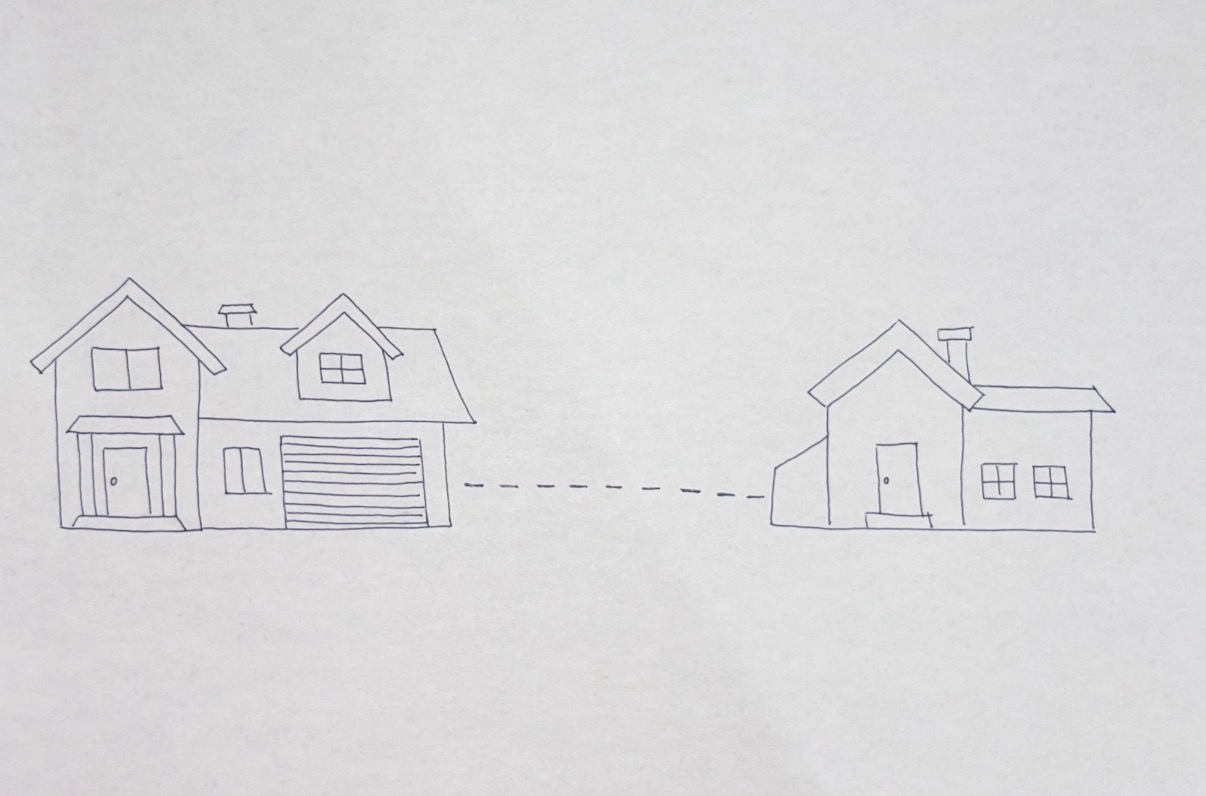
Depiction of a child navigating two separate households, symbolizing instability of post-divorce life.
Conflict in Intact Homes: Emotional Instability Without Structural Disruption
Even in intact families, parental conflict can leave a noticeable mark on a child’s emotional world. According to Radetzki et al., children who grow up hearing arguments, sensing tension, or navigating unpredictable parental moods often experience heightened anxiety, stress responses, and difficulties regulating their emotions. The constant anticipation of conflict, and the feeling of never knowing when the next argument will arise, creates a state of hypervigilance, where children become overly sensitive to tone, body language and shifts in emotions of the home. Their research consistently shows that children exposed to interparental conflict tend to have “lower emotional well-being, self-efficacy, academic achievement, and behavioural and impulsivity problems” (802). These findings indicate that conflict not only affects emotional regulation, but also how capable and confident children feel in their problem-solving skills and social interactions.

Child reacting to household conflict.
Behaviourally, the strain of conflict can appear in different ways depending on the child. Sirvanli-Ozen’s study discusses these behavioural and adjustment problems, noting that some may withdraw or become introverted, internalizing the stress and becoming overly anxious, while others may externalize the tension, displaying aggression, acting out at school/home or struggling to follow directions (130). These reactions often reflect a child’s attempt to cope with emotional overload in an environment where they feel little to no control. Additionally, Radetzki et al. describe various cognitive effects of conflict, including the draining of a child’s mental energy, reduced ability to focus and difficulties processing information and performing academically. Children preoccupied with family tension may have difficulty staying engaged in class, retaining new information or completing assignments as their attention is divided between school tasks and worries about home (802). Whether family tension occurs within one home or two, this cognitive strain can impact decision-making and problem-solving, making everyday challenges feel overwhelming and impossible.
Representation of a child’s academic performance impacted by family conflict.
In the article “Child Mental Health After Parental Separation: The Impact of Resident/Non-Resident Parenting, Parent Mental Health, Conflict and Socioeconomics,” Lucas et al. argue that “family structure per se was not the main cause of child mental health problems. Parental conflict made the greatest contribution to accounting for the mental health differences between children from intact and separated families” (60). This demonstrates that even without separation, conflict alone can significantly disrupt a child’s emotional/cognitive functioning. Yet despite these challenges, one crucial factor remains in place: the stability of a single home. Children still sleep in the same bed, follow one set of household routines, and have consistent access to both parents under one roof. Their attachment system, although strained, is not broken across spaces and their sense of identity remains attached in one physical environment.
Stability also allows for predictable caregiving patterns, which can help alleviate the effects of conflict as children know where they will be, who will be there and what to expect. Understanding this distinction is critical, because although conflict can be harmful, it does not destroy the child’s structural stability. Instead, it influences emotional well-being without modifying the child’s stable home and caregiving framework. Together, these findings emphasize that even without separation, conflict on its own can significantly disrupt a child’s functioning and sets the foundation for understanding why parental separation can produce an entirely different layer of developmental challenges.
Divorce and Post-Separation Instability: Structural Disruption and Developmental Consequences
While conflict within an intact home can affect a child’s emotions and behaviour, divorce introduces a fundamentally different form of instability – one that entirely alters the structure of a child’s daily life. After separation, children often move between two homes, two sets of routines and face inconsistent access to one parent. As one Canadian study found, “Children who had experienced parental breakup were found to have significantly higher odds of exhibiting mental health or functional difficulties. Following parental breakup, the relative odds of having mental health or functional difficulties was highest among children who had irregular contact with the other parent” (Galbraith & Kingsbury 75). Furthermore, divorce can also disrupt attachment systems/styles with reduced access to one parent, unpredictable schedules and mixed emotional availability, weakening the security children rely on during middle childhood.

A child’s weekly schedule illustrates divided routines across two homes.
Attachment theory helps explain why the instability introduced by divorce can have a lasting effect on children’s emotional and relational development. When divorce then alters routines or reduces access to one parent, the child’s attachment system can also shift as a result. Children who experience consistent warmth and reliability after separation may maintain or develop a secure attachment, however those exposed to inconsistent contact and/or emotional withdrawal are more likely to develop insecure attachment styles. Based on a longitudinal study following children from birth to the age of eighteen, Sirvanli-Ozen explains that “divorce decreases the likelihood of developing secure attachment styles towards parents while increasing the possibility of developing preoccupied attachment styles” (136), providing evidence that separation can fundamentally alter the ways children learn to expect care and respond to emotional closeness. According to the Cleveland Clinic’s overview of attachment theory, some children may adopt an anxious attachment, defined by fear of abandonment, clinginess and heightened sensitivity to changes in the availability of their parents. Others may develop an avoidant attachment, learning to suppress emotional needs because expressing them feels unsafe or ineffective. In high-conflict or highly unstable post-divorce situations, children can develop a disorganized attachment, characterized by confusion, mistrust and difficulty forming a sense of safety (“Attachment Styles in Infancy & Adulthood”). These patterns often persist into adulthood, shaping how individuals approach intimacy, resolve conflict and build trust in romantic relationships. Understanding these attachment styles acknowledges how post-divorce instability can influence not only childhood well-being, but also long-term relational/emotional outcomes.
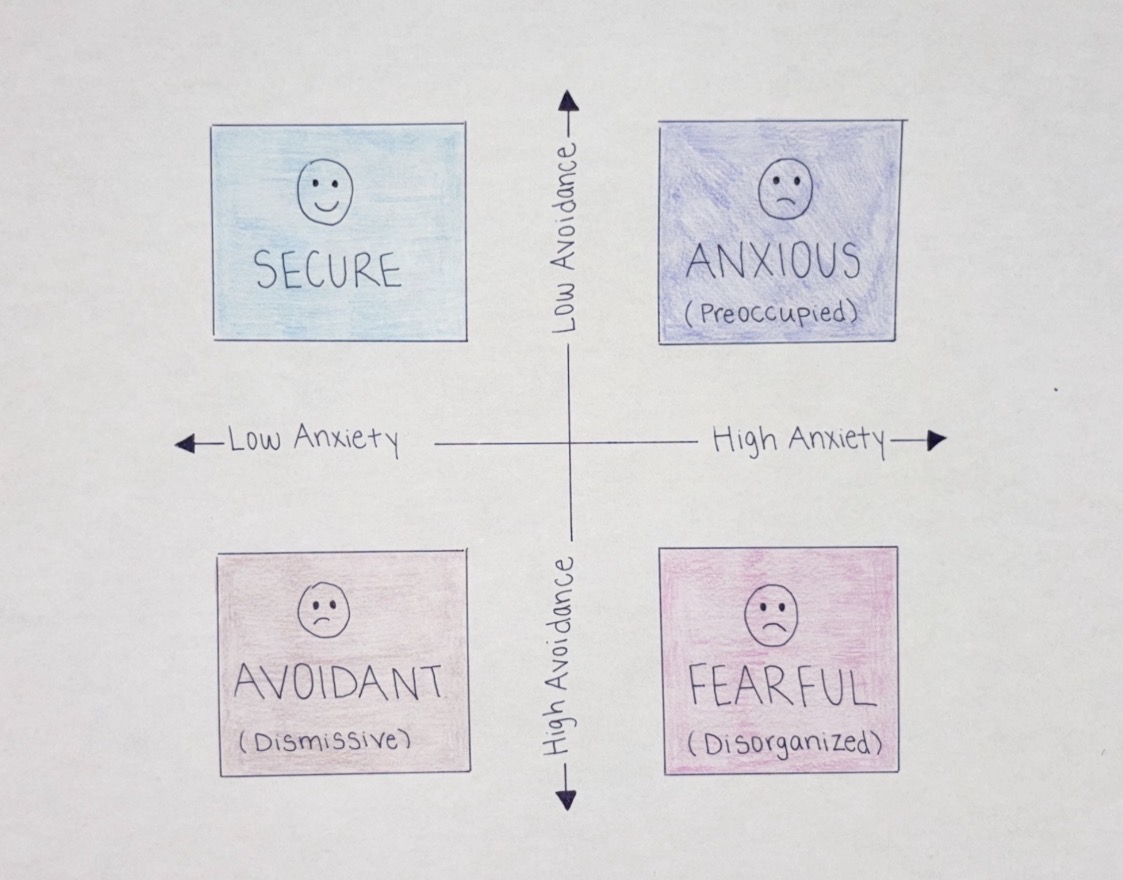
Visual model of attachment styles/patterns in children.
These attachment disruptions highlight why divorce often heightens a child’s emotional symptoms even further compared to conflicted but intact homes. In conflicted households, children may feel emotionally strained, but their attachment remains connected within one environment. However, after divorce that connection is split, making attachment insecurity far more likely. Strohschein’s longitudinal study supports this pattern, noting that “relative to children in intact households, children whose parents divorce over the course of the survey exhibit slightly higher levels of anxiety/depression prior to divorce, and there is a further increase in anxiety/depression in response to the divorce itself” (1297). Together, these findings emphasize that the real harm of divorce comes not only from conflict, but from the instability that comes with changing a family’s structure. By changing children’s attachment systems, daily routines and emotional expectations, divorce introduces a form of developmental disruptions that can extend far beyond the moment of separation into adolescence and adulthood. It is important to acknowledge, however, that divorce is not always the “wrong” choice, nor are all conflicted intact homes preferable by default. For example, in cases of chronic emotional abuse, or physical violence, remaining in one household can expose children to ongoing trauma that far outweighs the disruption of separation. In these situations, leaving the relationship and rebuilding stability in an alternative environment may be the option that best protects the wellbeing of children.
Comparison and Intergenerational Effects: Why Divorce Can Leave a Deeper Mark
When conflict in an intact home is compared directly with the instability produced by divorce, the difference in developmental impact becomes far more evident. Conflict produces emotional instability where children may feel anxious, overwhelmed or uneasy, but the structure of their world remains intact. They go to sleep in the same bed, live under one routine and have consistent access to both parents. Divorce on the other hand, introduces both emotional and structural change with two homes, divided rules, inconsistent expectations and fluctuating contact with each parent. The family-law resource Freed Marcroft, states that children benefit from consistent routines and stable caregiving environments, even when conflict is present (“What’s Better for Kids: Staying in an Unhappy Marriage or Divorce?”). Together, these differences demonstrate that the structural disruption created by divorce often carries developmental risks that extend beyond the emotional strain in conflicted, but intact homes.
Before considering the structural instability my father experienced, it is equally important to recognize the emotional impact his parents’ divorce had on him as a child. In a personal interview I conducted, my father, John Kim, described the early emotional confusion that followed his parents’ separation. He recalled that during those years, “I recall being sad for a period of time and it was disorienting,” highlighting the combination of sadness and uncertainty that shaped his early understanding of family change. Although the conflict in his home “was not extreme or excessive,” the emotional weight of the divorce lingered. His most painful memory illustrates how deeply children internalize parental decisions: “The most difficult memory I have of the entire divorce was when I called my dad and said I wanted to move with him. He said I should stay with my mom, and that response felt like a rejection.” His experience demonstrates how emotional wounds often form the foundation for the deeper instability that transpires when the structure of family life begins to shift.
After the emotional confusion of the divorce, my father also faced a deeper layer of structural instability. In our interview, he explained how his contact with his own father became unpredictable and inconsistent: “Until I became an adult, I did not have much of a relationship with my dad. He moved away after the divorce and we only saw him once in a while, maybe a few hours at a time each visit, about once per year. He did not have much of a role or influence in my life.” With one parent largely absent, daily responsibilities shifted onto him and his siblings, who “needed to grow up quickly and learn to take care of things on our own” (Kim). His childhood experiences reflect what developmental research consistently demonstrates – divorce can weaken children’s attachment bonds and push them toward independence, often before they are emotionally mature. Research shows that over time, such roles can “hinder their emotional and cognitive age-appropriate development and restrict their capacity for play and socialization” (Masiran et al. 2).
However, these experiences do not end in childhood. Intergenerational studies, particularly Amato’s work, highlights that divorce can influence adult relational patterns, shaping the internal models people carry into intimacy and commitment. Amato notes that children from divorced families often enter adulthood with various expectations about relationships: “adult children of divorce may have an elevated risk of seeing their own marriages end in divorce because they hold relatively liberal attitudes toward marital dissolution. Studies show that young adults who grew up in divorced families are more pessimistic about the chances of life-long marriage and evaluate divorce less negatively than do other young adults” (631). This does not determine their future, but it can have a heavy influence on how one interprets conflict, closeness and vulnerability. My father acknowledges that he never grew up in a two-parent household and while he believes his own divorce was situational, he also recognizes that his approach to fatherhood, and his strong desire to provide the stability he lacked, is shaped by his early experiences.
My own childhood echoes many of the patterns my father described. Like him, I grew up navigating two routines, two emotional climates and the expectation to adapt without showing too much struggle. Neither of us grew up in households filled with constant fighting, yet both of us felt the deeper impact of instability after the divorce. Together, the developmental evidence, intergenerational insights and lived experiences point to the same conclusion: conflict may strain a child’s emotional world, but divorce reshapes it entirely.
Looking across research, theory and two generations of lived experience, a consistent pattern becomes clear – conflict can unsettle a child emotionally, but divorce restructures the world they must learn to navigate. The emotional and cognitive strain produced by conflict is significant, yet it occurs within the stability of one home. Divorce, by contrast, alters the very foundation of childhood through the fragmentation of routines, reshaping of relationships and creating a form of instability that follows children late in life.
For parents reading this and trying to decide whether to stay or leave, the message is not that there is one universally correct answer, but that stability and emotional safety both matter deeply. For some families, strengthening the relationship through counselling or support systems may reduce conflict enough to live within one home. For others, separating and rebuilding routines apart may ultimately provide a more supportive environment. Regardless of the path chosen, children benefit when parents work to minimize the amount of chaos, maintain predictable routines and remain emotionally available. The guiding question becomes less “Should we stay or go?” and more “Which choice allows us to reduce conflict and create the most stable environment for our children?”
My father’s story and my own in different ways, reflect how this instability can shape identity, attachment and our understanding of love and safety long after childhood ends. By understanding the depth of these impacts, we can move beyond the assumption that divorce is automatically the healthier choice and instead acknowledge the complexity of a child’s experience when a family divides.
Works Cited
Amato, Paul R. “Explaining the Intergenerational Transmission of Divorce.” Journal of Marriage and Family, vol. 58, no. 3, Aug. 1996, pp. 628–40. EBSCOhost, https://doi.org/10.2307/353723.
“Attachment Styles in Infancy & Adulthood.” Cleveland Clinic, Aug. 2025, my.clevelandclinic.org/health/articles/25170-attachment-styles.
Freed, Meghan, and Kristen Marcroft. “What’s Better for Kids: Staying in an Unhappy Marriage or Divorce?” Freed Marcroft LLC, June 2025, freedmarcroft.com/whats-better-for-kids-staying-in-an-unhappy-marriage-or-divorce/.
Galbraith, Nora, and Mila Kingsbury. “Parental Separation or Divorce, Shared Parenting Time Arrangements, and Child Well-Being: New Findings for Canada.” Canadian Studies in Population, June 2022, pp. 1–34. EBSCOhost, https://doi.org/10.1007/s42650-022-00068-0.
Kim, John. Personal Interview. 17 October. 2025. In Person.
Lazzara, Julie. “Middle Childhood.” Lifespan Development, Maricopa Community Colleges, June 2020, open.maricopa.edu/devpsych/chapter/chapter-6-middle-childhood/.
Lucas, Nina, et al. “Child Mental Health after Parental Separation : The Impact of Resident/Non-Resident Parenting, Parent Mental Health, Conflict and Socioeconomics.” Journal of Family Studies, vol. 19, no. 1, Apr. 2013, pp. 53–69. EBSCOhost, research.ebsco.com/linkprocessor/plink?id=86bf7050-3539-36ac-90d8-ace2b42128a3.
Masiran, Ruziana, et al. “The Positive and Negative Aspects of Parentification: An Integrated Review.” Children and Youth Services Review, vol. 144, Jan. 2023. EBSCOhost, https://doi-org.ezproxy.capilanou.ca/10.1016/j.childyouth.2022.106709.
Radetzki, Phillip A., et al. “The Implications of High-Conflict Divorce on Adult-Children: Five Factors Related to Well-Being.” JOURNAL OF FAMILY STUDIES, vol. 28, no. 3, Sept. 2022, pp. 801–21. EBSCOhost, research.ebsco.com/linkprocessor/plink?id=86446772-8e4e-398e-bbb6-61a94a43564f.
Sirvanli-Ozen, Dilek. “Impacts of Divorce on the Behavior and Adjustment Problems, Parenting Styles, and Attachment Styles of Children: Literature Review Including Turkish Studies.” Journal of Divorce & Remarriage, vol. 42, no. 3–4, Jan. 2005, pp. 127–51. EBSCOhost, https://doi.org/10.1300/J087v42n03_08.
Strohschein, Lisa. “Parental Divorce and Child Mental Health Trajectories.” Journal of Marriage and Family, vol. 67, no. 5, Dec. 2005, pp. 1286–300. EBSCOhost, research.ebsco.com/linkprocessor/plink?id=422e2139-ea4a-3acb-8946-3d54998c22cc.